
Key takeaways
- A minimalist watering can should pour cleanly, fit your sink and sit quietly on a shelf. Learn how to match capacity, spout and material to your plants.
A watering can is one of the few garden tools that lives indoors, in plain sight, between uses. In a small home it sits on a shelf or beside a sink, so how it looks matters almost as much as how it pours. A good minimalist can delivers water exactly where the soil needs it, without splashing leaves or floors, and disappears visually when the job is done.
This guide covers watering cans only. A planter or a plant pot holds soil and roots; a watering can carries water to them. The five cans below range from a pint-sized Haws for seedlings to a large Bloem for patio containers.
As an Amazon Associate, we earn from qualifying purchases.
Quick Answer
For most indoor plant keepers, a 1 to 2 liter can with a long, narrow spout is the right choice: it reaches soil beneath crowded leaves, pours gently enough for seedlings and fits under a kitchen tap. Choose plastic for lightness and stainless steel for a calm, durable look; go larger only for outdoor containers.
How to Choose a Minimalist Watering Can
Capacity comes first, because it decides how often you refill and how heavy the can feels. A liter of water weighs about a kilogram, so a 2.6 gallon can carries more than ten kilograms when full. For a shelf of houseplants, a can between 700 milliliters and 2 liters covers a full round without straining your wrist. For a patio of large pots, a gallon or more saves trips, but only if you can lift it comfortably when full.
Spout shape decides accuracy. A long, thin spout reaches into crowded pots and under low leaves, putting water on the soil instead of on foliage. Wet leaves invite fungal problems, and a spout that cannot reach past the outer leaves forces you to lift and move pots. A removable rose head turns a stream into a shower, which suits seedlings and fresh sowings, where a direct stream can wash soil away from shallow roots. Check that a detachable rose seals well, because a loose joint drips onto the floor.
Material sets the look and the weight. Plastic is light and forgiving when knocked over, and modern thick-walled plastic resists cracking. Stainless steel looks calmer, resists rust and survives years of use, but it is heavier and dents when dropped.
Filling clearance is easy to overlook. Measure the space beneath your tap, because a tall can that does not fit under the kitchen faucet becomes a chore. A wide mouth fills quickly, and a second handle gives control when the can is full and heavy.
Haws Handy Watering Can, 1 Pint

The Haws Handy is the smallest can in this guide, and the most precise. Haws has made watering cans in England since 1886, and this little green can carries that heritage into the indoor garden. It holds about 700 milliliters, enough for a tray of seedlings or a shelf of small pots, and its removable brass-faced rose turns the flow into a gentle shower that will not flatten new sprouts.
The can weighs just over three ounces empty, and its compact body slips onto a shelf beside the pots it waters. The long spout reaches into tight spaces between plants, which matters on a crowded plant stand.
Specs: Capacity 700 ml (1 pint); Material plastic; Spout long with removable brass-faced rose; Model 150-1-GRN; Weight about 3.2 oz empty; ASIN B000TASSYQ
This can suits orchid keepers, African violet growers and anyone raising seedlings, where a gentle, aimed pour protects delicate roots. It does not suit a large collection, because the small capacity means frequent trips to the tap. Confirm the listing shows model 150-1-GRN.
Qilebi Long Spout Watering Can, 1.8 Liters
The Qilebi is the workhorse of this guide: a 1.8 liter plastic can with a 14-inch spout and a detachable shower head that switches between a direct stream and a soft spray. Use the stream for established plants and the shower head for seedlings, where a hard stream would disturb the soil.
At about eight ounces empty, the can stays light even when full, and the twist-tight joint is designed to prevent leaks. The wide mouth fills in seconds under a tap, and the compact body stores easily on a shelf. Green is the classic color; the same can appears in other colors, so check the listing matches the color you want.
Specs: Capacity 1.8 L (about 0.5 gallon); Material thick-walled plastic; Spout 14-inch long with detachable shower head; Color Green; Weight about 8.1 oz empty; ASIN B08L3TXWZP
This can suits plant keepers with a dozen or so medium pots who want one tool for both gentle and direct watering. One caution: a crawl of the listing showed no featured offers available, so confirm the listing is live, in stock, and keys to B08L3TXWZP.
WhaleLife Indoor Watering Can, 1.4 Liters, Blue
The WhaleLife is the most visibly modern can in this guide. Its translucent blue body, long spout and clean lines look deliberate on a shelf, which is what a minimalist home asks of a tool that stays in view. It holds 1.4 liters, a middle size that waters a small collection in one round without becoming heavy.
The long spout targets soil at the base of plants, keeping water off leaves and off the floor, and the light body is easy to carry with one hand. The can ships from Amazon and is sold by Whale Life, and the listing names model WC14-C. The translucent body also shows the water level at a glance, so you know when a refill is due.
Specs: Capacity 1.4 L (40 oz); Material plastic, translucent; Spout long; Model WC14-C; Color Blue; ASIN B08CCFVDZR
This can suits bonsai keepers and houseplant owners who want a tidy, modern tool for a small shelf. It does not suit large outdoor containers, where the modest capacity means many refills. The Light Blue variant is a separate listing, so confirm the listing shows the Blue 1.4 liter can.
Fasmov Plastic Watering Can, 1 Gallon, Bright Blue
The Fasmov is the middle ground between the compact indoor cans and the large outdoor Bloem. One gallon, about 4 liters, covers a row of patio pots or a dozen medium houseplants in a single fill, while the long, narrow spout keeps the pour aimed at the soil. The molded handle distributes the weight across the hand once the can holds a full gallon of water.
The body measures about 10.5 by 15 by 5.5 inches and stores against a wall or on a shelf. The single-stream spout is ideal for base watering, where water should go straight to the roots rather than over the foliage. There is no shower head, so this can is less suited to seedlings than the Qilebi or the Haws.
Specs: Capacity 1 gallon (4 L); Material plastic; Spout long, narrow, single stream; Model F-WateringCan; Color Bright Blue; Dimensions about 10.5 x 15 x 5.5 inches; ASIN B09NR858ZR
This can suits plant keepers who water both indoor and outdoor plants and want fewer refills. Confirm the listing shows Bright Blue and part number F-WateringCan-New-BrightBlue.
Bloem Easy Pour Watering Can, 2.6 Gallons, Black
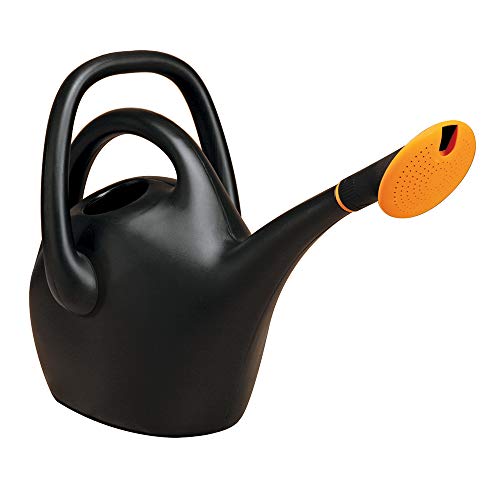
The Bloem Easy Pour is the largest can in this guide and the best choice for outdoor containers. It holds 2.6 gallons, enough to water a patio run or a modest vegetable bed in fewer trips, and its two handles change how that weight feels. Carry the full can by the top handle, then grip the rear handle to tip it smoothly.
The two-in-one spout rotates between a traditional pour and a rose shower, so one can serves both thirsty tomatoes and delicate seedlings. The body is UV-treated polypropylene, which resists fading and cracking outdoors. At about one pound empty, the can itself adds almost nothing to the load; the dual handles make the water’s weight manageable.
Specs: Capacity 2.6 gallons; Material UV-treated polypropylene; Spout two-in-one, rotating, stream or rose; Model 20-47287CP; Weight about 1 lb empty; Color Black; ASIN B0029D6NZC
This can suits gardeners with patio containers, raised beds or large pots who want one trip instead of many. It does not suit a small indoor shelf, where its size and weight are far more than the job needs. One caution: a crawl showed no featured offers available, so confirm the listing is live and in stock, and that it shows model 20-47287CP in Black.
Who Should Skip This Type of Watering Can
A watering can is not the right tool for every plant keeper. If you keep only two or three small succulents, a squeeze bottle or a small mister gives finer control with less storage. If you water a large garden bed or a lawn, a hose with a gentle nozzle covers far more ground than any can.
People with limited wrist strength should be careful with large cans. A gallon of water weighs about eight pounds, and a 2.6 gallon can weighs more than twenty pounds when full, so a smaller can with more frequent refills is often the kinder choice. If your plants live on high shelves, a can with a short spout forces you to lift the whole can above the pot, which risks spills. Finally, skip a decorative can if you water daily: a beautiful metal can that dents on the first drop becomes a source of frustration, not calm.
FAQ
How much capacity do I need for indoor plants?
For a shelf of small to medium houseplants, 1 to 2 liters covers a full watering round without refills. A pint can suits seedlings and a handful of small pots, while a gallon can suits a dozen or more medium pots. Match the can to the number of pots.
Is a long spout better than a short spout?
A long, narrow spout is better for crowded shelves and hanging plants, because it reaches soil beneath leaves without moving pots. A short spout pours faster and suits open outdoor beds. For indoor use, reach usually matters more than speed.
Do I need a rose head for seedlings?
A rose head turns a stream into a gentle shower, which protects shallow roots and fresh sowings from being washed out. If you raise seedlings or water African violets, a removable rose is worth having. For established plants, a direct stream at the base works well.
Can a watering can stay on display in a minimalist home?
Yes, if its shape is simple and its color is calm. A translucent modern can, a heritage green can or a polished steel can all read as decor on a shelf. Avoid novelty shapes and bright patterns.
Final Verdict
The right minimalist watering can is the one that matches your plants, your sink and your shelf. For most indoor keepers, the Qilebi 1.8 liter can is the most versatile single purchase, with a long spout and a detachable shower head for both seedlings and established plants. The Haws Handy suits a small, precise collection, and the WhaleLife suits a can that stays on display. For larger collections, the Fasmov gallon can cuts refills, and for patio containers the Bloem Easy Pour covers a full round in one trip.
Whichever can you choose, check the listing before ordering: confirm the model number, the color and the capacity, and confirm the listing is in stock. Watering cans look alike across sizes and colors, and the model number is the surest way to get the can you meant to buy.
FAQ
How much capacity do I need for indoor plants?
Is a long spout better than a short spout?
Do I need a rose head for seedlings?
Can a watering can stay on display in a minimalist home?
More from Amazon
Programs that pair well with the guide above. Offers and eligibility are set by Amazon and may change.
Free shipping on eligible items, Prime Video and more. Eligible new members can start with a free trial.
Start a Prime free trialAudiobooks and podcasts to listen to on the go. Eligible new members can start with a free trial.
Try Audible freeAd-free music streaming. Eligible new subscribers can start with a free trial.
Try Music Unlimited freeA free business account with business pricing and bulk-buying tools for work, shop or home office.
Create a business accountAs an Amazon Associate we earn from qualifying purchases.


Write Your Review
No reviews yet. Be the first to share your experience!