
Key takeaways
- Five recycling bins for kitchens compared by capacity, compartments and fit, from dual-compartment step cans to a concealed cabinet pullout system.
Quick answer: A recycling bin earns its place in a kitchen when it keeps two waste streams apart without taking over the floor, and the compartment split decides whether it actually does that job. The simplehuman 58 liter dual compartment recycler is the default pick, a brushed stainless steel step can with two compartments in one footprint and a soft-close lid. The Joseph Joseph Totem Compact is the small-kitchen pick, a 40 liter unit that stacks its two compartments vertically and adds an odor filter and a removable food waste caddy. The SONGMICS 16 gallon dual can is the budget pick, two 8 gallon compartments with a stay-open lid and fifteen custom-fit bags included. The SIMPLI-MAGIC 60 liter dual can is the color-coded pick, two 30 liter bins with green and black liners so sorting is visible at a glance. And the Rev-A-Shelf double pullout is the concealed pick, two 35 quart bins on full-extension slides that hide inside a base cabinet and roll out when the door opens.
As an Amazon Associate, we earn from qualifying purchases.
Table of Contents
- Why Recycling Ends Up in a Bag by the Back Door
- How to Choose
- Quick Comparison
- 1. simplehuman 58 Liter Rectangular Dual Compartment Recycler
- 2. Joseph Joseph Totem Compact 40 Liter, Stone
- 3. SONGMICS 16 Gallon Dual Compartment Trash Can, Cloud White
- 4. SIMPLI-MAGIC 60 Liter Dual Compartment Recycling Kitchen Step Trash Can
- 5. Rev-A-Shelf Double Pullout Trash Can, 35 Quart, Silver
- Fit and Safety Checks Before You Buy
- FAQ
- Conclusion
- Product and ASIN Reference
Why Recycling Ends Up in a Bag by the Back Door
A kitchen produces two waste streams at the same time, and most kitchens give only one of them a proper home. The trash gets the step can by the counter, and the recycling gets a paper bag on the floor, a cardboard box by the back door, or a loose pile on top of the trash can lid. The bag fails in a small number of ways, and each one is a sorting story. A bag with no rigid sides fails at shape, because bottles and cans slide to the bottom, the bag tips over when the door opens, and the pile spreads across the floor. A bag with no lid fails at odor, because a rinsed can is not a clean can, and the smell of a week of containers collects in the one corner of the kitchen with no ventilation. A bag with no label fails at sorting, because a guest, a child, or a tired cook at the end of the day puts the recycling in the trash can and the trash in the recycling bag, and the system depends on everyone remembering which bag is which. And a bag with no fixed place fails at habit, because the recycling lives wherever the bag was last set down, which is never the same place twice.
The dual-compartment bin answers each failure with the same move: give both streams a rigid home in one footprint, with a lid, a label, and a place that does not move. A two-compartment step can, in the simplehuman, SONGMICS and SIMPLI-MAGIC picks, keeps trash and recycling side by side under one lid, so the sorting decision happens at the moment of disposal and not at the curb. A vertical stacking unit, in the Joseph Joseph pick, does the same job in a narrower footprint, trading floor width for height, which is the right trade in a kitchen where the wall space is already spoken for. A concealed pullout, in the Rev-A-Shelf pick, does the same job out of sight, trading floor space entirely for cabinet space, which is the right trade in a kitchen where the bin is the thing that makes the room look untidy. What separates the five picks below is therefore not quality in the abstract but which failure each one is built against, and the honest way to shop this guide is to name the kitchen’s failure first. A household with a wide open floor and a full recycling habit wants a dual-compartment step can. A household with a narrow gap between the counter and the wall wants a vertical unit. A household that hates the sight of a bin wants a pullout. The sections that follow take each form on its own terms, with the published capacities and dimensions that decide fit, because in this category fit is not a detail: a bin that does not fit the gap, does not hold a week of recycling, or does not open when both hands are full is a bin that goes back to the bag by the back door.
How to Choose
Start with the local rules, because the hauler decides how many streams the bin has to hold. Some programs take all recyclables mixed in one cart, and a two-compartment bin is enough: one side for trash, one side for everything recyclable. Other programs ask for paper kept apart from containers and glass, and a two-compartment bin can only hold two of the three streams, which means the third stream needs its own home. Read the hauler’s guidance before ordering, and count the streams, because a bin bought for two streams that has to hold three is a bin bought twice. The five picks below are all two-stream designs, which fits the mixed-recycling programs most kitchens use, and the household that sorts paper separately should plan a small third container for it rather than forcing the third stream into a two-compartment bin.
Measure the footprint before the bin, because the bin is the wrong size more often than it is the wrong product. A freestanding recycler needs three numbers: the width of the gap it will sit in, the depth from the wall to the edge of the walkway, and the height to the counter overhang. The pedal needs clearance in front of the unit, since a foot has to reach it without the cook stepping back into the walkway, and the lid needs clearance above it, since a lid that opens into a counter overhang will not open fully. Measure with the bin’s place in mind, not from the kitchen’s outside dimensions, and measure around the baseboard, the cabinet toe kick and the door swing, since a bin that fits the gap and fouls the door is a bin that cannot sit flat. The pullout pick in this guide solves the footprint question and not the cabinet question, which is why the cabinet opening measurement comes first for it.
Read the compartment split, because equal halves are not always the right halves. A 60 liter dual can with two 30 liter compartments gives trash and recycling equal space, which suits a household that recycles as much as it throws away. A 58 liter recycler with a larger trash side and a smaller recycling side suits a household whose recycling is mostly cans and bottles that compress, while the trash is mostly bulky packaging that does not. The Joseph Joseph vertical unit splits its 40 liters between a larger lower compartment and a smaller upper one, which suits a household that fills the lower bin faster. Count a week of each stream before ordering, and buy the split that matches the week, because a recycling side that fills in three days while the trash side sits half empty is a bin that asks to be emptied twice as often as it should.
Decide between pedal, open top and pullout, because the three forms solve different kitchens. A step pedal opens the lid with a foot, which suits the busiest second of cooking, when both hands hold a hot tray or a pile of peelings. A pullout hides the bins inside a cabinet and rolls them out when the door opens, which suits a kitchen where the bin is the thing that makes the room look untidy and where floor space is worth more than the installation. A vertical stacking unit opens from the top and suits a narrow gap where a pedal can would crowd the walkway. If the hands are always full, buy a pedal. If the floor is always crowded, buy a pullout. If the gap is narrow, buy the vertical unit and spend the difference on a second liner.
Check the liner system before ordering, because a bin that needs a liner size the household does not stock is a bin that leaks. Dual-compartment bins take two liners, and the liner sizes are model specific: a 30 liter inner bucket takes a different bag than an 8 gallon inner bucket, and a tall kitchen bag pulled snug over the rim is not the same as a custom-fit liner with a cinch. The SONGMICS pick in this guide ships with fifteen custom-fit bags, which is the detail that matters on day one, and the SIMPLI-MAGIC pick uses color-coded liners so the green liner means recycling and the black liner means trash. Check what the bin ships with before ordering, and check whether the liners are a standard size the household already buys, because a bin that arrives with no liners and no standard fit is a bin that needs a second purchase on day one, and check whether the inner buckets lift out, since a bucket that lifts out is a bucket that empties without dragging a bag across the kitchen floor.
Quick Comparison
| Product | Form | Total capacity | Compartments | Tier |
|---|---|---|---|---|
| simplehuman 58 Liter Rectangular Dual Compartment Recycler | Dual-compartment step can | 58 liters | 2 | Premium |
| Joseph Joseph Totem Compact 40 Liter, Stone | Vertical stacking unit | 40 liters | 2 plus food waste caddy | Premium |
| SONGMICS 16 Gallon Dual Compartment, Cloud White | Dual-compartment step can | 16 gallons | 2 x 8 gallons | Budget |
| SIMPLI-MAGIC 60 Liter Dual Compartment | Dual-compartment step can | 60 liters | 2 x 30 liters | Mid-range |
| Rev-A-Shelf Double Pullout, 35 Quart, Silver | Cabinet pullout | 2 x 35 quarts | 2 | Mid-range |
1. simplehuman 58 Liter Rectangular Dual Compartment Recycler

The simplehuman 58 liter recycler is the default pick because it is the most complete freestanding recycler in this guide, and completeness is what a kitchen with no existing sorting system actually needs. The product information gives a rectangular dual-compartment step can with a total capacity of 58 liters, or about fifteen and three-tenths gallons, in a brushed stainless steel body with a soft-close plastic lid. The format is the whole argument: two compartments in one footprint, a step pedal that opens the lid hands-free, and a lid that closes silently instead of slamming, which is the detail that matters at the busiest second of cooking, when the lid is the thing that gets kicked shut. The listed footprint is about fourteen and two-tenths inches wide, twenty-two inches deep and twenty-five and eight-tenths inches high, which is a full-size kitchen bin, and the buyer should measure the gap before ordering, since a bin this deep needs real floor depth and a pedal that has room to travel.
The identity record is a capacity and a lid inside a family that shares a name. The recycler named here is the 58 liter rectangular dual-compartment step can with the soft-close plastic lid, shipped from Amazon and sold by Amazon. The same maker sells a hands-free sensor version of the same 58 liter body under a separate listing, a 46 liter dual-compartment version, and a 55 liter semi-round recycler, each under its own listing, and the two compartments, the brushed stainless steel body and the soft-close plastic lid in this section belong to the recycler named. The stock evidence is the Amazon product information block behind the figures above, with the listing shipped from and sold by Amazon. One point of honest caution belongs in this section: the listing data reviewed does not publish the split between the two compartments for this exact listing, so none is printed below; the buyer should confirm how much of the 58 liters sits on each side before ordering, since a household whose recycling fills faster than its trash needs to know which side is which.
The limits are the full-size form’s own trade. Fifty-eight liters is a large bin, and a small kitchen will feel it, since the footprint is wider than a single-compartment can of the same height and the pedal needs clearance in front. The brushed stainless steel body shows fingerprints the way all brushed steel does, and the household that wipes the body down weekly will keep it looking new while the household that does not will watch the smudges collect around the pedal. The liner pocket is the detail that earns its place, since replacement liners stored in the body are liners that get changed instead of liners that sit in a drawer. Buy the simplehuman recycler when the kitchen has the floor space for a full-size bin, when the household wants trash and recycling in one unit with no installation, and when a soft-close lid and a hands-free pedal matter more than the lowest tier.
Specs
– Form: Rectangular dual-compartment step can per the Amazon product information
– Total capacity: 58 liters per the Amazon product information
– Compartments: 2 per the Amazon product information
– Material: Brushed stainless steel per the Amazon product information
– Lid: Soft-close plastic lid per the Amazon product information
– Dimensions: About 14.2 x 22 x 25.8 inches per the Amazon product information
– Fulfillment: Ships from Amazon and sold by Amazon per the Amazon product information
– Compartment split: Not stated in the listing data reviewed
– Tier: Premium
2. Joseph Joseph Totem Compact 40 Liter, Stone

The Joseph Joseph Totem Compact is the small-kitchen pick, a 40 liter unit that stacks its two compartments vertically instead of side by side, and the vertical stack is the feature that matters when the floor gap is narrow. The product information gives a waste separation and recycling unit with a total capacity of 40 liters, or about ten and five-tenths gallons, in a stone finish, with an odor filter and a removable food waste caddy included. The format earns its place in a tight kitchen: the two compartments sit one above the other, so the footprint is the footprint of a single bin while the sorting is the sorting of two, and the unit fits a gap that a side-by-side dual can will not. The listed weight is about seven kilograms, which is light enough to move for cleaning and heavy enough to stay put when the lid opens, and the maker backs the unit with a ten-year guarantee against manufacturing defects, which is the longest warranty in this guide.
The identity record is a capacity and a color inside a family that shares a name. The unit named here is the Totem Compact in the 40 liter size in the stone colorway. The same maker sells the Totem Max in a 60 liter size and the Totem Compact in a stainless steel colorway under separate listings, and the two vertical compartments, the odor filter, the removable food waste caddy and the ten-year guarantee in this section belong to the Totem Compact named. The stock evidence is the Amazon product information block behind the figures above, with the listing carried on Amazon. One point of honest caution belongs in this section: the listing summary reviewed shows the recurring no-featured-offers artifact in its summary area, so the buyer should confirm the live offer before ordering, since a 40 liter unit is the pick that hurts most to find unavailable after the gap has been measured for it.
The limits are the vertical form’s own trade. Forty liters is the smallest total capacity in this guide, and a household that recycles heavily will empty it more often than the 58 and 60 liter picks, since each compartment holds less than a side-by-side bin’s. The upper compartment is the smaller one, so the stream that goes on top fills first, and the household should put the faster-filling stream on the bottom. The food waste caddy is a genuine third stream for scraps, and it needs emptying on its own schedule, since a caddy that sits full is a caddy that smells no matter how good the odor filter is. Buy the Totem Compact when the kitchen gap is narrow, when the household wants a food waste caddy without a second unit, and when a ten-year guarantee and a design that disappears against the wall matter more than the largest capacity.
Specs
– Form: Vertical stacking waste separation unit per the Amazon product information
– Total capacity: 40 liters per the Amazon product information
– Compartments: 2 plus a removable food waste caddy per the Amazon product information
– Odor control: Odor filter included per the Amazon product information
– Included: 2 inner buckets, 1 odor filter, 3 liners per the Amazon product information
– Weight: About 7 kilograms per the Amazon product information
– Warranty: 10-year guarantee against manufacturing defects per the Amazon product information
– Fulfillment: Carried on Amazon per the Amazon product information
– Tier: Premium
3. SONGMICS 16 Gallon Dual Compartment Trash Can, Cloud White

The SONGMICS 16 gallon dual can is the budget pick, two 8 gallon compartments with a stay-open lid and fifteen custom-fit bags included, and the included bags are the detail that matters on day one. The product information gives a dual-compartment pedal recycling bin with a total capacity of 16 gallons, or 60 liters, split into two 8 gallon compartments, in a stainless steel body in the cloud white colorway. The format earns its place on value: the two compartments sit side by side under a lid that stays open while the cook works and closes softly when the pedal is released, the inner buckets lift out with handles for emptying, and the fifteen bags in the box mean the bin is ready on arrival with no second purchase. The listed footprint is about twenty-two and nine-tenths inches long, fourteen and four-tenths inches wide and twenty-three and eight-tenths inches high, which is a full-size bin at a budget tier, and the buyer should measure the gap before ordering, since a bin this long needs real floor depth.
The identity record is a capacity and a color inside a family that shares a name. The can named here is the 16 gallon dual-compartment pedal bin in the cloud white colorway. The same maker sells the same 16 gallon dual can in a silver colorway and a two-pedal variant with separate soft-close lids under separate listings, and the two 8 gallon compartments, the stay-open lid, the fifteen included bags and the cloud white finish in this section belong to the can named. The stock evidence is the Amazon product information block behind the figures above, with the listing shipped from Amazon and sold by Amazon. The two 8 gallon split is the honest one for a household that recycles as much as it throws away, since neither side is the small side, and a household whose trash runs heavier than its recycling will fill the trash side first and should plan on that.
The limits are the budget form’s own trade. The cloud white finish is a painted stainless steel body rather than a bare brushed finish, so it shows scuffs differently than the premium picks, and the household that drags the bin across a rough floor will mark it sooner than a bare steel body. The stay-open lid is a convenience that is also a risk, since a lid left open in a kitchen with a curious pet or a small child is a lid that invites a visit, and the household with either should use the soft-close setting instead. The fifteen included bags are custom-fit, which is a gift on day one and a dependency after it, since the replacement bags are the maker’s own size and the household should check the supply before the included fifteen run out. Buy the SONGMICS dual can when the budget is the first question, when the household wants trash and recycling in equal halves, and when fifteen bags in the box matter more than a bare steel finish.
Specs
– Form: Dual-compartment pedal recycling bin per the Amazon product information
– Total capacity: 16 gallons per the Amazon product information
– Compartments: 2 x 8 gallons per the Amazon product information
– Material: Stainless steel per the Amazon product information
– Lid: Stay-open lid with soft closure per the Amazon product information
– Dimensions: About 22.9 x 14.4 x 23.8 inches per the Amazon product information
– Included: 15 custom-fit bags per the Amazon product information
– Fulfillment: Shipped from Amazon and sold by Amazon per the Amazon product information
– Tier: Budget
4. SIMPLI-MAGIC 60 Liter Dual Compartment Recycling Kitchen Step Trash Can
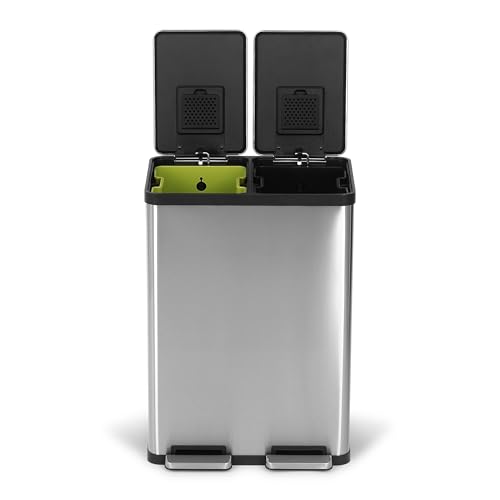
The SIMPLI-MAGIC 60 liter dual can is the color-coded pick, two 30 liter bins with green and black liners so the sorting is visible at a glance, and visibility is the feature that matters when the household includes guests, children, or anyone who sorts by color rather than by reading a label. The product information gives a rectangular hands-free dual-compartment recycling step can with a total capacity of 60 liters, or 16 gallons, split into two 30 liter compartments, in a brushed stainless steel body with a soft-close lid. The format earns its place on the sorting moment: the green liner means recycling and the black liner means trash, the color-coded liners fit standard liners with a bag cinch, and the single lid opens with a foot pedal so both hands stay free. The listed footprint is about nineteen and three-tenths inches long, fourteen and eight-tenths inches wide and twenty-six and four-tenths inches high, which is the tallest bin in this guide, and the buyer should measure the height to the counter overhang before ordering, since a tall lid needs clearance above it.
The identity record is a capacity and a liner system inside a family that shares a name. The can named here is the 60 liter rectangular dual-compartment step can with the soft-close single lid in brushed stainless steel. The same maker sells an 18 and five-tenths gallon version with an uneven 40 liter and 30 liter split and an 80 liter version with two 40 liter compartments under separate listings, and the two 30 liter compartments, the green and black color-coded liners and the soft-close single lid in this section belong to the can named. The stock evidence is a fulfillment mirror record crawled two days before writing, showing the listing in stock and fulfilled by Amazon, which is the freshest evidence in this lineup. One point of honest caution belongs in this section: a regional import listing for the same can showed it unavailable, so the buyer should confirm the live offer before ordering, since a color-coded system is only useful when both liners are actually in the box.
The limits are the equal-split form’s own trade. Two 30 liter compartments is the right split for a household that recycles as much as it throws away, and the wrong split for a household whose trash runs twice its recycling, since the recycling side will sit half empty while the trash side overflows. The single lid covers both compartments, so the lid opens for both streams at once, and the household that wants one stream covered while the other is open will not get it here. The tall body is the tallest in this guide, which suits a kitchen with clearance above the bin and crowds a kitchen where the bin sits under a low counter overhang. Buy the SIMPLI-MAGIC dual can when the household sorts by color, when the two streams run about even, and when a tall bin with a soft-close single lid matters more than a split lid.
Specs
– Form: Rectangular dual-compartment step can per the Amazon product information
– Total capacity: 60 liters per the Amazon product information
– Compartments: 2 x 30 liters per the Amazon product information
– Material: Brushed stainless steel per the Amazon product information
– Lid: Soft-close single lid per the Amazon product information
– Dimensions: About 19.3 x 14.8 x 26.4 inches per published fulfillment records
– Liners: Color-coded liners in green and black per the Amazon product information
– Fulfillment: In stock and fulfilled by Amazon per a fulfillment mirror record crawled 2 days before writing
– Tier: Mid-range
5. Rev-A-Shelf Double Pullout Trash Can, 35 Quart, Silver

The Rev-A-Shelf double pullout is the concealed pick, two 35 quart bins on full-extension slides that hide inside a base cabinet and roll out when the door opens, and concealment is the feature that matters when the bin is the thing that makes the kitchen look untidy. The product information gives a double pullout waste container with two 35 quart containers, or about eight and three-quarters gallons each, in a chrome frame with mounting hardware included, on full-extension slides. The format earns its place on floor space: the bins live inside the cabinet, the floor stays clear, and the slides extend fully outside the cabinet so the rear bin is reachable without reaching into the dark. The system mounts to the cabinet floor, and the adjustable door-mount brackets connect the cabinet door to the unit, which is the installation the buyer should plan for, since a pullout that is not mounted to the door is a pullout that has to be pulled by hand.
The identity record is a capacity and a frame inside a family that shares a name. The pullout named here is the double 35 quart system in the silver colorway with the chrome frame. The same maker sells the same double system in a black colorway, a wood-frame version, a top-mount version and a single-bin version under separate listings, and the two 35 quart containers, the chrome frame, the full-extension slides and the mounting hardware in this section belong to the pullout named. The stock evidence is the Amazon product information block behind the figures above, with the listing carried on Amazon. The two 35 quart split is the smaller total capacity in this guide, which suits a household that empties often and a kitchen where the cabinet is the constraint, and the buyer should confirm the cabinet opening before ordering, since a pullout bought for a cabinet it does not fit is a pullout that goes back.
The limits are the concealed form’s own trade. A pullout needs installation, and a household that rents or that will not drill into a cabinet should not buy it, since the door-mount brackets are required for operation and the frame mounts to the cabinet floor. The bins are smaller than the freestanding picks, so a household that recycles heavily will empty them more often, and the rear bin is the one that gets forgotten, since the front bin fills first and the rear bin hides behind it. The chrome frame is the wear point to inspect on arrival, since a frame that arrives bent is a pullout that will not slide straight, and the slides should be tested empty before the bins go in, since a slide that sticks empty will stick worse under load. Buy the Rev-A-Shelf pullout when the floor space is worth more than the installation, when the kitchen has a base cabinet with an opening the system fits, and when a bin that disappears matters more than the largest capacity.
Specs
– Form: Double pullout waste container for kitchen cabinets per the Amazon product information
– Total capacity: 2 x 35 quarts per the Amazon product information
– Compartments: 2 per the Amazon product information
– Frame: Chrome frame with mounting hardware per the Amazon product information
– Slides: Full-extension slides per the Amazon product information
– Opening mechanism: Pull-out per the Amazon product information
– Fulfillment: Carried on Amazon per the Amazon product information
– Cabinet fit: Confirm the cabinet opening before ordering per the Amazon product information
– Tier: Mid-range
Fit and Safety Checks Before You Buy
Measure the gap twice, because the bin is the wrong size more often than it is the wrong product. A freestanding recycler needs the width of the gap, the depth from the wall to the walkway, and the height to the counter overhang, and the pedal needs clearance in front while the lid needs clearance above. A pullout needs the cabinet opening width, the interior depth, and the height from the cabinet floor to the shelf above, and the door-mount brackets need a door that can carry them. Measure with the bin’s place in mind and around the baseboard, the toe kick and the door swing, since a bin that fits the gap and fouls the door is a bin that cannot sit flat, and a pullout that fits the opening and fouls the hinge is a pullout that cannot roll out.
Check the liner system before ordering, because a bin that needs a liner size the household does not stock is a bin that leaks. Dual-compartment bins take two liners, and the liner sizes are model specific, so confirm the bag size for each inner bucket and whether the bin ships with liners in the box. The SONGMICS pick ships with fifteen custom-fit bags, which covers the first month, and the SIMPLI-MAGIC pick uses color-coded liners so the green liner means recycling and the black liner means trash. A tall kitchen bag pulled snug over the rim is not the same as a custom-fit liner with a cinch, and a bag that slips off the rim is a bag that drops its contents into the bottom of the can.
No CPSC recall covers recycling bins as a class or any of the five picks in this guide, which is stated plainly because the absence of a recall is itself a finding. The nearby records that do exist are scoped to different products and are named here so the buyer can see the boundary. The Cosco 2-Step Kitchen Stepper was recalled in July 2025 under CPSC number 25-412, covering about three hundred two thousand units, because the safety bar can detach or break while in use; that is a folding stepstool, not a bin, and no pick in this guide is a stepstool. The Calphalon pizza wheel was recalled in September 2015, covering about three hundred thirty-five thousand units, because the handle can detach; that is a kitchen tool, not a bin. The Conair and Cuisinart riveted-blade food processors were recalled in December 2016, covering about eight million units; those are food processors, not bins. The Crock-Pot 6-Quart Express Crock Multi-Cooker was recalled in 2020; that is a pressurized electric cooker, not a bin. None of these records touches a recycling bin, and none of the five picks is covered by any of them.
Rinse containers before they go in, because a rinsed can is not a clean can and the smell of a week of containers collects in the one corner of the kitchen with no ventilation. Empty the food waste caddy on its own schedule, since a caddy that sits full is a caddy that smells no matter how good the odor filter is. Keep the recycling side visibly different from the trash side, with a label at the rim rather than on the lid top, since hands full of recycling read the rim label at the moment of choice and the sorting stays right on busy nights. And check the local rules once a year, because haulers change what they accept, and a bin bought for two streams that has to hold three is a bin bought twice.
FAQ
Which recycling bin size fits a family kitchen?
A total capacity of 58 to 60 liters suits most family kitchens, because the two compartments together hold about a week of trash and recycling for a household that empties weekly. A 40 liter unit suits a smaller household or a kitchen that empties twice a week, and a pullout with two 35 quart bins suits a household that empties often and values a clear floor over a large capacity. Count a week of each stream before ordering, and buy the split that matches the week rather than the largest bin the gap will hold.
Do dual-compartment bins hold enough recycling?
They hold enough when the split matches the household, and they fall short when it does not. A bin with two equal 30 liter compartments suits a household that recycles as much as it throws away, while a bin with a larger trash side suits a household whose recycling is mostly cans and bottles that compress. The recycling side fills fastest in households that cook at home and buy in bulk, so check which side fills first in the first two weeks and move the faster stream to the larger side if the bin allows it.
Can a regular trash can work as a recycling bin?
Yes, as long as the local program allows it and the bin is clearly marked so nobody mixes the streams. A regular can with a visible label at the rim works for a household that sorts one stream, and a second can beside it works for a household that sorts two. The advantage of a dual-compartment bin is that the two streams share one footprint and one lid, which keeps the sorting decision at the moment of disposal instead of at the curb, and the advantage of two separate cans is that each one can be the size its stream needs.
How do I keep a recycling bin from smelling?
Rinse containers before they go in, empty the bin on schedule rather than when it overflows, and wipe the inner buckets when a bag leaks. An odor filter helps, as on the Joseph Joseph pick, but a filter does not replace rinsing, and a bin that holds unrinsed containers will smell no matter how good the filter is. The food waste caddy needs emptying on its own schedule, since scraps smell faster than cans and bottles, and the lid should close fully between uses, since a lid left open is a lid that lets the smell out.
Conclusion
The best recycling bin for a kitchen is the one that keeps two waste streams apart in the space the kitchen actually has. The simplehuman 58 liter recycler is the default pick, a full-size dual-compartment step can with a soft-close lid and a brushed stainless steel body, for the household with the floor space and no existing sorting system. The Joseph Joseph Totem Compact is the small-kitchen pick, a 40 liter vertical unit with an odor filter and a food waste caddy, for the household with a narrow gap. The SONGMICS 16 gallon dual can is the budget pick, two equal 8 gallon compartments with fifteen bags in the box, for the household that wants the job done at the lowest tier. The SIMPLI-MAGIC 60 liter dual can is the color-coded pick, two 30 liter bins with green and black liners, for the household that sorts by color. And the Rev-A-Shelf double pullout is the concealed pick, two 35 quart bins on full-extension slides, for the household that wants the bin to disappear. Measure the gap, count a week of each stream, check the liner system, and buy the form that fits the kitchen’s failure first, because a bin that fits is a bin that gets used, and a bin that gets used is a kitchen that stays sorted.
More from Amazon
Programs that pair well with the guide above. Offers and eligibility are set by Amazon and may change.
Free shipping on eligible items, Prime Video and more. Eligible new members can start with a free trial.
Start a Prime free trialAudiobooks and podcasts to listen to on the go. Eligible new members can start with a free trial.
Try Audible freeAd-free music streaming. Eligible new subscribers can start with a free trial.
Try Music Unlimited freeA free business account with business pricing and bulk-buying tools for work, shop or home office.
Create a business accountAs an Amazon Associate we earn from qualifying purchases.





Write Your Review
No reviews yet. Be the first to share your experience!