
Key takeaways
- Compare the best soil test kits for home gardens: capsule pH and NPK kits, a 3-in-1 probe and mail-in lab tests with the listed specs for each pick.
Disclosure: As an Amazon Associate, I earn from qualifying purchases. If you buy through links in this article, I may earn a commission at no extra cost to you.
Our top pick: Luster Leaf 1601 Rapitest Soil Test Kit. Runner-up: MySoil Soil Test Kit.
Guessing at fertilizer is how beds end up overfed in one nutrient and starved in another. A soil test replaces the guess with a reading: how acidic or alkaline the soil is, and whether nitrogen, phosphorus and potash are low, adequate or high. The five kits below cover the three formats home gardeners actually use. Two are at-home chemical kits that work with capsules or liquid reagents and a color chart. Two are mail-in lab kits, where you send a sample off and get a written report back. One is a simple 3-in-1 probe for quick moisture, light and pH checks between real tests. None of them is the right answer for everyone, so the guide starts with how the formats differ before the picks themselves.
How to Choose a Soil Test Kit
Start with the format. Chemical kits give results the same day and can be repeated across many beds, but they read nutrient levels in broad bands rather than exact numbers. Mail-in lab kits take longer, yet they report measured nutrient levels and usually pair them with amendment recommendations for your soil. A probe meter is instant and reusable, but its pH reading is a rough estimate taken at probe depth, and it tells you nothing about nitrogen, phosphorus or potash.
Check what is actually measured. A full home test covers pH plus the three primary nutrients: nitrogen (N), phosphorus (P) and potash (K). Some kits only measure pH and moisture. That is fine for checking whether a bed is drifting too acidic, but it cannot explain why plants are hungry. If you are setting up a new vegetable bed or fixing a lawn that has failed for seasons, choose a kit that covers all four measures.
Count the tests, not just the box. Capsule and reagent kits are rated by the number of tests for each parameter, and those counts decide how many beds you can sample. A kit with ten tests per parameter handles a few beds with repeat checks. A single-use mail-in kit covers one composite sample, so a yard with very different areas may need more than one kit.
Sample properly, whichever kit you pick. Take small cores from several spots in one bed, mix them into a single composite sample, and remove stones and roots. Test before planting in spring and again when preparing beds in fall, rather than right after fertilizing, which skews the result. Keep the sampling depth consistent between tests so results can be compared across seasons.
Be realistic about accuracy. No numeric accuracy figure is listed for the probe pick here, and home chemical kits are designed to sort soil into low, medium and high bands. Treat both as guidance for what to add and what to hold back. When a planting decision is expensive, or a bed keeps failing despite amendments, a mail-in lab report is the stronger evidence to work from.
1. Luster Leaf 1601 Rapitest Soil Test Kit

The Rapitest 1601 is the classic home chemical kit, built around a capsule system and patented color comparators. You mix soil with water, transfer solution to a comparator, add the powder from a color-coded capsule, and match the developed color against the chart. The kit covers the full set of home measures — pH, nitrogen, phosphorus and potash — with ten tests for each, forty in total. That count is enough to work through several beds and still retest after amending.
Two inclusions make it friendly for beginners. The instructions walk through the sampling and mixing steps in detail, and a pH preference list covering hundreds of plants helps you decide whether your reading suits what you want to grow, or whether the soil needs adjusting first. The trade-off is the method itself: capsule tests read in bands, and the nutrient tests need the soil-and-water mixture to settle before the solution is drawn off, so a full round of testing takes a little patience rather than a few seconds.
Specs
- Brand: Luster Leaf
- Model: 1601
- Test type: At-home chemical capsule kit
- Measures: Soil pH, nitrogen, phosphorus and potash
- Tests included: 40 total, 10 for each parameter, as listed
- Method: Color-coded capsules with color comparator chambers
- Includes: 4 color comparators, eye dropper, instructions and fertilization guidelines, pH preference list for over 450 plants, as listed
- Item weight: 4 ounces, as listed
2. MySoil Soil Test Kit

MySoil takes the opposite approach: instead of testing at the kitchen table, you collect a sample and mail it to a lab in the prepaid envelope. The lab measures pH plus 13 plant-available nutrient levels, including nitrogen and the micronutrients that home kits skip, such as calcium, magnesium, iron and boron. Results are posted online in 6 to 8 days, as listed, with fertilizer recommendations tailored to your soil and to what you are growing, in both organic and synthetic options.
This is the pick for a gardener making a bigger decision: establishing a new lawn, rescuing a bed that underperforms every year, or setting a baseline before a season of feeding. The limits are built into the format. Each kit covers one sample, results are not instant, and there is no way to retest a single bed on a whim without another kit. Used once or twice a year as a reference point, though, it gives numbers the at-home formats cannot.
Specs
- Brand: MySoil
- Test type: Mail-in laboratory analysis
- Measures: Soil pH plus 13 plant-available nutrient levels, as listed
- Results: Online report in 6 to 8 days, as listed
- Recommendations: Tailored organic and synthetic fertilizer recommendations
- Includes: Sample container, scoop and prepaid mailing envelope, as listed
- Samples per kit: 1
- Manufacturer: Predictive Nutrient Solutions, Inc
- Item weight: 4.6 ounces, as listed
3. Soil Savvy Soil Test Kit
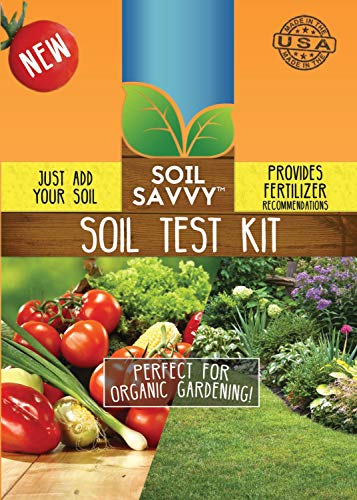
Soil Savvy is the other established mail-in option, and it follows a similar route with its own reporting style. You add your soil to the included jar, mail it in, and receive a complete nutrient analysis covering pH and 14 nutrients, as listed, together with a fertilizer recommendation printed on the report for the area you sampled. The recommendations include options suited to organic gardening, which is how many of its users grow.
Choosing between the two mail-in kits comes down to the report format you prefer and the nutrient panel you want to see; both replace home color matching with a lab measurement. Like any single-sample kit, Soil Savvy works best when the sample is a true composite of the bed rather than one scoop from the corner. Gardeners with several distinct areas — lawn, vegetable beds, fruit plantings — should plan on one kit per area rather than blending soils that will be managed differently.
Specs
- Brand: Soil Savvy
- Test type: Mail-in laboratory analysis
- Measures: Soil pH plus 14 nutrients, as listed
- Report: Complete nutrient analysis with fertilizer recommendation on the report
- Sampling: Add soil to the included jar and mail it to the lab
- Recommendations: Includes options suited to organic gardening, as listed
- Samples per kit: 1
4. SONKIR MS02 3-in-1 Soil Tester

The SONKIR MS02 is the quick-check tool of this group. Its two probes push into the soil and an analog dial reads three things selected by a switch: moisture on a 1 to 10 scale, light from 0 to 2000 lux, and pH from 3.5 to 8, all as listed. It needs no battery, works in pots as happily as in beds, and gives an answer in the time it takes the needle to settle. For deciding whether a container needs water today, or whether a plant is sitting in deep shade, that speed is the point.
Its limits need stating plainly. A probe pH reading is an estimate influenced by soil moisture and probe condition, and no numeric accuracy is listed for this meter. It cannot measure nitrogen, phosphorus or potash at all. Treat it as a between-tests monitor that works alongside a real kit, not as a substitute for one, and wipe the probes clean after each use so residue does not carry into the next reading.
Specs
- Brand: SONKIR
- Model: MS02
- Test type: Analog 3-in-1 probe meter, no battery required
- Measures: Moisture, light and soil pH
- pH range: 3.5 to 8, as listed
- Moisture scale: 1 to 10, as listed
- Light scale: 0 to 2000 lux, as listed
- Nutrients: Does not measure nitrogen, phosphorus or potash
5. LaMotte Model EL Turf and Garden Soil Test Kit

The LaMotte Model EL is the step up for gardeners who want a proper reagent kit at home. Made by a company known for test equipment, it uses liquid reagents, test tubes and laminated color charts in a carrying case, and it is stocked with 30 pH tests and 15 tests each for nitrogen, phosphorus and potassium, as listed. That capacity suits a larger property where several beds and a lawn all need checking in the same round.
Interpretation help is part of the package: a Garden Guide and the LaMotte Soil Handbook are included to turn readings into lime and fertilizer decisions. The procedures are more involved than dropping a capsule into a comparator — each parameter has its own steps — so this kit rewards gardeners who enjoy methodical work and keep notes. Refill reagents are available for this system, which makes it a longer-term bench tool rather than a one-season purchase.
Specs
- Brand: LaMotte
- Model: 5679-01
- Test type: At-home liquid reagent kit in carrying case
- Measures: Soil pH, nitrogen, phosphorus and potassium
- Tests included: 30 pH tests and 15 tests each for nitrogen, phosphorus and potassium, as listed
- Method: Liquid reagents with laminated color charts
- Includes: Garden Guide and LaMotte Soil Handbook, as listed
- Item weight: 2.9 pounds, as listed
Quick Comparison
| Pick | Format | Measures | Tests or samples | Results speed |
|---|---|---|---|---|
| Luster Leaf 1601 Rapitest | Chemical capsules | pH, N, P, K | 40 tests | Same day |
| MySoil Soil Test Kit | Mail-in lab | pH plus 13 nutrient levels | 1 sample | 6 to 8 days, as listed |
| Soil Savvy Soil Test Kit | Mail-in lab | pH plus 14 nutrients | 1 sample | By mail |
| SONKIR MS02 | Probe meter | Moisture, light, pH | Reusable | Instant estimate |
| LaMotte Model EL | Liquid reagents | pH, N, P, K | 75 tests | Same day |
FAQ
How often should I test my soil?
Once or twice a year is enough for most beds — before spring planting and again when preparing beds in fall. Retest after a major amendment, such as a liming program, to confirm the pH has actually moved before adding more.
Can a cheap probe replace a real test kit?
No. A 3-in-1 probe reads moisture and light usefully and gives a rough pH estimate, but it cannot measure nitrogen, phosphorus or potash. Use it for quick checks between proper tests, not instead of them.
Why do mail-in kits cost more per test?
Because a laboratory is measuring your sample and preparing a report. You are paying for measured nutrient levels, including micronutrients home kits do not cover, plus recommendations calculated for your soil rather than a generic chart.
My chemical test and my probe disagree on pH. Which do I trust?
Trust the chemical test, and even then read it as a band rather than a precise figure. Probe readings shift with soil moisture and probe condition. If the two disagree widely and the decision matters, a mail-in lab result settles it.
Should I test each bed separately?
Yes, if the beds are managed differently or planted with different crops. Soil a few steps apart can differ sharply, especially where one area was amended and another was not. Blend samples only within a single, uniform area.
Conclusion
For most home gardeners, the Luster Leaf 1601 Rapitest covers the essentials at the bench: pH and all three primary nutrients, forty tests, and guidance for matching plants to your pH. Gardeners who want measured numbers and a written plan should send a sample away — MySoil for its broad nutrient panel and tailored recommendations, Soil Savvy for its report with fertilizer guidance suited to organic growing. The SONKIR MS02 earns its place as the quick daily check for water, light and approximate pH, and the LaMotte Model EL is the kit for larger properties and methodical testers who want reagent capacity at home. Pick the format that matches the decision in front of you, sample carefully, and the results will be worth acting on.
More from Amazon
Programs that pair well with the guide above. Offers and eligibility are set by Amazon and may change.
Free shipping on eligible items, Prime Video and more. Eligible new members can start with a free trial.
Start a Prime free trialAudiobooks and podcasts to listen to on the go. Eligible new members can start with a free trial.
Try Audible freeAd-free music streaming. Eligible new subscribers can start with a free trial.
Try Music Unlimited freeA free business account with business pricing and bulk-buying tools for work, shop or home office.
Create a business accountAs an Amazon Associate we earn from qualifying purchases.








Write Your Review
No reviews yet. Be the first to share your experience!