
Key takeaways
- Compare self-watering plant globes and watering spikes for indoor plants, from ceramic cones and terracotta stakes to glass globes and drip spikes.
A minimalist plant shelf asks little: a few pots, clean lines, nothing blinking or humming in the corner. The problem arrives with travel, busy weeks, and thirsty plants in small pots that dry out long before the larger ones do. Self-watering globes and watering spikes solve that quietly. They are passive devices with no batteries, no pumps, and no apps. A filled globe, a porous terracotta stake, or a ceramic cone sits in the soil and releases water slowly, either on a fixed drip or in response to how dry the soil becomes.

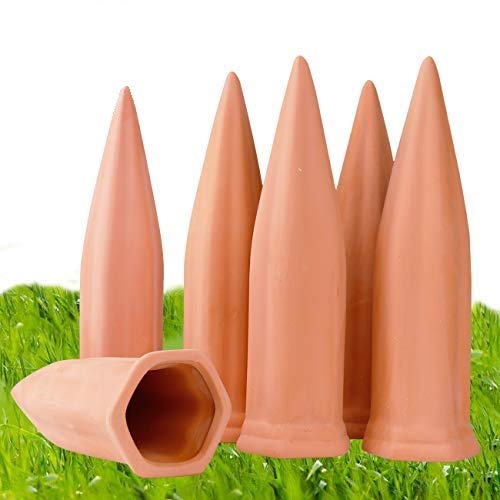
This guide compares five well-proven designs across the three main families: demand-driven ceramic cones, bottle-fed terracotta stakes, decorative glass globes, and adjustable plastic drip spikes. Each one suits a different kind of plant collection, from a single large floor plant to a windowsill of herbs.
As an Amazon Associate, we earn from qualifying purchases.
Quick answer
For most indoor plants, the Blumat Classic ceramic cones are the calmest choice because they release water only as the soil dries. Terracotta stakes from Remiawy are the simplest bottle-fed option, glass globes from 5 Star Super Deals and Kingbuy add a decorative touch, and Wonglea drip spikes give adjustable flow for mixed collections.
Blumat Classic Self-Watering Stakes, 6 Pack
The Blumat Classic is the reference design in this category, made in Austria and built around a porous ceramic cone connected by a thin tube to any nearby container of water. Setup takes a short soak: the cone and cap sit in water for at least fifteen minutes, the cap is pressed on underwater to keep air out, and the cone is pushed fully into the soil with the tube resting at the bottom of the reservoir.
What sets it apart is that the plant effectively waters itself. As the soil around the cone dries, moisture is drawn through the ceramic wall, and the cone pulls replacement water from the container. When the soil is moist, flow nearly stops. There is no timer and no fixed drip rate to guess at, which makes it forgiving for plants with uneven thirst. The main limit is height: the cones can draw water up about twelve inches, so the reservoir should sit close to pot level rather than on the floor below. One cone usually covers one or two plants in a small pot, and larger containers may need two or three cones sharing a bigger reservoir.
Remiawy Terracotta Watering Spikes, 6 Pack
Remiawy takes the oldest approach in the group: a plain porous terracotta spike, about six inches long, that accepts a filled bottle in its open top. A recycled wine bottle or a standard plastic bottle becomes the reservoir, and the clay wall meters the water into the surrounding soil. Dry soil wicks moisture out of the spike; saturated soil slows the exchange almost to a halt.
There is nothing to adjust and nothing to assemble, which is exactly the appeal. The trade-offs are equally plain. Terracotta is fragile, so spikes should be pushed into loosened soil rather than forced, and heavy bottles need the spike seated deeply so the assembly does not tip or snap the clay. Release speed varies with pot size, soil mix, and room conditions; the maker suggests roughly a week or more from a one-litre bottle under typical conditions, and recommends a trial run before a long trip. As a low-cost way to cover half a dozen pots with materials that disappear visually into terracotta planters, it is hard to beat.
5 Star Super Deals Aqua Plant Watering Globes, Large, 4-Pack

Glass globes are the decorative branch of the family, and this set of four large hand-blown stained-glass globes is the classic form: a rounded reservoir on a long hollow stem. Each globe is filled under the tap, the stem is pushed into the soil at a slight angle, and water migrates down as air bubbles rise to replace it.
The honest caveat with every glass globe is control. The release rate depends on soil density, stem angle, and how firmly the soil seals around the opening, so the same globe can empty in two days in a loose mix or last well over a week in dense soil. Making a pilot hole with a pencil before inserting the stem prevents the opening from clogging with compacted soil, the single most common complaint about this style. In return, the globes ask for no bottles, no tubing, and no reservoir sitting beside the pot, and the stained glass reads as part of the plant display rather than equipment. They suit medium pots best; very small pots can be flooded by a large globe, and very thirsty plants may drain one quickly.
Kingbuy Mushroom-Shaped Self-Watering Globes, 2 Pack

Kingbuy leans fully into the ornamental side with glass globes shaped like mushrooms. The mechanism is identical to any watering bulb: fill the stem and cap, invert it into the soil, and let soil dryness govern how fast the water leaves. The difference is intent. These are made to be seen, sitting above the foliage like small garden ornaments, which makes them a natural fit for a styled shelf, a gift plant, or a single statement pot where a plastic spike would spoil the look.
The two-pack size is a clue to their best use. They are not the economical way to water a dozen plants on a balcony; they are a finishing touch for one or two indoor plants that are watered by hand most of the time and only need backup during a long weekend. Glass is glass, so they should be handled by the stem with care and kept out of pots that get knocked often. Within that role, they do the simple job of a globe while adding something most watering tools never attempt: charm.
Wonglea Upgraded Self-Watering Spikes, 6 Pack
Wonglea represents the adjustable plastic drip spike, the most configurable design here. Each spike screws onto a standard bottle, and a small knob on the spike sets the drip rate, from roughly one drip every five seconds down to one every sixty seconds. At slow settings with a large bottle, a single spike can stretch watering across many days, and each plant gets its own setting rather than one shared behavior.
The spike itself uses a cross-shaped profile that grips the soil and resists tipping under a full bottle, and the one-piece body needs no assembly. Plastic is less elegant than clay or glass and will not disappear into a styled pot, but it is also nearly unbreakable, easy to rinse clean, and cheap to deploy across a whole collection. This is the practical pick for a mixed group of plants with very different thirst levels, or for a first experiment with vacation watering before committing to a ceramic system. As with any fixed-rate dripper, the setting that is right in a cool week may be generous in a hot one, so a short trial before travel is still worthwhile.
How to choose
Start with the watering logic you prefer. Demand-driven devices, the Blumat cones and the terracotta stakes, respond to soil moisture itself and are the safest choice for plants that resent wet feet. Fixed-reservoir globes release water by displacement and suit plants that like steady moisture. Adjustable drip spikes put the rate in your hands, which is powerful but means the rate is only as good as your setting.
Match the device to the pot. Small pots hold little soil and flood easily, so a small globe or a single cone at a slow setting is plenty. Large floor plants need volume: several cones on one reservoir, a big bottle on a stake, or two globes at opposite sides of the pot. Check reservoir placement too. Blumat cones need the water container near pot height, while bottle-fed stakes and spikes carry their reservoir above the soil and work anywhere.
Consider how visible the tool will be. On an open shelf, glass globes and terracotta blend in or even add to the display; tubing and plastic spikes read as equipment. Finally, count your plants. Per-plant cost falls quickly with multipacks of stakes and spikes, while globes are priced more like decor. Whatever you choose, run it for a few days while you are home before trusting it with a holiday.
Who should skip
Skip self-watering globes and spikes if your plants are mostly succulents and cacti that want long dry spells, since a device that keeps soil faintly moist works against them. Skip them if you are away for many weeks at a time; reservoirs in this size range are measured in days, and a timed irrigation system or a plant sitter fits better. Skip glass globes in homes where pots are regularly knocked by pets or children. And skip the whole category if you actually enjoy the ritual of watering by hand and rarely travel; a simple can remains the most minimalist tool of all.
FAQ
How long will a watering globe or spike keep a plant watered?
It depends on reservoir size, soil, and the plant itself. A bottle-fed terracotta stake commonly covers about a week, sometimes longer in a large pot. Glass globes range from a few days to over a week. Adjustable drip spikes at their slowest settings can stretch a large bottle across two weeks or more. Always trial the setup at home first.
Do terracotta watering spikes fit any bottle?
They fit most standard wine bottles and common plastic bottles with regular necks, which is what they are shaped for. Unusually narrow or wide bottle mouths may not seal well. If a bottle wobbles, seat the spike deeper in the soil or choose a heavier, straight-sided bottle so the assembly stays upright.
Can self-watering spikes overwater a plant?
Yes, if the match is wrong. A large globe in a small pot, or a drip spike set too fast, can keep soil soggy. Demand-driven cones and terracotta stakes are more self-limiting because release slows as soil moisture rises. The safeguard is the same in every case: test the device for several days while you are home and check the soil before leaving.
Are glass globes or ceramic cones better for indoor plants?
Ceramic cones are better for precision, because they respond to soil dryness and can serve a plant for as long as the reservoir lasts. Glass globes are better for appearance and simplicity, with no tubing or separate container. Many plant owners use cones for large or fussy plants and globes for small, decorative pots.
Final verdict
For a calm, set-and-forget system, the Blumat Classic cones are the strongest all-round choice, with Remiawy terracotta stakes as the simplest low-cost alternative. Choose the 5 Star Super Deals or Kingbuy globes when the watering tool is part of the display, and the Wonglea spikes when you want per-plant control on a budget. All five share the minimalist virtues that matter here: no power, no noise, and nothing to charge.
Product and ASIN Reference
| Product | ASIN |
|---|---|
| Blumat Classic Self-Watering Stakes, 6 Pack | B07H9HZ4FB |
| Remiawy Terracotta Watering Spikes, 6 Pack | B07F3YM1WD |
| 5 Star Super Deals Aqua Plant Watering Globes, Large, 4-Pack | B00CSXG6QE |
| Kingbuy Mushroom-Shaped Self-Watering Globes, 2 Pack | B0873VS4HZ |
| Wonglea Upgraded Self-Watering Spikes, 6 Pack | B0BJJRBZBP |
FAQ
How long will a watering globe or spike keep a plant watered?
Do terracotta watering spikes fit any bottle?
Can self-watering spikes overwater a plant?
Are glass globes or ceramic cones better for indoor plants?
More from Amazon
Programs that pair well with the guide above. Offers and eligibility are set by Amazon and may change.
Free shipping on eligible items, Prime Video and more. Eligible new members can start with a free trial.
Start a Prime free trialAudiobooks and podcasts to listen to on the go. Eligible new members can start with a free trial.
Try Audible freeAd-free music streaming. Eligible new subscribers can start with a free trial.
Try Music Unlimited freeA free business account with business pricing and bulk-buying tools for work, shop or home office.
Create a business accountAs an Amazon Associate we earn from qualifying purchases.



Write Your Review
No reviews yet. Be the first to share your experience!