
Key takeaways
- Compare five can openers for safe edges, easy turning, and simple cleanup, with manual and electric picks for every kitchen, hand strength, and drawer.
Table of Contents
- Quick Answer
- 1. OXO Good Grips Smooth Edge Can Opener
- 2. Hamilton Beach Smooth Touch Electric Can Opener
- 3. Cuisinart Deluxe Electric Can Opener
- 4. KitchenAid Classic Multifunction Can Opener
- 5. Gorilla Grip Heavy Duty Smooth Edge Can Opener
- How to Choose a Can Opener
- Who Should Skip These Can Openers
- Care and Safety
- Frequently Asked Questions
- Conclusion
- Product and ASIN Reference
Quick Answer
The best can opener for most kitchens is the OXO Good Grips Smooth Edge Can Opener, a manual opener that cuts below the rim so the can and the lid are left with smooth edges, with built-in pliers that lift the lid away without a finger touching it. The Hamilton Beach Smooth Touch Electric Can Opener is the pick for a cook who wants the turning done by a motor, because its push-down lever starts the cut and its extra-tall frame fits standard cans and pop-top cans alike. The Cuisinart Deluxe Electric Can Opener is the pick for a tidy countertop, because its single-touch operation, magnetic lid holder, and detachable cutting lever keep the daily routine simple and the cleanup quick. The KitchenAid Classic Multifunction Can Opener is the pick for a small drawer and a small routine, because its stainless steel cutting wheel, soft ergonomic handles, and built-in bottle opener cover the everyday job in a slim frame. The Gorilla Grip Heavy Duty Smooth Edge Can Opener is the pick for a household that wants a smooth edge at a simple level, because its stainless steel body, soft handle, and oversized turn knob make a manual opener that is easy to hold and easy to turn. Buy the OXO opener first if a sharp lid edge is the worry that keeps coming up, buy an electric opener first if turning a knob is the hard part, and buy the KitchenAid opener first if the drawer is small and cans are opened only a few times a week.
As an Amazon Associate, we earn from qualifying purchases.
A can opener is a small tool with an outsized job. It is used standing at the counter with wet hands, it is used when dinner is already late, and it is used by everyone in the household from a teenager making lunch to an older cook opening a can of soup. The difference between a good opener and a poor one is rarely dramatic in a shop display. It shows up on the third can of the week, when the wheel slips, when the lid drops into the food, when the rim leaves a sharp edge that catches a finger, or when the knob asks for more grip strength than the hand has that day. This guide compares five openers that cover the real range of kitchens: two electric openers that do the turning, and three manual openers that differ in cut style, grip, and size. Each pick below is described from its published listing details, so the choice can be matched to the cans opened most often, the hands doing the opening, and the drawer or counter where the tool will live.
The first decision is the cut. A traditional top-cut opener pierces the lid from above and leaves a sharp rim on the can and a sharp disc to throw away. A smooth-edge opener cuts below the rim, from the side, so the lid lifts off whole with a dull edge and the can keeps a smooth rim that is safe to touch while scooping out the contents. The second decision is the power source. A manual opener needs no outlet, no batteries, and no counter space, and it works in a power cut and in a camping kit. An electric opener needs a counter spot and an outlet, and in return it removes the turning entirely, which matters more than any other feature for a cook with limited grip strength or a sore wrist. The third decision is the grip. An oversized knob, a soft handle, a long crank, and a lever each change how much force the hand must supply, and the right grip is the one that feels secure when the hands are wet. The sections that follow take each opener on its own terms, with the published dimensions and materials that decide fit, because a tool that does not fit the drawer, the can, or the hand is a tool that ends up at the back of the drawer and then forgotten.
1. OXO Good Grips Smooth Edge Can Opener

The OXO Good Grips Smooth Edge Can Opener is the best can opener for most kitchens, because it solves the problem most people actually have with can openers: the sharp lid. The listing describes a manual opener that cuts on the side of the can, below the edge, so the smooth edge design leaves no sharp edges on the can or the lid. The sharp, hardened stainless steel cutting wheel stays clean by avoiding contact with the can contents, while the lid pliers allow for no-touch lid removal. That combination is the whole argument for this opener. A can of tomatoes can be opened, the lid lifted away with the pliers, and the contents scooped out over a smooth rim, without a finger ever meeting a sharp edge and without the lid falling into the food.
The grip is the second reason this opener leads the guide. The handles are soft and non-slip, the knob is an oversized side-wind knob, and the mechanism turns smoothly around the can with a steady, even motion. A cook with hands that tire easily will notice the difference on a large can, because the side-wind position lets the hand turn from a comfortable angle instead of gripping a small knob from above. The opener is built for right-handed operation, which is worth knowing before buying, and it measures four and one-half inches wide by seven and one-half inches high, a size that fits a standard kitchen drawer without crowding the other tools. The stainless steel blade material and the stainless steel body material keep the tool simple to wipe clean, and the hand-wash care keeps the wheel sharp and the handles in good condition over time.
The lid pliers deserve a closer look, because they change the cleanup as much as the cut changes the safety. The ordinary way to remove a cut lid is to pry it up with a fingertip, and a fingertip on a sharp lid is the most common small cut in a kitchen. The OXO opener holds the lid after the cut, so the lid goes straight to the recycling bin without a finger touching an edge at all, and the smooth rim left on the can means a finger that brushes the rim while scooping out the contents meets smooth metal instead of a blade. A household with children, a household with an older cook, or any kitchen where a hand reaches into a drawer or a recycling bin without looking will feel the difference the first time a lid is handled without a flinch.
The limits are the manual form’s own trade. A manual opener asks the hand to turn the knob all the way around the can, so a cook with very limited grip strength or a sore wrist may still find a large can tiring, and the side-cutting design needs the opener to sit squarely on the rim before the cut begins, which takes a little practice on the first few cans. The opener is also a single-purpose tool: it opens cans and nothing else, so a kitchen that opens a can once a month will not feel its benefit the way a daily user does. Buy the OXO Smooth Edge opener when cans are a weekly staple, when a sharp lid edge is the worry that keeps coming up, and when smooth edges and a held lid matter more than a powered opener that does the turning for its user.
Specs
- Form: Manual smooth-edge can opener per the Amazon listing
- Cut style: Side cut below the rim, leaves smooth edges on can and lid per the Amazon listing
- Blade material: Hardened stainless steel per the Amazon listing
- Body material: Stainless steel per the Amazon listing
- Handles: Soft non-slip handles with oversized side-wind knob per the Amazon listing
- Lid removal: Built-in pliers for no-touch lid removal per the Amazon listing
- Dimensions: 4.5 x 7.5 inches per the Amazon listing
- Model number: 1049953 per the Amazon listing
- Care: Hand wash per the Amazon listing
- Warranty: OXO Better Guarantee for repair or replacement per the Amazon listing
- Tier: Mid-range
2. Hamilton Beach Smooth Touch Electric Can Opener

The Hamilton Beach Smooth Touch Electric Can Opener is the pick for a cook who wants the turning done by a motor. The listing describes an electric automatic can opener with an easy push-down lever, a smooth-touch cut that eliminates sharp edges, and a frame that opens all standard-size and pop-top cans. The extra-tall design is the detail that decides whether the opener fits the cans a household actually buys, because a tall can of tomatoes and a short can of tuna need different clearance, and an opener that is too short for a tall can is an opener that cannot finish the job. The push-down lever is the control: press it, the motor turns the can, and the cut walks around the rim until the lid is free.
The smooth-touch cut is the same idea as the OXO opener, applied by a motor instead of a hand. The cutting assembly works from the side of the rim, so the lid lifts off with a smooth edge and the can keeps a smooth rim, and the lid can be placed back on the can as a cover while the contents wait for the pan. That matters in a kitchen where a can is opened before the rest of dinner is ready, because a smooth lid is safe to handle and safe to set aside, while a sharp lid needs to be thrown away at once. The black and chrome finish suits a countertop that already holds a coffee maker or a toaster, and the opener stays on the counter, ready, instead of hiding in a drawer where it must be found before every use.
The electric form has its own trade. It needs a counter spot and an outlet, so a kitchen with no free counter space will find it in the way, and a household that opens a can once a month will not feel its benefit the way a daily user does. The motor also means the opener has parts that a manual opener does not: a cutting lever, a drive wheel, and a cord, each of which needs wiping after use. The listing notes a one-year limited warranty against defects in materials and workmanship from the date of purchase, which is worth keeping in mind alongside the habit of wiping the cutting assembly after opening a can of something sticky. Buy the Hamilton Beach Smooth Touch opener when turning a knob is the hard part, when cans are opened daily, and when a countertop spot is available for a tool that earns its place by removing the turning entirely.
The opener also suits a household where more than one person opens cans. A teenager, an older cook, and a guest can all press the same lever and get the same result, because the motor supplies the force and the hand only guides the can into place. That consistency is the quiet advantage of an electric opener: the result does not depend on grip strength, on wet hands, or on how tired the cook is at the end of the day. The extra-tall frame keeps the can steady while the motor works, and the push-down lever keeps the hand clear of the cutting area, so the whole routine is a press, a wait, and a lift.
Specs
- Form: Electric automatic can opener per the Amazon listing
- Cut style: Smooth-touch side cut, eliminates sharp edges per the Amazon listing
- Operation: Easy push-down lever per the Amazon listing
- Can sizes: Opens all standard-size and pop-top cans per the Amazon listing
- Frame: Extra tall per the Amazon listing
- Colors: Black and chrome per the Amazon listing
- Model number: 76606AG per the Amazon listing
- Warranty: One-year limited warranty per the maker manual
- Tier: Premium
3. Cuisinart Deluxe Electric Can Opener

The Cuisinart Deluxe Electric Can Opener is the pick for a tidy countertop. The listing describes a deluxe electric can opener with single-touch automatic operation, an easy-clean detachable cutting lever, a nonslip base, and a magnetic lid holder, in black, under model CCO-50BKN. The single-touch idea is the whole routine: place the can, press once, and the opener does the turning while the cook gets on with the rest of dinner. The magnetic lid holder keeps the lid after the cut, so the lid goes straight to the recycling bin without a finger touching an edge, and the nonslip base keeps the opener steady on the counter while the motor works.
The detachable cutting lever is the detail that decides whether an electric opener stays clean. A cutting lever that comes off can be washed properly after opening a can of something sticky, rather than being wiped in place and left with a film that attracts odors. The lever is also the part that meets the can, so keeping it clean keeps the next cut clean too. The black finish suits a countertop that already holds dark appliances, and the compact electric form fits a corner of the counter without crowding the coffee maker. The opener is a single-purpose countertop tool, and it earns its spot the same way a toaster does: by doing one job every day, without fuss, and by being ready the moment it is needed.
The limits are the electric form’s own trade. It needs a counter spot and an outlet, so a kitchen with no free counter space will find it in the way, and a household that opens a can once a month will not feel its benefit the way a daily user does. The motor also means the opener has a cord to keep clear of the sink and a cutting assembly to wipe after use. Buy the Cuisinart Deluxe opener when cans are opened daily, when a tidy countertop matters, and when a single press and a detachable lever matter more than a manual opener that folds away into a drawer.
The opener also suits a cook who wants the same result every time. A manual opener depends on the hand that turns it, and the result changes with grip strength, with wet hands, and with how tired the cook is. An electric opener supplies the same force every time, so the cut is the same on the first can of the week and the last. That consistency is the quiet advantage of the Cuisinart opener: the routine is a press, a wait, and a lift, and the lid is held by a magnet instead of a fingertip.
Specs
- Form: Electric automatic can opener per the Amazon listing
- Operation: Single-touch automatic operation per the Amazon listing
- Cutting lever: Easy-clean detachable cutting lever per the Amazon listing
- Lid holder: Magnetic lid holder per the Amazon listing
- Base: Nonslip base per the Amazon listing
- Colors: Black per the Amazon listing
- Model number: CCO-50BKN per the Amazon listing
- Tier: Premium
4. KitchenAid Classic Multifunction Can Opener
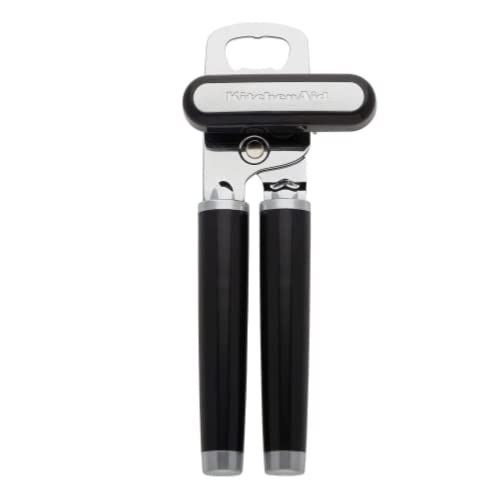
The KitchenAid Classic Multifunction Can Opener is the pick for a small drawer and a small routine. The listing describes a classic multifunction can opener and bottle opener in black, with a razor-sharp stainless steel cutting wheel, soft ergonomic handles, and an oversized turning knob. The frame measures eight and thirty-four hundredths inches long, the width is three and fifty-four hundredths inches, and the weight is four and forty-eight hundredths ounces, a slim, light form that slides into a drawer without crowding the other tools. The built-in bottle opener sits in the same frame, so one tool opens cans and removes bottle caps, saving space in a kitchen where every drawer slot is spoken for.
The cutting wheel is the heart of the tool. It pierces the lid and slices smoothly in one motion, and the oversized turning knob gives the hand leverage that a small knob cannot, which matters for a cook with limited hand strength. The soft ergonomic handles span the can width and give the hand a comfortable grip, even when the hands are wet, and the stainless steel construction resists staining from citrus and tomato. The opener is a manual tool with no motor, no batteries, and no cord, so it works in a power cut, in a camping kit, and in a kitchen with no free counter space, and the only maintenance is a wash and a dry.
The limits are the traditional top-cut design. The wheel cuts through the lid from above, so the lid it leaves behind has a sharp edge and the can keeps a sharp rim, which means the lid needs to be thrown away at once and a finger that brushes the rim while scooping out the contents meets a sharp edge. A household with children, or any kitchen where a hand reaches into a recycling bin without looking, should weigh that trade against the slim size and the low tier. The manual form also asks the hand to turn the knob all the way around the can, so a cook with a sore wrist may find a large can tiring. Buy the KitchenAid Classic opener when the drawer is small, when cans are opened a few times a week, and when a slim, light, two-in-one tool matters more than a smooth edge.
The opener also suits a cook who already owns KitchenAid tools and wants a matching drawer. The black finish and the classic shape sit comfortably beside other kitchen tools, and the lifetime limited warranty with a one-year hassle-free replacement, as described on the listing, backs a tool that is meant to be used for years. The compact size is the real argument: a tool that stores well gets used, and a tool that stores badly gets moved to the back of the drawer and then forgotten, so the storage question is not a detail but the question that decides whether the purchase was worth making at all.
Specs
- Form: Manual can opener with built-in bottle opener per the Amazon listing
- Cut style: Top cut with stainless steel cutting wheel per the Amazon listing
- Blade material: Stainless steel per the Amazon listing
- Handles: Soft ergonomic handles with oversized turning knob per the Amazon listing
- Dimensions: 8.34 x 3.54 inches per the Amazon listing
- Weight: 4.48 ounces per the Amazon listing
- Colors: Black per the Amazon listing
- Care: Hand wash with warm soapy water and dry at once per the Amazon listing
- Tier: Budget
5. Gorilla Grip Heavy Duty Smooth Edge Can Opener

The Gorilla Grip Heavy Duty Smooth Edge Can Opener is the pick for a household that wants a smooth edge at a simple level. The listing describes a heavy-duty stainless steel smooth-edge manual can opener and bottle opener, designed in the United States, with a soft comfortable handle, an oversized handheld turn knob, and a multifunctional kitchen tool form, in black. The smooth-edge idea is the same as the OXO opener: the cut leaves no sharp edge on the can or the lid, so the lid lifts off with a dull edge and the can keeps a smooth rim that is safe to touch while scooping out the contents. The stainless steel body keeps the tool rigid under pressure, and the soft handle keeps the grip comfortable through a full turn around a large can.
The oversized turn knob is the detail that decides whether a manual opener suits a cook with hands that tire easily. A small knob asks the fingers for force, while a large knob lets the whole hand turn, and the difference shows up on the third can of the week. The built-in bottle opener sits in the same frame, so one tool opens cans and removes bottle caps, saving space in a drawer that already holds a peeler, a zester, and a garlic press. The opener is a manual tool with no motor, no batteries, and no cord, so it works in a power cut and in a camping kit, and the only maintenance is a wash and a dry.
The limits are the manual form’s own trade. A manual opener asks the hand to turn the knob all the way around the can, so a cook with very limited grip strength or a sore wrist may still find a large can tiring, and the smooth-edge design needs the opener to sit squarely on the rim before the cut begins, which takes a little practice on the first few cans. The opener is also a single-purpose tool with a bottle opener added, so a kitchen that opens a can once a month will not feel its benefit the way a daily user does. Buy the Gorilla Grip opener when cans are a weekly staple, when a sharp lid edge is the worry that keeps coming up, and when a sturdy stainless steel manual opener at a simple tier matters more than a powered opener that does the turning for its user.
The opener also suits a household that wants a second opener. A smooth-edge manual opener in a camping kit, in a holiday home, or in a drawer beside the main electric opener covers the times when the countertop tool is in use, when the power is out, or when a guest opens a can while the cook is busy. The black finish suits a drawer that already holds dark-handled tools, and the heavy-duty stainless steel body is built to be picked up daily without flexing or loosening.
Specs
- Form: Manual smooth-edge can opener with built-in bottle opener per the Amazon listing
- Cut style: Smooth edge, leaves no sharp edges on can or lid per the Amazon listing
- Blade material: Stainless steel per the Amazon listing
- Body material: Stainless steel per the Amazon listing
- Handles: Soft comfortable handle with oversized handheld turn knob per the Amazon listing
- Colors: Black per the Amazon listing
- Tier: Budget
How to Choose a Can Opener
The first decision is the cut style, because the cut decides what the hand meets afterward. A smooth-edge opener cuts below the rim, from the side, so the lid lifts off whole with a dull edge and the can keeps a smooth rim. A top-cut opener pierces the lid from above and leaves a sharp rim on the can and a sharp disc to throw away. A household with children, a household with an older cook, or any kitchen where a hand reaches into a drawer or a recycling bin without looking should put the smooth edge first, because the edge is the part of the can that causes the small cuts. A household that opens cans rarely and throws the lid away at once may accept a top cut, because the sharp edge is handled once and then gone.
The second decision is the power source, because the power source decides who can open a can. A manual opener needs no outlet, no batteries, and no counter space, and it works in a power cut, in a camping kit, and in a kitchen with no free counter space. An electric opener needs a counter spot and an outlet, and in return it removes the turning entirely, which matters more than any other feature for a cook with limited grip strength or a sore wrist. The test is simple: if turning a knob is the hard part, buy electric; if the drawer is small and the hands are strong, buy manual. A household where more than one person opens cans should also think about consistency, because an electric opener supplies the same force every time, while a manual opener depends on the hand that turns it.
The third decision is the grip, because the grip decides how much force the hand must supply. An oversized knob, a soft handle, a long crank, and a push-down lever each change the work in a different way. An oversized knob lets the whole hand turn instead of the fingers alone. A soft handle keeps the grip secure when the hands are wet. A push-down lever keeps the hand clear of the cutting area and asks for a press instead of a turn. The right grip is the one that feels secure on the third can of the week, not the one that looks comfortable in a shop display, so the knob size and the handle material deserve as much attention as the blade.
The fourth decision is the can, because the can decides whether the opener fits. A tall can of tomatoes and a short can of tuna need different clearance, and an opener that is too short for a tall can cannot finish the job. An extra-tall electric opener fits standard cans and pop-top cans alike, while a manual opener fits any can it can sit squarely on, because the hand guides it around the rim. A household that buys mostly tall cans should check the frame height first, and a household that buys mostly small cans should check that the opener locks onto a small rim without slipping. The lid holder matters too: a magnet that holds the lid after the cut keeps the lid out of the food and off the counter, while an opener with no lid holder asks the cook to lift the lid with a fingertip.
The fifth decision is the cleanup and the storage, because a tool that is hard to clean or hard to store gets used less. A detachable cutting lever can be washed properly after opening a can of something sticky, while a fixed lever must be wiped in place. A manual opener that folds away into a drawer needs a drawer slot of its own, and an electric opener that stays on the counter needs a counter spot that is not in the way of the coffee maker. Measure the drawer before buying, because a tool that does not fit the drawer it will live in ends up on the counter, and a tool on the counter ends up in the way. The longest tool in this guide is the KitchenAid opener at eight and thirty-four hundredths inches, the widest manual opener is the OXO opener at four and one-half inches, and the electric openers need a counter spot with an outlet nearby, so the whole set fits a standard kitchen with room to spare when the storage is planned first.
The sixth decision is the tier, and it is the least important of the six. The budget tier in this guide is the KitchenAid opener and the Gorilla Grip opener, each a single manual tool built to last. The mid-range tier is the OXO opener, a single tool whose smooth edge and lid pliers answer a safety worry. The premium tier is the Hamilton Beach opener and the Cuisinart opener, each an electric tool whose motor removes the turning. None of these tiers is a quality ranking: the budget pick is not a lesser tool, it is a tool whose value comes from simplicity, and the premium pick is not a better tool in every way, it is a tool whose motor answers a harder job. Buy the tier that matches the chore’s frequency, not the tier that sounds most impressive, because a budget tool used three times a week is a better purchase than a premium tool used once a month.
Who Should Skip These Can Openers
A household that opens a can once a month should skip the electric openers, because a countertop tool that is used once a month is a tool that earns nothing for its counter space. The same household should buy one manual opener, use it for a month, and then decide whether the drawer has room for a second. The test is always the same: if the chore does not repeat weekly, the tool does not belong on the counter yet.
A kitchen with no free counter space should skip the electric openers, because a tool that does not fit the counter it will live on ends up in a cupboard, and a tool in a cupboard gets used less than a tool in a drawer. The same kitchen should buy a manual opener that folds away into a drawer, because a drawer tool is ready the moment the drawer opens, while a cupboard tool must be found, plugged in, and put away again after every use.
A cook with very limited grip strength should skip the manual openers in their manual forms, and look instead for the electric openers in this guide, because a manual opener asks the hand to turn all the way around a can and an electric opener asks the hand only to press a lever or a button. The manual openers in this guide ask less of the hand than a small-knob opener, because an oversized knob and a soft handle spread the work, but they still ask the hand to turn, so a cook with a sore wrist should match the tool to the hand and not buy a tool that asks the hand for more than it can give.
A household that buys only pull-tab cans should skip all five openers, because a pull-tab can needs no opener at all, and a tool that opens a can the household never buys is a tool that earns nothing for its drawer space. The same logic applies to a household that cooks only with fresh food: a can opener is a tool for canned tomatoes, beans, tuna, coconut milk, and stock, and a kitchen that never buys those ingredients does not need one yet.
Care and Safety
The care routine for a can opener is short, and it decides how long the tool lasts. A manual opener should be washed with warm soapy water after opening a can of something sticky, and dried at once, because a blade dried promptly stays sharp longer than one left damp, and a handle dried promptly stays free of spots. An electric opener should have its cutting lever wiped after use, and a detachable lever should be washed properly and dried before it is put back, because a lever left with a film attracts odors and dulls the next cut. A cord should be kept clear of the sink and away from a hot hob, and an opener with a damaged cord should be unplugged and set aside until the cord is checked, because a frayed cord near water is not a detail to leave for later.
The safety routine is shorter still. A smooth-edge opener leaves a dull lid and a smooth rim, so the lid can be handled without a flinch and the rim can be touched while scooping out the contents. A top-cut opener leaves a sharp lid and a sharp rim, so the lid should be thrown away at once and a finger should not brush the rim while emptying the can. A lid held by a magnet or by pliers should go straight to the recycling bin, not onto the counter where a child or a pet can find it. A can that is dented along the rim should be checked before opening, because a dented rim can make the opener slip, and a slipping opener is an opener that should be reseated before the cut begins. Keep the opener where the hand can find it without reaching blind into a drawer, because a hand that reaches blind into a drawer meets a point instead of a handle.
Frequently Asked Questions
What is the best can opener for most kitchens?
The OXO Good Grips Smooth Edge Can Opener is the best can opener for most kitchens, because it cuts below the rim so the can and the lid are left with smooth edges, with built-in pliers that lift the lid away without a finger touching it. The soft non-slip handles and the oversized side-wind knob make the turning comfortable, and the stainless steel cutting wheel stays clean by avoiding contact with the can contents. Buy it first when a sharp lid edge is the worry that keeps coming up and cans are opened weekly.
Should I buy a manual or an electric can opener?
Buy a manual opener when the drawer is small, when the hands are strong, and when cans are opened a few times a week, because a manual opener needs no outlet, no batteries, and no counter space, and it works in a power cut and in a camping kit. Buy an electric opener when turning a knob is the hard part, when cans are opened daily, and when a countertop spot is available, because the motor supplies the same force every time and the hand only presses a lever or a button. A household where more than one person opens cans will feel the electric opener’s consistency most, because the result does not depend on grip strength.
What is a smooth-edge can opener and is it safer?
A smooth-edge can opener cuts below the rim, from the side, so the lid lifts off whole with a dull edge and the can keeps a smooth rim that is safe to touch while scooping out the contents. A traditional top-cut opener pierces the lid from above and leaves a sharp rim on the can and a sharp disc to throw away. The smooth edge is safer for a household with children, for a household with an older cook, and for any kitchen where a hand reaches into a drawer or a recycling bin without looking, because a dull lid and a smooth rim cannot catch a finger the way a sharp edge can.
How do I clean and store a can opener?
Wash a manual opener with warm soapy water after opening a can of something sticky, and dry it at once, because a blade dried promptly stays sharp longer than one left damp. Wipe an electric opener’s cutting lever after use, and wash a detachable lever properly and dry it before putting it back. Store a manual opener in a drawer slot of its own, where the hand can find it without reaching blind, and keep an electric opener on the counter with its cord clear of the sink and away from a hot hob. Measure the drawer before buying, because a tool that does not fit the drawer it will live in ends up on the counter and in the way.
Conclusion
A can opener earns its drawer space when it opens the cans a household actually buys, with the hands that actually open them, and leaves an edge the hand can touch without a flinch. The OXO Good Grips Smooth Edge Can Opener is the default pick, a manual opener that cuts below the rim and lifts the lid with built-in pliers, for the cook who opens cans weekly and wants no sharp edge to manage afterward. The Hamilton Beach Smooth Touch Electric Can Opener is the powered pick, an extra-tall electric opener with a push-down lever, for the cook who wants the turning done by a motor. The Cuisinart Deluxe Electric Can Opener is the tidy pick, a single-touch electric opener with a detachable cutting lever and a magnetic lid holder, for the cook who wants a simple countertop routine. The KitchenAid Classic Multifunction Can Opener is the slim pick, a light manual opener with a bottle opener built in, for the small drawer and the small routine. The Gorilla Grip Heavy Duty Smooth Edge Can Opener is the sturdy pick, a stainless steel manual opener with an oversized turn knob, for the household that wants a smooth edge at a simple tier. Measure the drawer, match the opener to the hand, and buy the cut style first, because a smooth edge and a held lid are the details that decide whether opening a can is a chore or a moment that passes without notice.
Product and ASIN Reference
| Product | ASIN |
|---|---|
| OXO Good Grips Smooth Edge Can Opener | B000079XW2 |
| Hamilton Beach Smooth Touch Electric Can Opener | B00T4RH8E6 |
| Cuisinart Deluxe Electric Can Opener | B001C2F5NW |
| KitchenAid Classic Multifunction Can Opener | B07YP2VH4B |
| Gorilla Grip Heavy Duty Smooth Edge Can Opener | B09NXMDPS1 |
More from Amazon
Programs that pair well with the guide above. Offers and eligibility are set by Amazon and may change.
Free shipping on eligible items, Prime Video and more. Eligible new members can start with a free trial.
Start a Prime free trialAudiobooks and podcasts to listen to on the go. Eligible new members can start with a free trial.
Try Audible freeAd-free music streaming. Eligible new subscribers can start with a free trial.
Try Music Unlimited freeA free business account with business pricing and bulk-buying tools for work, shop or home office.
Create a business accountAs an Amazon Associate we earn from qualifying purchases.


Write Your Review
No reviews yet. Be the first to share your experience!