
Key takeaways
- Compare the best baseball gear bags for players, from bat backpacks to wheeled equipment bags with helmet, glove and cleat storage for every level.
A baseball gear bag carries everything a player needs between home and the field: bats, a helmet, a glove, cleats, and the small items that vanish in a dugout. The right bag keeps each piece in its own place, guards the glove pocket from getting crushed under a helmet, and hangs on the fence instead of sitting in the dirt. The wrong bag turns every game into a hunt for a missing batting glove or a lost water bottle.
This guide compares five full-kit bags built for real players, from a youth pack for a first season to a team duffle that swallows two full sets of catcher’s gear. Each bag below holds a helmet, a glove, and cleats alongside bats, so a player walks to the field with one bag instead of three. Match the size to the player’s age, the number of bats carried, and how the bag travels: on a back, over a shoulder, or in a car trunk.
Quick Picks
As an Amazon Associate we earn from qualifying purchases
| Product | Best for | Key spec |
|---|---|---|
| Easton DUGOUT Backpack | All-around youth and rec play | 20 in H x 12.5 in W x 10 in D, 4 compartments |
| Rawlings SAVAGE Backpack | Young players and T-ball | 16 in x 12 in x 6 in, neoprene bat sleeves |
| Easton E100G Team Equipment Duffle | Team hauls and catcher’s gear | 38 in long, fits two full catcher’s sets |
| Easton Moxie Backpack | First bag for young players | 5 compartments, T-ball and rec design |
| Easton GAME READY Backpack | Adult and intermediate players | 20.5 in long, vented main and shoe compartments |
How to Choose
Size the bag to the player
A bag that fits a small child hangs below the knees and drags on the ground, while a youth bag on a tall teenager leaves bats poking out the top and a helmet squeezed into a pocket meant for a glove. Youth packs in the 16-inch range suit T-ball and early rec players, mid-size packs around 19 to 20 inches suit most Little League and rec players, and full-size adult packs suit high school and older travel players. A bag that matches the player also balances better on the back, which matters on a long walk from a parking lot to a far field.
Count the bat sleeves
Most player backpacks hold two bats in side sleeves, which covers a game bat and a backup for the large majority of youth and rec players. Travel players often carry three or four bats — a game bat, a backup, a wood bat for practice, and sometimes a teammate’s bat — and need a pack with four sleeves or a roomy duffle. Count the bats the player actually carries on a tournament weekend, not the bats owned in total, and leave one sleeve free for a water bottle on hot days. A bat riding loose inside the main compartment bangs against the helmet and wears out the lining, so sleeves matter more than they look.
Look for helmet and cleat separation
A helmet tossed loose in a bag flattens the glove pocket and scuffs the shell, while cleats mixed with a jersey spread mud and odor through everything else. The best full-kit bags give the helmet its own pocket or an external holder, and give cleats a separate vented compartment that keeps dirt and smell away from the glove. Vents matter: a sealed shoe pocket traps moisture and grows mildew over a season, while mesh or vented panels let cleats dry between games. When comparing bags, open the layout in your mind and assign every item a home — helmet, glove, cleats, bats, water bottle, valuables — before deciding the bag is big enough.
Check the carry and the fence hook
A loaded gear bag is heavy, and the carry system decides whether the walk to the field feels fine or miserable. Padded shoulder straps and a padded back panel spread the load, and a top handle helps when lifting the bag into a car trunk or onto a bench. A fence hook is the small feature players use every single game: it hangs the bag on the dugout chain-link, off wet ground and out of the way, so gear stays clean and reachable between innings. Duffle bags trade the backpack carry for a huge single compartment, which suits coaches and catchers, while backpacks suit players who walk to the field on their own.
The 5 Best Options
Easton DUGOUT Backpack

The Dugout is Easton’s bread-and-butter player pack, and it earns its place as the all-around pick for youth and rec players past their first season. Two mesh side pockets hold bats or water bottles, the large main compartment swallows a helmet and a glove with room to spare, and the vented shoe compartment keeps cleats away from the rest of the kit. A fence hook hangs the bag in the dugout, padded straps with air mesh make the walk comfortable, and rubber zipper pulls open easily with gloves on. It is the bag seen most often in Little League dugouts, and for good reason.
Specs
- Large main compartment fits a helmet, a glove, and more
- Two mesh side pockets fit bats or water bottles
- Large front personal pocket for accessories
- Vented shoe compartment keeps cleats separate
- Padded back and shoulder straps with air mesh
- Fence hook for hanging in the dugout
- Rubber zipper pulls
- Dimensions: 20 in H x 12.5 in W x 10 in D
Best for: Youth and rec players who want one dependable bag for the whole season.
Watch out for: Holds two bats, not four, so heavy travel-ball loads may need a bigger pack.
Rawlings SAVAGE Backpack
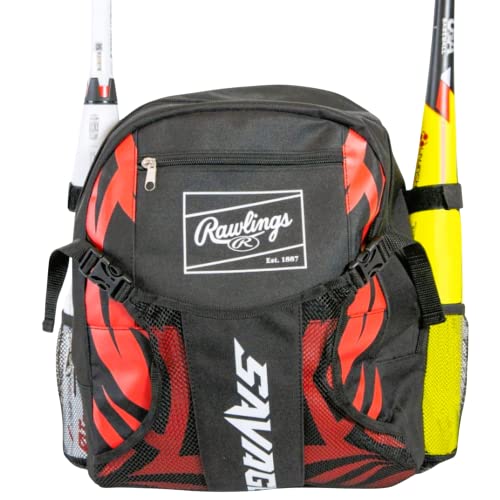
The Savage is a medium-size youth pack built for T-ball and young players who are serious about keeping gear organized on game day. Neoprene bat sleeves grip two bats, an external front pocket holds the helmet where it cannot crush the glove, and the large main compartment with dual zippers swallows the rest of the kit. Padded shoulder straps and a back panel keep the carry comfortable for small frames, and the integrated fence hook keeps the bag out of the dirt. At 16 inches tall it fits young backs without dragging, yet it still handles travel ball and fastpitch league play.
Specs
- Neoprene bat sleeves hold two bats
- External front pocket holds a helmet
- Large main compartment with dual zippers
- Padded shoulder straps and back panel
- Integrated fence hook
- Dimensions: 16 in x 12 in x 6 in
- 4 compartments; polyester blend; adjustable straps
Best for: T-ball and youth players who need a right-size pack for a growing kit.
Watch out for: The compact frame fills fast once a player carries extra gear beyond the basics.
Easton E100G Team Equipment Duffle
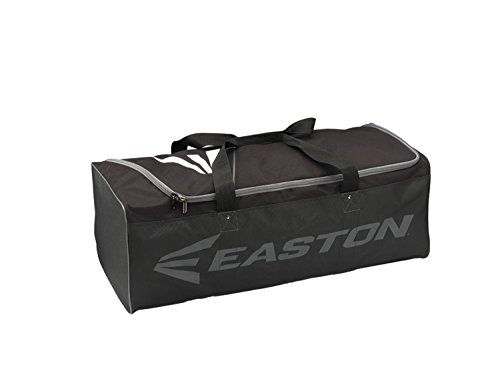
The E100G is the big duffle for coaches and teams, a 38-inch cavern built to swallow two full sets of catcher’s gear or a pile of helmets with room left over. Diamond-embossed hex ripstop polyester stands up to season after season of rough handling, lockable zippers guard the load, and reinforced straps spread the weight when the bag is carried. A large U-shaped zipper opening makes loading simple, even with bulky gear, and the single huge compartment takes oversized bats without a fight. It is heavy when full, so it suits car travel more than a long walk.
Specs
- 38 in L x 14 in W x 14 in H
- Fits two full sets of catcher’s gear
- Diamond-embossed T420D hex ripstop 600D polyester
- Lockable zippers
- Reinforced carry straps
- Large U-shaped zipper opening
- Weight: 3.3 lb; model A159009BK
Best for: Coaches and teams hauling a full kit or two sets of catcher’s gear.
Watch out for: Bulky when empty and heavy when full, so it suits car travel best.
Easton Moxie Backpack

The Moxie is Easton’s entry youth backpack, the right first bag for a T-ball or early rec player who needs to carry a light kit on a small frame. A large interior pocket holds the glove, an adjustable external gear pouch takes the helmet, a valuables pocket guards small items, and two side sleeves hold bats or water bottles. The compact size and five compartments keep a young player’s gear sorted without the weight of a full-size pack, and the bright sublimated graphics help a child spot their own bag in a crowded dugout. It is a light-kit bag, not a travel-ball hauler.
Specs
- Designed for T-ball, rec, and travel players
- Large interior pocket for a glove
- Adjustable external gear pouch for a helmet
- Valuables pocket for small items
- 2 side sleeves for bats or water bottles
- 5 compartments; zipper closure; adjustable straps
- One size; soft shell; multiple colorways
Best for: Young players who need a light, easy-to-carry first bag.
Watch out for: Light kit only — a player with three bats and full travel gear will outgrow it fast.
Easton GAME READY Backpack
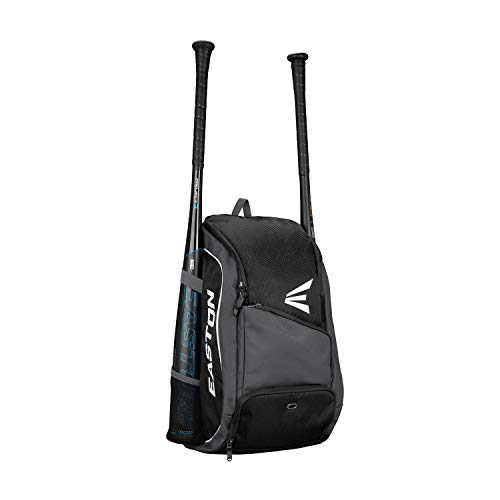
The Game Ready is Easton’s adult-size player pack, built for intermediate baseball and fastpitch players who carry a serious kit. A vented main compartment fits a helmet and a glove, a separate vented shoe compartment keeps cleats apart from the rest, and two mesh side pockets hold bats or water bottles. A front utility pocket takes personal items, padded straps ease the carry, and a fence hook keeps the bag off the dugout floor. At 20.5 inches long it is a full-size pack, so it suits older players better than small children.
Specs
- Adult size; 20.5 in long
- Vented main compartment fits a helmet and a glove
- Separate vented shoe compartment
- 2 mesh side pockets for bats or water bottles
- Front utility pocket for personal items
- Padded back and shoulder straps
- Fence hook; 600D polyester; zipper closure
Best for: Adult and intermediate players who carry a full kit to every game.
Watch out for: Full-size frame may overwhelm a small child; measure before buying.
Which One Fits Your Situation
A young player in a first season
Pick the Moxie or the Savage. Both fit a small frame, hold a helmet and a glove, and carry one or two bats without dragging on the ground. The Moxie costs less and comes in bright colors a child can spot, while the Savage adds a fence hook and a more organized layout. Either bag lets a young player carry their own gear, which builds good habits from the first practice.
A travel player with a full kit
Pick the Dugout or the Game Ready. The Dugout suits youth travel players with two bats and a standard kit, while the Game Ready suits older players who need an adult frame and a separate shoe compartment. Both hold a helmet, a glove, and cleats with room to spare. If the player carries four bats, look for a pack with four sleeves or add a duffle for the extra bats.
A coach hauling team gear
Pick the E100G duffle. Its 38-inch cavern swallows two full sets of catcher’s gear, a pile of helmets, or a team’s worth of bats, and the reinforced straps and lockable zippers handle the weight. Pack it in the car rather than carrying it far, and use backpacks for individual players so the coach is not the only one hauling gear. One duffle plus five backpacks covers a whole team.
An adult rec player
Pick the Game Ready. Its adult frame fits a full-size helmet and glove without squeezing, the vented compartments keep the kit fresh between games, and the fence hook earns its keep in every dugout. The Dugout also works if the player prefers a slightly smaller pack. Skip the youth bags — a small frame will crowd an adult kit and wear out fast.
Common Mistakes
- Buying an adult-size pack for a small child — the bag drags, the straps slip, and the child stops wanting to carry it.
- Counting only bats and forgetting the helmet — a helmet needs its own pocket or it crushes the glove.
- Tossing cleats in with the glove and jersey — mud and odor spread through the whole bag.
- Skipping the fence hook — a bag on wet dugout ground soaks up water and dirt.
- Choosing a duffle for a player who walks to the field — a backpack carries far better on a back than a duffle on a shoulder.
Frequently Asked Questions
How many bats should a baseball gear bag hold?
Two bats cover most youth and rec players: a game bat and a backup. Travel players often carry three or four, so they need a pack with four sleeves or a roomy duffle for the extras. Count the bats carried on a tournament weekend, not every bat owned, and keep one sleeve free for a water bottle on hot days.
Can one bag hold a helmet, a glove, and cleats?
Yes, when the bag is a full-kit design with separate homes for each item. Look for a main compartment that fits the helmet and glove, plus a vented shoe compartment for cleats. The five bags in this guide all meet that bar. A bat-only bag will not — it holds bats and little else, so a player ends up carrying a second bag for the rest.
What is the difference between a bat bag and a gear bag?
A bat bag carries bats and little else, while a gear bag carries the whole kit: bats, a helmet, a glove, cleats, and personal items. Gear bags add a helmet pocket, a vented shoe compartment, and a front pocket for valuables. Players who walk to the field with one bag want a gear bag; a bat bag suits a player who already carries a separate kit bag.
How do I keep a baseball gear bag fresh between games?
Empty the bag after every game, shake out dirt, and let cleats dry outside the bag before packing them away. Leave the main compartment open overnight so air moves through it, and wipe the inside with a damp cloth when mud builds up. A vented shoe compartment helps a lot, but even the best vents cannot save a bag that stays zipped shut with wet gear inside.
FAQ
How many bats should a baseball gear bag hold?
Can one bag hold a helmet, a glove, and cleats?
What is the difference between a bat bag and a gear bag?
How do I keep a baseball gear bag fresh between games?
More from Amazon
Programs that pair well with the guide above. Offers and eligibility are set by Amazon and may change.
Free shipping on eligible items, Prime Video and more. Eligible new members can start with a free trial.
Start a Prime free trialAudiobooks and podcasts to listen to on the go. Eligible new members can start with a free trial.
Try Audible freeAd-free music streaming. Eligible new subscribers can start with a free trial.
Try Music Unlimited freeA free business account with business pricing and bulk-buying tools for work, shop or home office.
Create a business accountAs an Amazon Associate we earn from qualifying purchases.
Write Your Review
No reviews yet. Be the first to share your experience!