
Key takeaways
- Find the best blackout curtains for bedrooms and living rooms. Compare five room-darkening panels on fabric, fit, header style, and light blocking.
The best blackout curtains block most incoming light, add privacy at night, and help a room feel cooler in summer and warmer in winter, all while looking like ordinary drapes. The strongest all-around choice is a pair of heavy, triple-layer polyester panels with a grommet top, sized at least one and a half times the width of the window, and hung high and wide so the fabric covers the edges where light leaks in. That combination works in bedrooms, living rooms, nurseries, and home offices alike, and it is the standard the five panels below are judged against.
As an Amazon Associate, we earn from qualifying purchases.
Blackout curtains earn their name from the way they are built. A true blackout panel uses a dense weave, a foam or triple-layer backing, or a heavy multi-layer construction that stops most light from passing through the fabric itself. Room-darkening curtains sit one step below: they cut a large share of daylight but let a soft glow through, which suits living rooms and dining rooms where total darkness is not the goal. Thermal curtains overlap with both categories, adding an insulating layer that slows heat transfer through the window. Many panels on this list do all three jobs at once, which is why the same curtain can serve a bedroom at night and a bright living room during the day.
Choosing well comes down to four decisions made before ordering: the size of the panel, the header style that fits the rod already on the wall, the weight and layering of the fabric, and the color. Darker colors block a little more light than pale ones in the same fabric, while heavier triple-layer panels block more than thin single-layer ones. Length matters too. Panels that just cover the glass look neat, but panels that run from a rod mounted near the ceiling down to the floor block more light at the top and bottom edges and make the window look larger. This guide covers all of those decisions, then compares five panels that cover the most common rooms, window sizes, and budgets.
Table of Contents
- Why Blackout Curtains Work
- Nicetown Grey Blackout Curtains
- Deconovo Blackout Curtain Panel
- RYB Home Soundproof Blackout Curtains
- BGment Navy Blue Blackout Curtains
- H.Versailtex Blackout Curtains
- How to Choose Blackout Curtains
- Measuring and Hanging for the Best Light Block
- Care and Common Mistakes
- Frequently Asked Questions
- Conclusion
- Product and ASIN Reference
Why Blackout Curtains Work
A window is the weakest point in a room for both light and temperature. Glass lets in sunlight and lets heat escape, and a bare window offers no privacy after dark. A blackout curtain addresses all three problems with fabric alone. The dense weave or layered backing stops most light at the fabric surface, the extra weight and trapped air between layers slow heat moving through the window, and the opaque panel closes off the view into the room. None of that requires special hardware. A standard curtain rod, a few minutes of hanging, and panels sized with enough extra width are all it takes.
The difference between a good blackout curtain and a disappointing one usually shows up at the edges, not in the middle of the panel. Light leaks around the sides, over the top, and under the hem when a panel is too narrow, too short, or hung on a rod that sits tight against the wall. That is why width matters more than most shoppers expect. A panel that measures one and a half to two times the width of the window gathers into soft folds when drawn, and those folds close the gaps at the sides. A rod mounted several inches above the window frame and extending past the frame on both sides gives the fabric somewhere to sit beyond the glass, which seals the top and side gaps. A panel that reaches the floor, or pools slightly on it, closes the gap at the bottom. Get those three details right and even a mid-weight panel can darken a room dramatically.
Fabric weight is the second factor. Single-layer panels rely on a tight weave and a coating to block light, and they tend to be lighter and easier to wash. Triple-layer panels sandwich a dark inner layer between two face fabrics, which blocks more light and adds insulation and a softening of outside sound. The trade-off is weight and bulk: triple-layer panels are heavier on the rod and take longer to dry after washing. For a bedroom where sleep quality is the priority, the heavier build is usually worth it. For a living room where the curtains open and close every day, a lighter panel that slides easily on the rod may be the better daily companion.
Header style is the third factor, and it is the one most often overlooked until the curtains arrive. Grommet tops thread directly onto the rod through metal rings, slide smoothly, and form even folds, which makes them the easiest choice for curtains that move daily. Rod-pocket tops slide the rod through a sewn channel, giving a gathered, traditional look that suits bedrooms and formal living rooms, but they move less freely. Back-tab tops loop fabric tabs over the rod for a tailored, pleated appearance. Each style works with a standard rod, so the choice is mostly about how the curtain should look and how often it will be drawn.
Color is the fourth factor, and it interacts with light blocking in a simple way: in the same fabric, a dark color blocks slightly more light than a pale one, because less light reflects through the weave. That does not mean pale blackout curtains fail. A well-made white or cream triple-layer panel still blocks most light, and it keeps a bright room feeling airy during the day. The right choice is the color that suits the room, with the understanding that a navy or charcoal panel in the same line will darken a bedroom a touch more than an ivory one.
The five panels below cover the full range of those decisions. There is a single-panel budget option for one small window, two-panel sets in standard and extra-long lengths, a heavy three-layer set for tall windows and noise, and a back-tab option for a more tailored look. All five are machine washable, all five hang on a standard rod, and all five are built around the same idea: dense, layered fabric that blocks most light while looking like a normal curtain.
Nicetown Grey Blackout Curtains

Nicetown has built its name on straightforward blackout panels that do the core job well: block light, add privacy, and hang neatly without fuss. This grey set is the most versatile pick in the roundup, a mid-range two-panel set in the most commonly ordered size, with a grommet top that slides easily and a soft, heavy fabric that falls in even folds. Grey is a practical color choice too. It is dark enough to help with light blocking, neutral enough to sit beside almost any wall color or sofa, and forgiving about dust and everyday marks. For a first set of blackout curtains, or a replacement for tired panels in a bedroom or living room, this is the set to start with.
Each panel measures 52 inches wide by 84 inches long, which is the standard full-length size for a typical window. Two panels together give 104 inches of fabric width, enough to cover a window up to about 60 inches wide with the fullness needed for proper folds. The 84-inch length suits a rod mounted above a standard window with the hem reaching the floor, or a rod mounted high with the hem just brushing the floor. The silver grommets have an inner diameter of 1.6 inches, so they fit most standard curtain rods and slide without catching.
The fabric is a heavy, soft blackout material with the same color on both sides, so the panels look finished from inside the room and from the street. The listing describes the panels as blocking most light, with thermal insulation, sound-softening weight, and energy-efficient performance. The edges are thread-trimmed and the fabric is described as wrinkle-free, which matters for panels that hang in a living room where they are on display all day. In practice, that means the curtains arrive looking presentable with little steaming or ironing, and they keep their shape between washes.
Care is simple, which is one of the reasons this set suits daily use. The panels are machine washable in cool water with a mild detergent, with no bleach, and they can be ironed at a low temperature. That makes them practical for bedrooms, where curtains collect dust, and for homes with pets or children, where washability is not optional. The grey colorway also pairs well with sheer voile panels sold by the same brand, for anyone who wants a layered look with a sheer panel underneath for daytime privacy and the blackout panel on top for night.
Where this set fits best is a main bedroom or a living room with a standard window. It is heavy enough to darken a bedroom for sleep, light enough on the rod to open and close every day, and neutral enough to work with existing furniture. The one limitation is length: at 84 inches, it suits standard windows but not extra-tall windows or rooms with high ceilings, where a 108-inch panel is the better choice. For those rooms, the RYB Home set below covers the taller size. For everyone else, this is the balanced, mid-range pick that does everything well without asking for special hardware or special care.
Specs
- Brand: Nicetown
- Color: Grey
- Size per panel: 52 x 84 inches
- Panels included: 2
- Header: Grommet top, silver grommets with 1.6 inch inner diameter
- Fabric: Heavy, soft blackout fabric, same color on both sides
- Light blocking: Blocks most light, room darkening
- Insulation: Thermal insulated, energy-efficient
- Sound: Heavy fabric helps soften outside noise
- Care: Machine washable in cool water, mild detergent, no bleach, low-temperature ironing
- Value group: Mid-range
Deconovo Blackout Curtain Panel
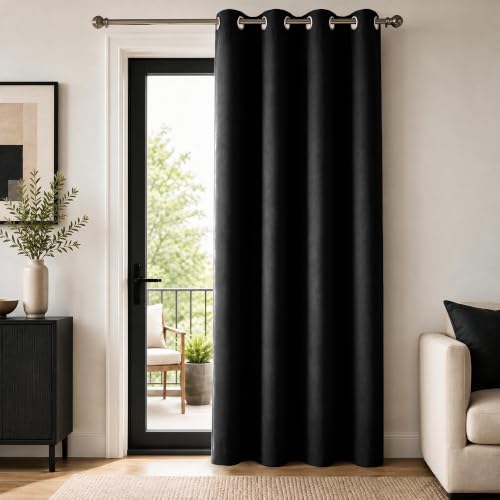
Deconovo takes the opposite approach to the Nicetown set: a single panel, sold on its own, for one window or for a narrow opening where a full pair would be too much fabric. That makes it the budget pick of the roundup, and the most flexible one for odd situations. A single panel suits a small bedroom window, a kitchen window, a nursery window, or a door window where one panel is all the space allows. It also suits anyone who wants to try a blackout curtain in one room before committing to a full set, or who needs to replace a single damaged panel rather than a whole pair.
The panel measures 42 inches wide by 84 inches long, in black, with a solid grommet top. The 42-inch width is narrower than the 52-inch standard, which is exactly right for a single-panel job: it covers a window up to about 28 inches wide with enough fullness for folds, and it does not overwhelm a small room with excess fabric. The 84-inch length matches the standard full-length size, so it hangs from a rod above a normal window down to the floor. The grommet top threads onto a standard rod and slides smoothly, so the panel opens and closes with one hand.
The fabric is a thermal insulated blackout material, described as energy-saving and machine washable, with a room-darkening effect. Black is the strongest color choice for light blocking in any fabric, because it absorbs light rather than reflecting it through the weave, so this panel darkens a room more than a pale panel of the same weight. That makes it a strong choice for a bedroom, a nursery where daytime naps matter, or a home office where screen glare is a problem. The single-panel format also makes it easy to pair with a second panel later: order two singles for a wider window, or one single alongside an existing curtain for a layered look.
The trade-off for the lower cost and the single-panel format is coverage. One 42-inch panel will not cover a wide living room window on its own, and anyone with a window wider than about 30 inches should plan on two singles or a two-panel set instead. The panel is also a single color and a single size in this listing, so shoppers who want a matched pair in a different width should look at the two-panel sets in this guide. Within its lane, though, this is the simplest and most affordable way to get a true blackout panel onto a window, and the machine-washable fabric keeps it practical for nurseries and children’s rooms where curtains get handled often.
This panel is the right pick for a small window, a first blackout curtain, a nursery, or a room where only one panel is needed. It is also the right pick for a renter who wants better sleep without replacing every curtain in the home. Hang it high and wide, let the fabric gather into folds, and a single panel can darken a small room surprisingly well.
Specs
- Brand: Deconovo
- Color: Black
- Size: 42 x 84 inches
- Panels included: 1
- Header: Solid grommet top
- Fabric: Thermal insulated blackout fabric
- Light blocking: Room darkening, blocks most light
- Insulation: Thermal insulated, energy-saving
- Care: Machine washable
- Value group: Budget
RYB Home Soundproof Blackout Curtains

RYB Home builds its blackout curtains for the hardest jobs: tall windows, street-facing rooms, and spaces where outside noise is as much a problem as outside light. This set is the premium pick in the roundup, and the difference is in the construction. Each panel uses three layers of fabric, which blocks more light than a single-layer panel, adds insulation against heat and cold, and gives the curtain enough weight to soften outside sound. The set is also the longest in the roundup, which makes it the right choice for high ceilings, tall windows, and patio doors.
Each panel measures 52 inches wide by 108 inches long, and the set includes two panels. That 108-inch length is the key detail. It suits windows that run nearly floor to ceiling, rooms with high ceilings where an 84-inch panel would stop well short of the floor, and sliding doors where the curtain needs to cover the full height of the opening. Two panels give 104 inches of total width, enough for a wide window or a door with the fullness needed for proper folds. The pure white colorway keeps a tall room feeling bright during the day, even though the panels are heavy and fully lined in effect by their triple-layer build.
The header is a grommet top, with the rings set into the heavy fabric so the panels slide on a standard rod despite their weight. The listing describes the set as a three-in-one combination of soundproofing, blackout, and thermal insulation, with three layers of heavy fabric. That weight is the point: heavier curtains hang straighter, fold more evenly, and block more light at the edges, because the fabric does not billow away from the wall. In a street-facing bedroom or a living room beside a busy road, that weight is doing two jobs at once, darkening the room and softening the sound from outside.
The trade-off is that heavier panels demand a sturdier rod and brackets, and they are more work to take down and wash than a light single-layer panel. A standard rod with solid brackets handles them well, but a thin tension rod will not. The white color also shows dust more readily than a dark color, so these panels need washing a little more often in a busy home. Those are fair costs for the coverage and the performance, and they are the reason this set sits in the premium group rather than the mid-range.
Where this set fits best is a tall window, a high-ceiling living room, a patio door, or a street-facing bedroom where noise and light arrive together. It is also the right pick for a home theater room, where total darkness matters and the heavy fabric helps with sound. For a standard window, the extra length would pool on the floor, so measure first: if the distance from rod to floor is under 96 inches, choose an 84-inch panel instead. If it is 96 inches or more, this is the set that actually reaches the floor.
Specs
- Brand: RYB Home
- Color: Pure White
- Size per panel: 52 x 108 inches
- Panels included: 2
- Header: Grommet top
- Fabric: Three-layer heavy blackout fabric
- Light blocking: Blackout, blocks most light
- Insulation: Thermal insulating, three-in-one blackout, thermal, and sound-softening build
- Sound: Heavy triple-layer fabric helps soften outside noise
- Care: Machine washable
- Value group: Premium
BGment Navy Blue Blackout Curtains
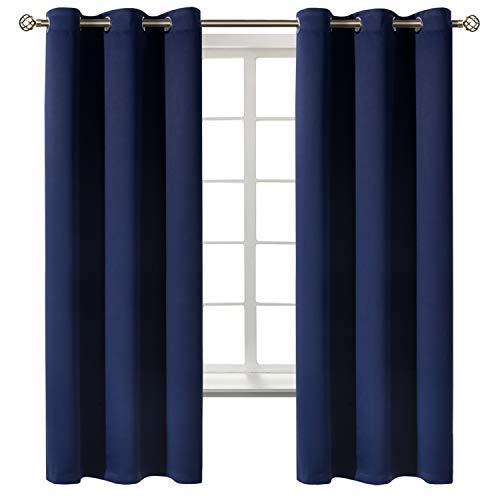
BGment is the pick for anyone who wants the strongest light blocking in a standard size, at a budget-friendly position. The secret is the color. Navy blue is one of the darkest curtain colors available, and in the same triple-layer fabric it blocks more light than a pale color, because the dark fabric absorbs light instead of letting it glow through. Paired with a 63-inch length, this set also suits a window that does not need a full-length panel, such as a short bedroom window, a kitchen window, or a window with a radiator or furniture beneath it.
Each panel measures 42 inches wide by 63 inches long, and the set includes two panels. The 63-inch length is the practical choice for windows where an 84-inch panel would bunch on a sill, a heater, or a piece of furniture. It is long enough to cover the glass fully and hang neatly, and short enough to stay clear of what sits below the window. Two panels give 84 inches of total width, enough for a window up to about 55 inches wide with good fullness. The navy color is solid on both sides, with no chemical smell noted in the listing, and it is described as safe for a kids room and nursery.
The fabric is 100 percent polyester in a triple-layer construction, with six silver metal grommets per panel and a 1.6 inch inner diameter that fits most standard rods. The listing describes the panels as blocking most harsh sunlight for deeper sleep and restful afternoon naps, with the navy shade offering stronger darkening performance than lighter colors in the same line. The triple-layer fabric also helps balance room temperature against summer heat and winter chill, reduces outside noise, and adds privacy. The grommet top slides smoothly and the panels are described as wrinkle-free and ready to use, so they look neat straight out of the package.
Care is straightforward: machine washable in cold water on a gentle cycle, tumble dry low, warm iron if needed, and no bleach. That makes the set practical for a nursery or a kids room, where curtains are touched often and washed more than most. The navy color hides dust and marks better than a white panel, which helps between washes. The shorter length also makes the panels easier to handle on wash day than a full-length pair, since there is less fabric to lift and fold.
The limitation is the length. At 63 inches, this set will not reach the floor on a standard window, so it is not the right choice for a formal living room where floor-length curtains are part of the look. It is the right choice for a bedroom with a short window, a nursery, a kids room, or any window where the sill or the furniture below rules out a longer panel. For a small or mid-size window where darkness matters most, this is the strongest light-blocking set in the roundup for its size, and the navy color is the reason why.
Specs
- Brand: BGment
- Color: Navy Blue
- Size per panel: 42 x 63 inches
- Panels included: 2
- Header: Grommet top, 6 silver metal grommets per panel, 1.6 inch inner diameter
- Fabric: 100 percent polyester, triple-layer fabric, solid navy on both sides
- Light blocking: Room darkening, blocks most harsh sunlight, navy shade darkens more than lighter colors
- Insulation: Thermal insulated, triple-layer fabric helps balance room temperature
- Sound: Reduces outside noise
- Care: Machine washable in cold water on gentle cycle, tumble dry low, warm iron if needed, no bleach
- Value group: Budget
H.Versailtex Blackout Curtains

H.Versailtex offers the most tailored look in the roundup, and it does so with a header style the other panels do not use. Instead of grommets, these panels hang from back tabs and a rod pocket, which creates soft, structured pleats and a more formal appearance. That makes them the right pick for a living room or a main bedroom where the curtains are part of the decor all day, not just a tool for blocking light at night. The ivory and cream colorway adds to that effect, keeping the room bright and warm while the panels are drawn during the day.
Each panel measures 52 inches wide by 84 inches long, and the set includes two panels. That is the standard full-length size, giving 104 inches of total width for a window up to about 60 inches wide with proper fullness, and a length that runs from a rod above a normal window down to the floor. The back-tab and rod-pocket header gives two hanging options from the same panel: thread the rod through the pocket for a gathered look, or use the back tabs for a pleated, tailored fall. Both options work on a standard rod, and the choice is about appearance rather than hardware.
The fabric is a thermal insulated blackout material with a room-darkening effect, built as a window treatment panel that suits living rooms, bedrooms, and other main rooms. The ivory and cream color is the palest in the roundup, and it is worth understanding what that means. A pale panel in a well-made blackout fabric still blocks most light, because the blocking comes from the dense weave and the insulating layer, not from the color alone. The difference is at the margin: a dark panel in the same fabric blocks a little more. What the pale color gives back is a brighter room during the day, a softer look against light walls, and a curtain that reads as decor rather than as a blackout tool.
The trade-off for the tailored header is movement. Back-tab and rod-pocket panels do not slide as freely as grommet panels, so they suit rooms where the curtains stay in one position most of the time, or move once in the morning and once at night. They are less suited to a room where the curtains are pulled back and forth many times a day, such as a living room with a television where glare changes through the afternoon. For those rooms, a grommet-top panel is the easier daily choice. For a bedroom or a formal living room where the curtains are set and left, the tailored fall is worth the slower slide.
This set is the right pick for a living room or a main bedroom where appearance matters as much as light blocking, and for anyone who prefers the look of pleats over the look of metal rings. Hang the rod high and wide, let the panels fall in their pleats to the floor, and the room gains both darkness at night and a finished, tailored look during the day.
Specs
- Brand: H.Versailtex
- Color: Ivory and Cream
- Size per panel: 52 x 84 inches
- Panels included: 2
- Header: Back tab and rod pocket
- Fabric: Thermal insulated blackout fabric
- Light blocking: Room darkening, blocks most light
- Insulation: Thermal insulated
- Care: Machine washable
- Value group: Mid-range
How to Choose Blackout Curtains
Start with the window, not the curtain. Measure the width of the window frame, then measure from the planned rod position down to the floor or to the sill. The rod should sit four to six inches above the frame and extend three to six inches past the frame on each side. That placement is what lets the curtain cover the glass plus the gaps around it. Once those two numbers are known, the panel size follows: total panel width should be one and a half to two times the window width, and the panel length should match the distance from rod to floor for full-length curtains, or rod to sill for shorter ones.
Next, decide how dark the room needs to be. A bedroom, a nursery, or a home theater needs a true blackout panel in a dark color and a heavy triple-layer build. A living room or a dining room usually needs a room-darkening panel, where a soft glow during the day is acceptable and the priority is glare control and privacy. A home office needs enough darkening to cut screen glare without making the room feel closed in during the day. Match the fabric weight and the color to that need, and do not pay for a heavier build than the room requires.
Then choose the header style by how the curtains will be used. Grommet tops are the easiest choice for curtains that move daily, because the metal rings slide freely and form even folds. Rod-pocket tops suit a gathered, traditional look in a room where the curtains move rarely. Back-tab tops suit a tailored, pleated look in a formal room. All three hang on a standard rod, so the decision is about daily use and appearance, not about buying new hardware.
Then consider the fabric and the care. Polyester is the most common blackout fabric because it holds its shape, resists wrinkles, and washes well. Triple-layer polyester blocks more light and insulates better than a single layer, but it is heavier and takes longer to dry. Check the care label before ordering: machine-washable panels are far more practical in bedrooms, nurseries, and homes with pets than panels that need special cleaning. If the curtains will hang in a kitchen or a kids room, washability should be a requirement, not a preference.
Finally, think about the room as a whole. Curtains are one of the largest fabric surfaces in a room, so their color sets the tone. A dark panel makes a room feel smaller and more enclosed, which suits a bedroom. A pale panel keeps a room feeling open, which suits a living room. A neutral grey, ivory, or cream panel is the safest choice when the wall color or the furniture may change, while a navy or black panel is the strongest choice when darkness is the priority. Order the color that suits the room first, and let the fabric weight do the light-blocking work.
Measuring and Hanging for the Best Light Block
Good blackout curtains can still disappoint if they are hung badly, because most light leaks in around the edges rather than through the fabric. The fix is in the mounting, and it takes only a few measurements and a little extra width. Mount the rod high, mount it wide, and let the fabric overlap the frame on every side. Those three steps close the gaps where light gets in.
Mount the rod four to six inches above the top of the window frame. That extra height does two things: it hides the gap above the frame where light spills over the top of the curtain, and it makes the window look taller. If the ceiling is close to the frame, mount the rod as high as the space allows, even if that is only two or three inches above the frame. Every inch of extra coverage at the top helps.
Extend the rod three to six inches past the frame on each side. That extra width gives the fabric somewhere to sit beyond the glass when the curtains are drawn, which closes the side gaps. It also lets the curtains stack clear of the glass when they are open, so the full window is visible during the day. A rod that ends exactly at the frame leaves the curtain edges sitting on the glass, and light leaks past them.
Choose a length that reaches the floor for full-length curtains, or the sill for short curtains. A panel that stops an inch short of the floor leaves a bright line of light at the bottom, which is often the most noticeable leak in a dark room. A panel that just brushes the floor, or pools slightly on it, closes that gap. For a short panel, the hem should sit just below the sill, not above it, for the same reason.
Check the rod and brackets before hanging a heavy set. Triple-layer panels are heavier than single-layer ones, and a long rod with a heavy pair needs solid brackets screwed into the wall or into a stud. A rod that sags in the middle leaves a gap at the top of the window and makes the curtains hard to draw. If the rod is longer than about 60 inches, a center support bracket is worth adding. Test the draw before the room is dark: close the curtains in daylight and look for bright lines at the top, sides, and bottom, then adjust the rod position or add a panel until the lines disappear.
Care and Common Mistakes
The most common mistake is ordering panels that are too narrow. A pair of panels that exactly matches the window width will hang flat when drawn, with no folds and no overlap at the sides, and light will leak past the edges. The fix is to order panels whose combined width is at least one and a half times the window width. Folds are not decoration on a blackout curtain; they are part of how the curtain blocks light, because the overlapping layers at each fold add density where the fabric doubles over.
The second mistake is ordering the wrong length. A panel that is too short leaves a gap at the bottom, and a panel that is far too long pools heavily on the floor, collecting dust and making the room hard to clean. Measure from the rod to the floor before ordering, and choose the closest standard length at or just above that measurement. If the choice is between a panel an inch short and a panel a few inches long, choose the longer one and let it brush the floor.
The third mistake is choosing a pale single-layer panel for a bedroom and expecting total darkness. Pale colors and thin fabrics block a large share of light, but a bedroom needs a dark color and a heavy triple-layer build for the deepest darkness. If the room must be dark for sleep or for daytime naps, choose navy, charcoal, or black in a triple-layer fabric, hang the rod high and wide, and check for edge leaks in daylight.
The fourth mistake is forgetting the rod. A blackout curtain is only as good as the rod that holds it, and a heavy set on a weak rod will sag, gap, and slide badly. Use a sturdy rod with solid brackets, add a center support for a wide span, and make sure the grommets or tabs move freely before the curtains are needed at night. A curtain that is hard to draw is a curtain that stays open, and an open curtain blocks no light at all.
Care is simple for all five panels in this guide. Machine wash in cold water on a gentle cycle with a mild detergent, skip the bleach, tumble dry low or hang to dry, and iron at a low temperature if needed. Wash curtains a few times a year, or more often in a dusty room or a home with pets. Dust the tops of the panels and the rod between washes, since dust collects there first. With that routine, a good set of blackout curtains keeps its color, its shape, and its light-blocking performance for years.
Frequently Asked Questions
Do blackout curtains really block all light?
No curtain blocks every bit of light, because some light always finds its way around the edges. A well-made blackout panel blocks most light passing through the fabric itself, and the remaining light comes through gaps at the top, sides, and bottom. Hanging the rod high and wide, choosing panels with enough extra width for full folds, and letting the hem reach the floor closes most of those gaps, which is why mounting matters as much as fabric.
How wide should blackout curtains be?
Total panel width should be one and a half to two times the width of the window. A pair of 52-inch panels gives 104 inches of fabric, which suits a window up to about 60 inches wide. A narrower window needs less fabric, but the panels should still be wider than the window so they gather into folds when drawn. Flat, stretched-tight panels leak light at the edges and look thin.
Are blackout curtains safe around kids and pets?
Blackout curtains themselves are a safe window covering, and several panels in this guide are described as safe for a kids room or nursery. The safety issue with window coverings is usually cords, so choose cordless panels and keep any cords from blinds or shades out of reach. Machine-washable fabric is also worth choosing for a kids room, since curtains there get touched and washed more often.
Can blackout curtains help with heat and noise?
Yes, within limits. The same dense, layered fabric that blocks light also slows heat moving through the window, which helps a room stay cooler in summer and warmer in winter, and the extra weight helps soften outside noise. They do not replace insulation or soundproofing, but in a room with a bare window they make a noticeable difference, especially when the panels cover the frame fully and hang to the floor.
Conclusion
The best blackout curtains are the ones that fit the window, suit the room, and get used every day. For most homes, that means a two-panel set in a standard size with a grommet top, hung high and wide on a sturdy rod. The Nicetown grey set is the balanced mid-range choice for a bedroom or living room, the Deconovo single panel is the budget choice for a small window or a nursery, and the RYB Home triple-layer set is the premium choice for tall windows and street-facing rooms. The BGment navy set is the strongest light blocker in a short length, and the H.Versailtex set is the tailored choice for a formal room. Measure the window, choose the length and the color for the room, hang the rod high and wide, and check for light leaks in daylight. Get those steps right, and any of these five panels will darken the room, add privacy, and make the window look finished.
Product and ASIN Reference
| Product | ASIN |
|---|---|
| Nicetown Grey Blackout Curtains | B015SJ7RYY |
| Deconovo Blackout Curtain Panel | B016MB5MOE |
| RYB Home Soundproof Blackout Curtains | B08B419DCT |
| BGment Navy Blue Blackout Curtains | B07D6HCZTY |
| H.Versailtex Blackout Curtains | B01M9IZ0AT |
More from Amazon
Programs that pair well with the guide above. Offers and eligibility are set by Amazon and may change.
Free shipping on eligible items, Prime Video and more. Eligible new members can start with a free trial.
Start a Prime free trialAudiobooks and podcasts to listen to on the go. Eligible new members can start with a free trial.
Try Audible freeAd-free music streaming. Eligible new subscribers can start with a free trial.
Try Music Unlimited freeA free business account with business pricing and bulk-buying tools for work, shop or home office.
Create a business accountAs an Amazon Associate we earn from qualifying purchases.





Write Your Review
No reviews yet. Be the first to share your experience!