
Key takeaways
- Five minimalist potato mashers compared, from a smooth stainless plate to a twist-action ricer, with notes on texture, storage, and easy cleanup.
A potato masher is a single-purpose tool, and that is exactly why it suits a minimalist kitchen when it is chosen well. The wrong one bends at the neck, rusts at the joints, traps mash in corners that never quite wash clean, and takes up drawer space out of proportion to the one job it does. The right one is a single piece of honest material, shaped for the texture you actually like, and it disappears into a drawer or onto a hook without complaint.
This guide compares five mashers that cover the main designs worth owning: a flat stainless plate for smooth results, a classic wire head for rustic texture, a wheat-straw-handled steel masher that cuts virgin plastic, a twist-action ricer for purée-level smoothness, and a heat-resistant nylon five-blade masher that is safe on nonstick and doubles as a pan chopper. Each is one simple tool with no batteries, no attachments, and nothing to assemble.
As an Amazon Associate, we earn from qualifying purchases.
Quick answer
For most kitchens, the OXO Good Grips Smooth Potato Masher is the calm default: one stainless plate, one cushioned horizontal handle, and reliably smooth results. Choose the KitchenAid wire masher for chunkier, rustic mash, the Joseph Joseph Helix for ricer-smooth purée, and the Farberware nylon masher if your potatoes cook in nonstick pans.
OXO Good Grips Smooth Potato Masher

The OXO Smooth masher replaces the traditional wire tangle with a single flat stainless steel plate pierced with fine holes. You press straight down with the horizontal handle, and the potato is forced through the plate in one motion, which produces an even, fine texture without the lumps a wire head leaves behind. The broad plate also covers more of the pot per press, so a batch takes fewer passes and less repositioning.
The horizontal handle is the design detail that matters. It sits above the plate like a knob, so your hand pushes down with the palm rather than gripping a vertical stick, and the cushioned grip absorbs pressure when you work through a large pot of russets. Because the plate is one smooth piece of stainless steel, there are no wire junctions for mash to lodge in, and the whole tool rinses clean or goes in the dishwasher.
At roughly ten inches long it stores flat in a drawer or hangs from the hole in the handle. The tradeoff is texture: a plate masher makes smooth mash, full stop. If your household prefers skins-in, deliberately lumpy potatoes, a wire design below will suit you better. For everyone else, this is the benchmark single masher.
KitchenAid Gourmet Stainless Steel Wire Masher
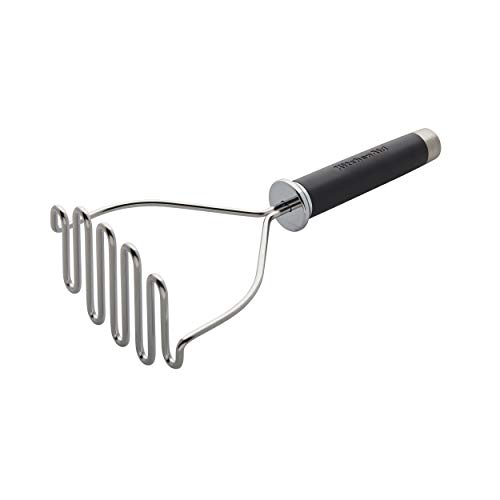
The KitchenAid Gourmet masher keeps the oldest design in this guide: a head of thick stainless steel wire, bent into a broad zigzag, on a straight handle. Wire mashers leave a rustic, slightly uneven texture that many people consider the point of homemade mash, and the open wire head works through butter and warm milk without pushing everything to the sides of the bowl the way a flat plate can.
The wire itself is substantial at 4.5 millimeters, so the head does not flex or splay when you lean on a firm potato, and the stainless construction resists rust across years of dishwasher cycles. The matte handle is finished with a chrome-plated bolster and a stainless end cap, which keeps the look quiet and gives the tool a balanced, weighty feel at just over ten inches long.
Wire heads do ask a little more of cleanup: mash can cling between the wires if it dries on, so a quick rinse right after serving is the habit to build. In exchange you get the most forgiving masher here for undercooked potatoes, because the wire cuts through firm pieces instead of skating over them. KitchenAid also states a limited warranty for this line, which is unusual at this level of kitchen tool.
Zyliss Stainless Steel Potato Masher

The Zyliss masher pairs a stainless steel mashing head with a handle made partly from wheat straw composite, a material choice that reduces the virgin plastic in the tool by about half. For a minimalist kitchen that also tries to buy less plastic, that is a meaningful detail in an object you will keep for a decade.
The head is a rounded grid plate that produces a smooth, even mash, and the handle has a soft-touch finish that stays comfortable through a full pot. The proportions are slightly longer than the OXO, which helps in deep stockpots, and the whole masher is dishwasher safe. Zyliss builds the head and handle as one clean unit with no crevices at the joint, so nothing ferments in a seam between washes.
One honest note: the grey wheat-straw version is the current listing for this design, and it has at times shown limited featured offers, so availability can be thinner than the bigger brands here. The masher itself is simple and well made; just be prepared for the listing to come and go. If it is in stock when you shop, it is the most considered material story in this roundup.
Joseph Joseph Helix Potato Ricer Masher

The Helix is the outlier here: it is a ricer disguised as a masher. You load cooked potato into the perforated stainless chamber, set the horizontal handle on top, and twist as you press. The twisting motion forces the potato through the fine holes in smooth strands, giving the fluffy, lump-free result that normally requires a separate countertop ricer with a lever and a hopper.
For a small kitchen, that two-in-one character is the argument. A traditional ricer is a bulky single-task object; the Helix is the size of a masher and hangs on a hook. The two-part design separates for washing, so the chamber does not trap residue, and the stainless and nylon construction goes in the dishwasher.
The tradeoffs are capacity and effort. The chamber holds a modest amount per load, so a very large batch means more cycles of fill, twist, and empty, and the twisting action asks more of wrists than a straight press does. Choose it when texture is the priority and batch sizes are moderate. For holiday-scale mashing, one of the open mashers above will be faster.
Farberware Heat Resistant Nylon Meat and Potato Masher

The Farberware masher takes a different shape again: five nylon blades radiating from a central handle, like a squat pinwheel. You press and rock it in the pot, and the blades cut and mash at the same time. Because the head is BPA-free nylon rated to 450 degrees Fahrenheit, it can work directly in a nonstick pan without scratching the coating, which none of the steel heads above should do.
That in-pan ability is why this tool earns its place in a minimalist drawer despite looking like a gadget. The same five blades break up ground meat as it browns, mix and chop in the pan, and mash soft vegetables, so one tool covers jobs that might otherwise argue for a separate meat chopper. A small tip-up foot lifts the head off the counter when you set it down mid-cooking, keeping the worktop cleaner.
The texture ceiling is lower than the steel mashers: nylon blades flex slightly, and the mash comes out soft and rustic rather than fine. It is also the least elegant object in this guide. But it is ten inches long, dishwasher safe, and genuinely multi-purpose, which is its own kind of minimalism.
How to choose
Start with texture, because it decides the design family. For smooth, even mash, pick a plate or a ricer: the OXO plate for simple pressing, the Joseph Joseph Helix when you want true purée. For rustic, chunkier results, pick an open design: the KitchenAid wire head or the Farberware five-blade.
Next, match the head to your cookware. Stainless steel heads are durable and efficient, but they should stay out of nonstick pans. If you mash in the pot your potatoes boiled in and that pot is coated, the Farberware nylon masher is the safe choice, or mash in a separate uncoated bowl with a steel tool.
Then consider the handle. Horizontal knob handles, like the OXO and the Helix, let you push with your palm and suit anyone who finds gripping and pressing at once uncomfortable. Straight handles, like the KitchenAid and Zyliss, give more reach in deep pots and hang neatly. Finally, think about storage: every tool here is a single piece around ten inches long that fits a drawer or a hook, which is the real minimalist test. If a masher needs a dedicated crock on the counter, it has failed it.
Who should skip
Skip this category entirely if you already own a sturdy ricer or a food mill and like the results; a masher would duplicate a tool you use happily. Skip the plate and ricer designs if your household genuinely prefers lumpy, skins-in mash, since no amount of technique will make them produce it. Skip the nylon Farberware if you mostly mash in stainless or cast iron and want the finest texture, because its flexing blades cannot match steel. And skip buying a second masher for a second home or a holiday cabin until you have lived with one design at home; texture preference is personal, and the cheapest minimalist move is learning which single style you actually reach for.
FAQ
Is a potato ricer better than a masher?
A ricer makes smoother, fluffier mash because it forces potato through fine holes in strands, but it is bulkier and slower for large batches. A masher is faster and stores smaller. The Joseph Joseph Helix splits the difference by putting a ricer action into a masher-sized tool.
Can I use a metal masher in a nonstick pot?
It is not a good idea. Steel heads can scratch and wear the coating over time. Either transfer the potatoes to an uncoated bowl before mashing with a metal tool, or choose a nylon masher like the Farberware, which is made to work directly in coated pans.
Which masher is easiest to clean?
Flat plate designs, like the OXO Smooth and the Zyliss, rinse clean fastest because mash has nowhere to hide. Wire heads need a rinse before anything dries between the wires. All five tools in this guide are dishwasher safe, including the two-part Helix, which separates for washing.
Do I need a masher if I have a stand mixer?
A mixer can overwork potatoes and turn them gluey if you are not careful, and it is a lot of machine to wash for a side dish. A hand masher gives you direct control over texture, takes seconds to rinse, and stores in a drawer. Most cooks who own both end up reaching for the masher.
Final verdict
One masher, chosen for the texture you love, is all a calm kitchen needs. The OXO Smooth is the default recommendation for its fine plate, palm-friendly handle, and effortless cleaning. The KitchenAid wire masher serves traditionalists who want rustic mash and a tool that shrugs off firm potatoes. The Zyliss adds a lighter material footprint, the Joseph Joseph Helix delivers ricer-level smoothness without ricer bulk, and the Farberware covers nonstick pans and ground meat with a single nylon tool. Pick by texture and cookware, and the drawer stays simple.
Product and ASIN Reference
| Product | ASIN |
|---|---|
| OXO Good Grips Smooth Potato Masher | B00004OCL9 |
| KitchenAid Gourmet Stainless Steel Wire Masher | B07TKMY2NW |
| Zyliss Stainless Steel Potato Masher | B0DBZ27N5Z |
| Joseph Joseph Helix Potato Ricer Masher | B01N7MJB0C |
| Farberware Heat Resistant Nylon Meat and Potato Masher | B07D15V7T3 |
FAQ
Is a potato ricer better than a masher?
Can I use a metal masher in a nonstick pot?
Which masher is easiest to clean?
Do I need a masher if I have a stand mixer?
More from Amazon
Programs that pair well with the guide above. Offers and eligibility are set by Amazon and may change.
Free shipping on eligible items, Prime Video and more. Eligible new members can start with a free trial.
Start a Prime free trialAudiobooks and podcasts to listen to on the go. Eligible new members can start with a free trial.
Try Audible freeAd-free music streaming. Eligible new subscribers can start with a free trial.
Try Music Unlimited freeA free business account with business pricing and bulk-buying tools for work, shop or home office.
Create a business accountAs an Amazon Associate we earn from qualifying purchases.



Write Your Review
No reviews yet. Be the first to share your experience!