
Key takeaways
- Learn how to choose a coat rack that fits your entryway, holds winter coats, and stays stable. Compare freestanding, wall-mounted, and hall tree styles.
The entryway sets the tone for the whole home, and nothing undermines it faster than a pile of coats on a chair. A good coat rack gives every jacket, hat, scarf, and bag a proper home, so the front door stays clear and the morning routine runs smoother. It is a small piece of furniture with an outsized effect on daily order.
Choosing one takes more thought than it first appears. Coat racks come as freestanding trees, wall-mounted rails, and full hall trees with benches and shoe storage, and each type suits a different space. A tall freestanding rack can crowd a narrow hallway, while a wall-mounted rail may not hold enough for a family of five. Weight capacity, stability, hook spacing, and wall strength all matter, and getting any of them wrong means coats on the floor.
As an Amazon Associate, we earn from qualifying purchases.
Quick answer
Measure the entryway first, then match the rack type to the space: freestanding trees suit open corners, wall-mounted rails suit narrow halls, and hall trees with benches suit busy family mudrooms. Check hook capacity and stability, anchor tall racks to the wall, and leave enough hook spacing so heavy winter coats do not crowd each other.
1. VASAGLE Coat Rack with Storage Shelf

The VASAGLE freestanding coat rack pairs eight hooks with a small storage shelf, making it a compact all-rounder for entryways that need more than hanging space. The shelf holds sunglasses, wallets, keys, and other small items that otherwise end up scattered across a console table, so the whole coming-and-going routine stays in one spot.
The rack stands 67.2 inches tall and is built from rubberwood and medium-density fiberboard in a natural beige finish. The warm, pale tone suits Scandinavian, modern, and farmhouse interiors alike, and the rounded hooks are designed to protect clothing from snags and scratches. Each hook holds up to 8.8 pounds, the shelf supports up to 22 pounds, and the overall load capacity is 92 pounds, which covers several heavy winter coats plus bags.
The wide base keeps the rack stable on flat floors, and the two-tier layout keeps frequently used items at hand height.
2. Umbra Picket Wall-Mounted Coat Rack

The Umbra Picket is the most design-led option in this guide, and the best pick for tight entryways where floor space is precious. It is a wall-mounted rail with five beveled pine wood pegs that flip down when needed and fold back flat when not in use. Folded away, it looks like a piece of wall art rather than a storage fixture.
Each peg supports up to 5 pounds, for a total capacity of 25 pounds, which is enough for a few everyday coats, bags, and hats. The rail measures about 15 inches wide, so it fits on a narrow stretch of wall beside a door, and mounting hardware is included. The natural pine finish brings warmth to plain walls, and several rails can be mounted side by side for a larger household.
This rack suits apartments, small foyers, and bedrooms where a freestanding tree would block the walkway.
3. VASAGLE Hall Tree with Shoe Bench

For busy family entryways, the VASAGLE hall tree combines four functions in one unit: a coat rack, a shoe bench, a shoe rack, and a hanging rod. Nine removable hooks in two rows hold coats, hats, and bags at heights that work for adults and children, and the bench gives everyone a place to sit while putting on shoes.
The unit measures 13.3 by 28.3 by 72.1 inches, in a rustic brown and black finish that suits farmhouse and industrial interiors. The bench supports up to 198 pounds, each hook holds up to 6.6 pounds, and the mesh shelves beneath the bench keep shoes off the floor. Anti-tip straps are included so the tree can be secured to the wall, and adjustable feet keep it level on slightly uneven floors.
It needs a wider wall than a simple rack, so measure first, but for a household with children, it replaces three separate pieces of furniture with one organized station.
4. ELYKEN Freestanding Coat Rack with Umbrella Holder
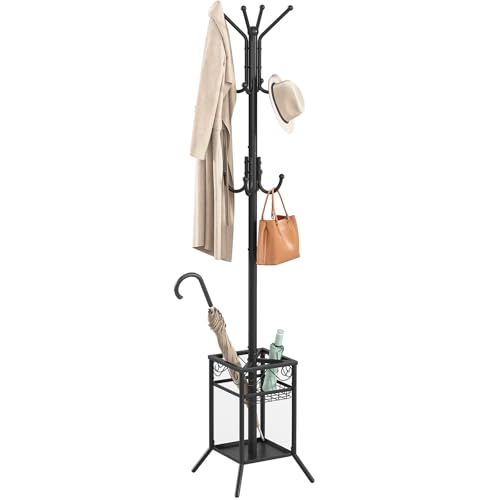
The ELYKEN freestanding rack is built for households that need maximum hanging capacity in a small footprint. Twelve hooks arranged in three tiers hold coats, scarves, hats, and bags at different heights, so children’s items can hang low while adult coats use the upper tiers. A built-in umbrella holder at the base keeps wet umbrellas off the floor and out of the way.
The rack is made from metal with a rust-resistant finish in classic black, and it measures 13.6 by 13.6 by 71.9 inches. Each hook holds up to 8.8 pounds, and the stable base is designed to handle the weight of several heavy coats without tipping. The slim square footprint tucks neatly into a corner, making it a good fit for apartments and narrow hallways where a round-based tree would intrude into the walkway.
For renters and small-space households that cannot mount anything on the wall, this freestanding design offers the most hooks per square foot of floor in this guide, plus a genuinely useful umbrella stand.
5. PuliKit Wall-Mounted Coat Rack with Shelf and Drawer

The PuliKit wall-mounted organizer turns a bare entryway wall into a command center. It combines twelve metal hooks with a top shelf, a hidden storage drawer, and a key and mail holder in a single 29-inch solid wood unit. The design keeps coats, keys, mail, sunglasses, and small essentials in one place, so nothing gets lost on the way out the door.
The rack is made from solid wood with a rustic brown finish, and it supports up to 80 pounds in total, which is generous for a wall-mounted unit. The two sections can be mounted together or separately to fit the wall layout, and the hooks are spaced to keep heavy coats from crowding each other. At 29 inches long and about 10.8 inches high, it fits above a console table or beside a door without dominating the wall.
It needs solid wall fixings and a stud or proper anchors, but once installed, it handles the daily load of a family entryway while keeping the floor completely clear.
How to choose
Start by measuring the space. Note the width of the wall or corner, the ceiling height, and the depth the rack can extend into the walkway without blocking the door swing. A freestanding rack needs a clear circle of floor roughly 16 to 20 inches across, while a wall-mounted rail needs only a flat stretch of wall. Hall trees need the most room, so check the width against the available wall before falling for the design.
Next, count the load. Add up the coats, hats, scarves, and bags the household hangs on a typical winter day, then check the hook count and the weight capacity per hook. Heavy wool coats need strong hooks spaced far enough apart to hang without bunching, while children’s items can use lower hooks or a second tier. A rack that holds four coats will frustrate a family of five, no matter how good it looks.
Stability is the safety check that matters most. Freestanding racks should have a wide, weighted base, and tall racks should be anchored to the wall with an anti-tip kit, especially in homes with children or pets. Wall-mounted racks need proper fixings into a stud or suitable wall anchors, since drywall alone will not hold a fully loaded rail. Check the manufacturer’s weight limit and respect it.
Material and finish come next. Solid wood and metal racks last longest and suit high-traffic entryways, while lighter materials work for a single person’s light use. Match the finish to the door hardware and nearby furniture so the rack reads as part of the room rather than an afterthought. In a mudroom that sees wet coats and muddy boots, a wipe-clean metal or sealed wood finish will age better than raw timber.
Who should skip
A coat rack is not the answer for every entryway. Homes with a full coat closet near the front door may not need one at all, and adding a rack can simply create a second, messier pile beside a perfectly good closet. In that case, better closet hooks or a tidy shoe bench may serve the space better.
Very narrow hallways can also be a poor fit for freestanding racks, which narrow the walkway and become a tripping hazard in the dark. A slim wall-mounted rail or a row of individual wall hooks is a safer choice there, and it keeps the floor clear for foot traffic.
Renters who cannot drill into walls should skip wall-mounted racks unless the landlord approves, since a loaded rail can pull anchors out of drywall and damage the wall. A freestanding tree is the safer option for a rental, and it moves easily when the household relocates.
FAQ
How many hooks do I need on a coat rack?
Count the people in the household and add two spare hooks for guests and bags. Each person typically needs one hook for a coat and one for a hat, scarf, or bag. A family of four usually needs eight to ten hooks, while a single person or a couple can manage well with five or six.
Should I anchor a freestanding coat rack to the wall?
Yes, if the rack is tall or the household includes children or pets. A fully loaded rack is top-heavy, and a pull on one side can tip it. Most hall trees include an anti-tip kit, and a simple wall anchor takes minutes to fit. It is cheap insurance against a fall.
What is the best coat rack for a small entryway?
A wall-mounted rail or a slim freestanding tree with a small base works best. Wall-mounted rails use no floor space at all, while a slim tree tucks into a corner. Avoid hall trees with benches in a small entryway, since they need a wide wall and can block the door swing.
Can a coat rack hold heavy winter coats?
Yes, provided the hooks and the rack are rated for the load. Look for hooks rated at 8 pounds or more each and a total capacity that covers the household’s coats. Solid wood and metal racks handle heavy coats better than lightweight decorative models, and hooks spaced widely apart stop coats from crowding and slipping off.
Final verdict
The right coat rack is the one that fits the entryway, holds the household’s outerwear, and stays standing under a full winter load. Freestanding trees suit open corners and renters, wall-mounted rails suit narrow halls and small apartments, and hall trees with benches suit busy family mudrooms where shoes are part of the problem. Measure the space, count the hooks needed, check the weight limits, and anchor tall racks to the wall.
For most homes, a sturdy freestanding rack with eight to twelve hooks covers daily needs without dominating the entryway. Small spaces benefit most from a wall-mounted rail, while families with children will get the most value from a hall tree with a bench. Choose the type that matches the space, and the front door will stay clear all winter.
FAQ
How many hooks do I need on a coat rack?
Should I anchor a freestanding coat rack to the wall?
What is the best coat rack for a small entryway?
Can a coat rack hold heavy winter coats?
More from Amazon
Programs that pair well with the guide above. Offers and eligibility are set by Amazon and may change.
Free shipping on eligible items, Prime Video and more. Eligible new members can start with a free trial.
Start a Prime free trialAudiobooks and podcasts to listen to on the go. Eligible new members can start with a free trial.
Try Audible freeAd-free music streaming. Eligible new subscribers can start with a free trial.
Try Music Unlimited freeA free business account with business pricing and bulk-buying tools for work, shop or home office.
Create a business accountAs an Amazon Associate we earn from qualifying purchases.







Write Your Review
No reviews yet. Be the first to share your experience!