
Key takeaways
- Five kitchen drawer organizers compared by fit and form, from a fixed silverware tray and an expanding bamboo tray to a knife block and spring dividers.
Quick answer: A kitchen drawer organizer earns its place when it matches the exact mess it is bought to fix, and the five tools below each fix a different one. The madesmart Classic Large Silverware Tray is the default pick, a six-compartment plastic tray in granite measuring sixteen inches by twelve and nine-tenths inches by one and eighty-eight hundredths inches, for the standard drawer where forks, knives and spoons slide into one tangled pile. The Lipper International Bamboo Expandable 23-Inch Drawer Organizer is the bamboo pick, a wood tray that slides out to twenty-three inches wide, for the wide drawer where a fixed tray leaves a gap on one side. The Joseph Joseph DrawerStore Expanding Cutlery, Utensil and Gadgets Organizer is the expanding pick, a grey tray with five overlapping cutlery compartments and two deep-sided gadget compartments that expands up to twenty-two inches, for the drawer that has to hold both flatware and gadgets. The Joseph Joseph DrawerStore Compact Knife Organizer is the knife pick, a two-tier bamboo block that holds up to nine knives with blades up to nine inches, for the drawer where loose blades dull each other and nick fingers. And the Homemaid Living Bamboo Drawer Organizer set of four is the divider pick, four spring-loaded bamboo dividers that extend from seventeen and one-half inches to twenty-two inches, for the drawer that has no fixed layout at all and needs walls that move. Measure the drawer first, because every pick in this guide is a size before it is a product, and a tray that is wider than the drawer by half an inch is a tray that goes back in the box.
As an Amazon Associate, we earn from qualifying purchases.
Table of Contents
- Why Kitchen Drawers Get Messy in the Same Ways
- How to Choose
- Quick Comparison
- 1. madesmart Classic Large Silverware Tray, Granite
- 2. Lipper International Bamboo Expandable 23-Inch Drawer Organizer
- 3. Joseph Joseph DrawerStore Expanding Cutlery, Utensil and Gadgets Organizer, Grey
- 4. Joseph Joseph DrawerStore Compact Knife Organizer, Bamboo
- 5. Homemaid Living Bamboo Drawer Organizer, Set of 4
- Fit and Safety Checks Before You Buy
- FAQ
- Conclusion
- Product and ASIN Reference
Why Kitchen Drawers Get Messy in the Same Ways
Kitchen drawers do not get messy at random. They fail in the same five ways, and each failure has a shape. The flatware drawer fails because forks, knives and spoons share one open box, so every opening of the drawer slides the whole pile to one side and the household digs for a teaspoon under a stack of serving spoons. The wide drawer fails because a fixed tray is narrower than the drawer, so a gap opens along one side and the gap becomes a graveyard for twist ties, spare batteries and the one measuring spoon that never has a home. The mixed drawer fails because flatware and gadgets share the same space, so a vegetable peeler ends up under a pile of forks and a can opener migrates to the back where nobody can see it. The knife drawer fails because blades lie loose, so edges knock against each other and dull, handles catch on each other, and a hand reaching in blind meets a point instead of a handle. And the junk drawer fails because it has no walls at all, so everything in it is one layer deep and nothing has an address, which means the household owns three pairs of scissors and can never find one.
An organizer answers one of these failures, not all of them, which is why a general guide has to be read as five separate answers. A fixed tray answers the flatware drawer, because six compartments give every piece of flatware a lane and the lanes keep the pile from sliding. An expanding tray answers the wide drawer, because a tray that slides wider closes the gap instead of leaving it. An expanding cutlery and gadget tray answers the mixed drawer, because angled cutlery compartments plus deep gadget compartments let two kinds of contents share one drawer without sharing one pile. A knife block answers the knife drawer, because a blade that sits in its own slot cannot knock against another blade and cannot meet a reaching hand point first. And spring-loaded dividers answer the junk drawer, because walls that press against the drawer sides turn one open box into lanes that can be moved whenever the contents change. The sections that follow take each form on its own terms, with the published dimensions that decide fit, because in this category fit is not a detail: a tray that is too wide, too tall or too deep for its drawer is a tray that cannot close, and a drawer that cannot close is a drawer that stays messy.
How to Choose
Measure the drawer before the organizer, because organizers are the wrong size more often than they are the wrong product. A drawer needs three numbers: the inside width from side to side, the inside depth from front to back, and the inside height from the drawer floor to the top of the drawer side. A fixed tray needs the width to match within a small margin, since a tray that is wider than the drawer by half an inch does not fit at all and a tray that is narrower by three inches leaves the gap this guide exists to close. An expanding tray needs the range to cover the drawer width, since a tray that expands to twenty-two inches cannot fill a twenty-four inch drawer and a tray that starts at seventeen inches cannot squeeze into a fifteen inch drawer. A knife block needs the height as well as the footprint, since the Joseph Joseph knife organizer in this guide needs a drawer at least three and thirty-five hundredths inches high, and a drawer that is shallower than that will not close over it. Measure inside the drawer, not outside the cabinet, and measure around the drawer runners and the front lip, since a tray that fits the floor of the drawer and fouls the runner is a tray that cannot sit flat.
Name the failure before the form, because the form follows the failure. A household whose forks and spoons tangle needs a fixed tray with lanes, not a set of dividers, and a household whose drawer is wide needs an expanding tray, not a fixed one. Walk to the worst drawer in the kitchen and write down what goes wrong when it opens: does the pile slide, does a gap swallow small things, do gadgets hide under flatware, do blades knock together, or does nothing have a place at all. Match that failure to the form in this guide that answers it, and buy that form first. A kitchen with two bad drawers needs two organizers, and a kitchen with one bad drawer needs one, so the honest way to shop this guide is to fix the worst drawer first and stop there until the next drawer shows itself.
Decide between plastic and bamboo, because the two materials solve different kitchens. Plastic is light, easy to wipe and easy on the budget, which suits a tray that will be pulled out and rinsed and a household that wants a tray that can be washed without a second thought. Bamboo is warm, solid and easy on the eye, which suits a drawer that the household opens a dozen times a day and a kitchen where wood cabinetry makes a plastic tray look out of place. The madesmart tray and the Joseph Joseph expanding tray in this guide are plastic, and the Lipper tray, the Joseph Joseph knife organizer and the Homemaid dividers in this guide are bamboo or wood. Bamboo needs a wipe with a damp cloth and a dry by hand rather than a soak, and the Joseph Joseph knife organizer asks for an occasional oiling with a food-safe oil, which is a small care routine that a plastic tray never asks for. If the tray will be washed often, buy plastic. If the tray will be seen every day, bamboo earns its place.
Check the height the organizer needs, because a tray that is too tall is a tray that stops the drawer from closing. The Joseph Joseph expanding tray in this guide needs a drawer at least three and one-quarter inches high, and the Joseph Joseph knife organizer needs a drawer at least three and thirty-five hundredths inches high. A shallow drawer in an older kitchen can be less than three inches high inside, and a tray that needs more height than the drawer has will sit proud of the drawer sides and catch on the cabinet frame. Measure the inside height with a ruler held upright in the drawer, and remember that a tray loaded with tall-handled tools needs more clearance than the tray alone, since a ladle handle that sticks up above the drawer side will stop the drawer just as surely as a tall tray will.
Check what the organizer needs from the household before ordering, because a tray that needs care the household will not give is a tray that will look tired in a year. A bamboo tray that is soaked in the sink will swell and crack, so the household that washes everything by soaking should buy plastic. A plastic tray with a soft-grip lining should be wiped when it gets sticky, since a lining that has gone tacky holds dust as well as forks. A divider set that relies on spring tension needs drawer sides that are straight and solid, since a divider that presses against a bowed drawer side will creep out of place. Buy the form whose care routine the household will actually follow, because an organizer that is cared for is an organizer that stays in the drawer, and an organizer that stays in the drawer is a drawer that stays in order.
Quick Comparison
| Product | Form | Key size | Material | Tier |
|---|---|---|---|---|
| madesmart Classic Large Silverware Tray, Granite | Fixed flatware tray | 16 x 12.9 x 1.88 inches | Plastic | Budget |
| Lipper International Bamboo Expandable 23-Inch Drawer Organizer | Expanding bamboo tray | Expands to 23 inches wide | Bamboo | Mid-range |
| Joseph Joseph DrawerStore Expanding Cutlery, Utensil and Gadgets Organizer, Grey | Expanding cutlery and gadget tray | 12.4 x 15.55 x 2.17 inches, expands to 22 inches | Plastic | Premium |
| Joseph Joseph DrawerStore Compact Knife Organizer, Bamboo | Two-tier knife block | 15.7 x 4.5 x 3.5 inches | Bamboo | Mid-range |
| Homemaid Living Bamboo Drawer Organizer, Set of 4 | Spring-loaded dividers | Extends 17.5 to 22 inches | Bamboo | Budget |
1. madesmart Classic Large Silverware Tray, Granite

The madesmart Classic Large Silverware Tray is the default pick because it is the simplest answer to the most common drawer failure, the flatware drawer where forks, knives and spoons slide into one tangled pile. The product information gives a tray measuring sixteen inches by twelve and nine-tenths inches by one and eighty-eight hundredths inches, in plastic in a granite color, weighing one and nineteen hundredths pounds. The format is the whole argument: six spacious compartments with branded icons that sort flatware by size and type, so forks go in one lane, knives in another and spoons in a third, and the lanes keep the pile from sliding when the drawer opens and closes. A soft-grip surface lining keeps items in place inside the compartments, and sturdy non-slip rubber feet keep the tray itself from moving around as the drawer opens and closes, which are the two small details that decide whether a tray stays put or migrates to the back of the drawer.
The identity record is a size and a color inside a family that shares a name. The tray named here is the Classic Large Silverware Tray in granite, with six compartments. The same maker sells the same tray in other colors and sells a smaller five-compartment tray for small drawers under separate listings, and the six compartments, the sixteen by twelve and nine-tenths by one and eighty-eight hundredths inch size, the granite color and the soft-grip lining in this section belong to the tray named. The stock evidence is the Amazon product information block behind the figures above, with the listing carried on Amazon. One point of honest caution belongs in this section: the listing record reviewed is about two hundred days old, so the buyer should confirm the live offer before ordering, since a tray is the pick that hurts most to find unavailable after the drawer has been emptied for it.
The limits are the fixed-tray form’s own trade. Six compartments hold flatware, so a household that wants gadgets in the same drawer needs the expanding Joseph Joseph tray in this guide instead, and sixteen inches by twelve and nine-tenths inches is a fixed footprint, so a drawer that is narrower than sixteen inches in either direction cannot take this tray at all and a drawer that is much wider will leave the gap along one side that this guide exists to close. The plastic body is lighter than a bamboo tray and will flex slightly under a full load, which is the trade for a tray at a budget tier, and the rounded corners that make cleaning easy also mean the corners hold less than a square corner would, since a rounded corner is a corner that gives up a little space. Buy the madesmart tray when the flatware drawer is the worst failure, when the household wants a tray that drops in and works on the first day, and when a budget tier matters more than an expanding fit.
Specs
– Form: Classic large silverware tray per the Amazon product information
– Compartments: 6 per the Amazon product information
– Dimensions: 16 x 12.9 x 1.88 inches per the Amazon product information
– Material: Plastic per the Amazon product information
– Color: Granite per the Amazon product information
– Weight: 1.19 pounds per the Amazon product information
– Features: Soft-grip lining and non-slip rubber feet per the Amazon product information
– Care: BPA-free plastic with rounded corners for easy cleaning per the Amazon product information
– Use: Kitchen drawer organizer for silverware and utensils per the Amazon product information
– Fulfillment: Carried on Amazon per the Amazon product information
– Tier: Budget
2. Lipper International Bamboo Expandable 23-Inch Drawer Organizer
The Lipper International Bamboo Expandable 23-Inch Drawer Organizer is the bamboo pick, a wood tray that slides out to twenty-three inches wide for the wide drawer where a fixed tray leaves a gap on one side. The product record names it an expandable twenty-three inch drawer organizer in bamboo, made by Lipper International, and the tracking record behind it has followed the listing since late September 2009, which is a long life for a drawer tray and a sign that the form has stayed in production through many kitchen trends. The format earns its place on the slide: a tray that expands closes the gap instead of leaving it, so the wide drawer gets a tray that fills it rather than a tray that floats in it, and the bamboo body is warm to the eye in a drawer that the household opens a dozen times a day, which is the material advantage over a plastic tray that the household sees as a tool rather than a furnishing.
The identity record is a width inside a family that shares a name. The organizer named here is the bamboo expandable drawer organizer that reaches twenty-three inches, model 8872 in the maker record. The same maker sells bamboo kitchen storage in other forms, including a bamboo cabinet shelf and an in-drawer knife organizer under separate listings, and the twenty-three inch expanded width, the bamboo body and the expandable form in this section belong to the organizer named. The stock evidence is the Amazon listing data behind the figures above, with the listing carried on Amazon and a third-party new offer recorded at the end of January 2026 in the tracking record. Two points of honest caution belong in this section. First, the listing record reviewed is about two hundred days old, so the buyer should confirm the live offer before ordering. Second, the record reviewed states the expanded width and the bamboo material but does not state the depth or the height of the tray, so the buyer should measure the drawer depth and height against the tray on arrival and confirm the fit before loading it, since a tray whose depth is unknown is a tray that should be checked, not assumed.
The limits are the expanding bamboo form’s own trade. A tray that expands to twenty-three inches is built for a wide drawer, so a narrow drawer will not take it at all, and a bamboo tray needs a wipe with a damp cloth and a dry by hand rather than a soak, since bamboo and standing water are a poor match. The expanding mechanism is the part to test on arrival, since a tray that slides smoothly on the first day and sticks on the thirtieth is a tray that needs its runners wiped clean, and the household should check that the expanded sides lock in place before loading the tray, since a side that creeps inward under load will narrow the tray while the drawer is closed. Buy the Lipper tray when the wide drawer is the worst failure, when the household wants a tray that fills the drawer rather than floating in it, and when a warm bamboo material that the household sees every day matters more than a plastic tray that can be soaked.
Specs
– Form: Bamboo expandable drawer organizer per the Amazon listing data
– Expanded width: 23 inches per the Amazon listing data
– Material: Bamboo per the Amazon listing data
– Maker: Lipper International per the Amazon listing data
– Tracking: Monitored since late September 2009 per the tracking record
– Fulfillment: Carried on Amazon per the Amazon listing data
– Care: Wipe bamboo with a damp cloth and dry by hand per the maker guidance
– Use: Kitchen drawer organizer for flatware and utensils per the Amazon listing data
– Fit note: Depth and height not stated in the record reviewed, so measure on arrival
– Tier: Mid-range
3. Joseph Joseph DrawerStore Expanding Cutlery, Utensil and Gadgets Organizer, Grey

The Joseph Joseph DrawerStore Expanding Cutlery, Utensil and Gadgets Organizer is the expanding pick, a grey tray that holds both flatware and gadgets in one drawer, for the mixed drawer where a peeler ends up under a pile of forks. The product information gives a tray measuring twelve and four-tenths inches deep by fifteen and fifty-five hundredths inches wide by two and seventeen hundredths inches high, weighing two and three-tenths pounds, in grey plastic. The format earns its place on the angle: five overlapping compartments store cutlery at an angle so a full set fits in far less width than a conventional tray needs, and two deep-sided compartments hold gadgets, so what usually takes two drawers can be organized into one. Both sides of the tray expand outward up to twenty-two inches, which is the part that lets the tray fit the drawer rather than asking the drawer to fit the tray, and molded cutlery icons in the compartments speed up sorting, since a fork icon in a compartment is a fork icon that does not need to be read twice.
The identity record is a form inside a family that shares a name. The tray named here is the DrawerStore expanding cutlery, utensil and gadgets organizer in grey, model 85166 in the maker record. The same maker sells the same DrawerStore range in compact and bamboo forms and sells an expanding cookware organizer under a separate listing, and the five overlapping compartments, the two deep-sided gadget compartments, the twenty-two inch expanded width and the grey color in this section belong to the tray named. The stock evidence is the Amazon product information block behind the figures above, with the listing carried on Amazon. One point of honest caution belongs in this section: the listing record reviewed is about two hundred days old, so the buyer should confirm the live offer before ordering, since a tray is the pick that hurts most to find unavailable after the drawer has been emptied for it.
The limits are the expanding tray form’s own trade. Two and seventeen hundredths inches of height needs a drawer at least three and one-quarter inches high, so a shallow drawer in an older kitchen cannot take this tray at all, and the tray is meant to be washed and dried by hand, so the household that washes everything in the dishwasher should expect a hand-wash routine for this tray. The overlapping compartments save width by stacking cutlery at an angle, which means a household that wants every piece lying flat will find the angle unfamiliar on the first day, and the expanded sides add width but not depth, so a drawer that is short front to back will still leave the tray short front to back. Buy the Joseph Joseph expanding tray when the mixed drawer is the worst failure, when the household wants flatware and gadgets in one drawer, and when a tray that expands to fit the drawer matters more than a fixed tray that asks the drawer to fit it.
Specs
– Form: Expanding cutlery, utensil and gadgets organizer per the Amazon product information
– Compartments: 5 overlapping cutlery compartments plus 2 deep-sided gadget compartments per the Amazon product information
– Dimensions: 12.4 x 15.55 x 2.17 inches per the Amazon product information
– Expanded width: Up to 22 inches per the Amazon product information
– Minimum drawer height: 3.25 inches per the Amazon product information
– Material: Plastic per the Amazon product information
– Color: Grey per the Amazon product information
– Weight: 2.3 pounds per the Amazon product information
– Care: Wash and dry by hand per the Amazon product information
– Fulfillment: Carried on Amazon per the Amazon product information
– Tier: Premium
4. Joseph Joseph DrawerStore Compact Knife Organizer, Bamboo
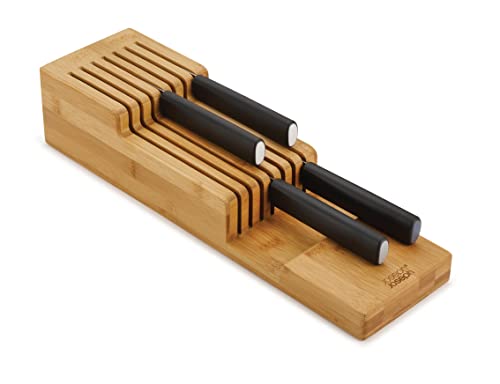
The Joseph Joseph DrawerStore Compact Knife Organizer is the knife pick, a two-tier bamboo block that holds up to nine knives with blades up to nine inches, for the drawer where loose blades dull each other and nick fingers. The product information gives a block measuring fifteen and seven-tenths inches deep by four and one-half inches wide by three and one-half inches high, in bamboo, weighing one and seventy-four hundredths pounds. The format earns its place on the tier: a two-tier design puts small knives on the top tier and large knives on the lower tier, so blades of different lengths sit in their own slots instead of lying across each other, and non-slip feet on the base keep the block from sliding around in the drawer when the drawer opens and closes. Nine knives in a block four and one-half inches wide is a narrow footprint for a full knife set, which is the point of the form, since a knife drawer that holds nine blades in the width of a single tray lane leaves the rest of the drawer free for everything else.
The identity record is a capacity inside a family that shares a name. The block named here is the DrawerStore compact knife organizer in bamboo, model 85169 in the maker record, first available at the end of December 2020. The same maker sells the same DrawerStore range in compact cutlery and expanding forms and sells a larger two-tier knife organizer that holds twelve knives or more under a separate listing, and the nine knife capacity, the two tiers, the nine inch blade limit and the bamboo body in this section belong to the block named. The stock evidence is the Amazon product information block behind the figures above, with the listing carried on Amazon. One point of honest caution belongs in this section: the listing record reviewed is about two hundred eighty days old, so the buyer should confirm the live offer before ordering, since a knife block is the pick that hurts most to find unavailable after the loose blades have been taken out of the drawer for it.
The limits are the knife-block form’s own trade. Three and one-half inches of height needs a drawer at least three and thirty-five hundredths inches high, so a shallow drawer cannot take this block at all, and nine knives is the capacity, so a household with fourteen knives needs a second block or a different form. The bamboo body should be wiped with a damp cloth and dried by hand and oiled regularly with a food-safe oil, which is a care routine that a plastic tray never asks for, and a blade longer than nine inches does not fit the slots, so a long carving knife needs a home elsewhere. Buy the Joseph Joseph knife organizer when the knife drawer is the worst failure, when the household wants blades in their own slots instead of loose in a pile, and when a narrow bamboo block that leaves the rest of the drawer free matters more than a wide tray that holds everything flat.
Specs
– Form: Compact two-tier knife organizer per the Amazon product information
– Capacity: Holds up to 9 knives per the Amazon product information
– Blade limit: Blades up to 9 inches per the Amazon product information
– Dimensions: 15.7 x 4.5 x 3.5 inches per the Amazon product information
– Minimum drawer height: 3.35 inches per the Amazon product information
– Material: Bamboo per the Amazon product information
– Weight: 1.74 pounds per the Amazon product information
– Features: Non-slip feet per the Amazon product information
– Care: Wipe with a damp cloth, dry by hand and oil regularly with a food-safe oil per the Amazon product information
– Fulfillment: Carried on Amazon per the Amazon product information
– Tier: Mid-range
5. Homemaid Living Bamboo Drawer Organizer, Set of 4
The Homemaid Living Bamboo Drawer Organizer set of four is the divider pick, four spring-loaded bamboo dividers that extend from seventeen and one-half inches to twenty-two inches, for the drawer that has no fixed layout at all and needs walls that move. The product information gives dividers measuring fifty-nine hundredths of an inch deep by twenty-two and one-quarter inches wide by two and fifteen hundredths inches high at full extension, in natural bamboo with a water-resistant finish, in a set of four. The format earns its place on the spring: a built-in spring-loaded mechanism locks each divider securely in place, so the household presses a divider between the drawer sides and it stays, and the dividers can be positioned horizontally or vertically and stacked as needed, so the same four dividers can make four long lanes one week and a grid of small compartments the next. A set of four dividers is the smallest kit that can build a real layout, since two dividers make three lanes and four dividers make a layout that can hold flatware, gadgets and the small things that never have a home.
The identity record is a count inside a family that shares a name. The set named here is the Homemaid Living bamboo drawer organizer set of four, part number 3024 in the maker record. The same maker sells the same dividers in a set of eight and in white under separate listings, and the four dividers, the seventeen and one-half to twenty-two inch extension, the spring-loaded mechanism and the water-resistant bamboo finish in this section belong to the set named. The stock evidence is the Amazon product information block behind the figures above, with the listing carried on Amazon. One point of honest caution belongs in this section: the listing record reviewed is about one hundred ninety days old, so the buyer should confirm the live offer before ordering, since a divider set is the pick that hurts most to find unavailable after the drawer has been emptied for it.
The limits are the divider form’s own trade. Dividers make walls but not a floor, so a household that wants a tray with a bottom should buy the madesmart tray in this guide instead, and a spring-loaded divider needs drawer sides that are straight and solid, since a divider that presses against a bowed drawer side will creep out of place over time. Two and fifteen hundredths inches of height suits a standard drawer and not a deep drawer, since a divider that is shorter than the drawer side leaves a gap above it that small things can cross, and four dividers are enough for one drawer, so a household with three bad drawers needs three sets. Buy the Homemaid Living set when the junk drawer is the worst failure, when the household wants walls that move instead of a tray that stays, and when a bamboo divider set that can be repositioned in a minute matters more than a fixed tray that cannot change.
Specs
– Form: Bamboo drawer organizer dividers, set of 4 per the Amazon product information
– Extension: 17.5 to 22 inches per the Amazon product information
– Dimensions: 0.59 x 22.25 x 2.15 inches at full extension per the Amazon product information
– Material: Bamboo with a water-resistant finish per the Amazon product information
– Features: Built-in spring-loaded mechanism per the Amazon product information
– Placement: Horizontal or vertical, and stackable per the Amazon product information
– Color: Natural per the Amazon product information
– Use: Kitchen, dresser, bedroom and bathroom drawers per the Amazon product information
– Fulfillment: Carried on Amazon per the Amazon product information
– Tier: Budget
Fit and Safety Checks Before You Buy
Measure the drawer three times, because the organizer is the wrong size more often than it is the wrong product. A drawer needs the inside width from side to side, the inside depth from front to back, and the inside height from the drawer floor to the top of the drawer side. A fixed tray needs the width to match within a small margin, since a tray that is wider than the drawer by half an inch does not fit at all. An expanding tray needs the range to cover the drawer width, since the Lipper tray in this guide expands to twenty-three inches and the Joseph Joseph expanding tray expands to twenty-two inches, and a drawer wider than either range needs a different form. A knife block needs the height as well as the footprint, since the Joseph Joseph knife organizer in this guide needs a drawer at least three and thirty-five hundredths inches high and the Joseph Joseph expanding tray needs a drawer at least three and one-quarter inches high. Measure inside the drawer, not outside the cabinet, and measure around the drawer runners and the front lip, since a tray that fits the floor of the drawer and fouls the runner is a tray that cannot sit flat.
Check the height before the first load, because a tray that is too tall is a tray that stops the drawer from closing. A shallow drawer in an older kitchen can be less than three inches high inside, and a tray that needs more height than the drawer has will sit proud of the drawer sides and catch on the cabinet frame. Measure the inside height with a ruler held upright in the drawer, and remember that a tray loaded with tall-handled tools needs more clearance than the tray alone, since a ladle handle that sticks up above the drawer side will stop the drawer just as surely as a tall tray will. Load the tray on the counter first and close the drawer slowly on the first try, since a drawer that is forced shut over a tall load is a drawer that can crack a tray or chip a blade.
No CPSC recall covers kitchen drawer organizer trays, dividers or in-drawer knife blocks as a class, or any of the five picks in this guide, which is stated plainly because the absence of a recall is itself a finding. The nearby records that do exist are scoped to different products and are named here so the buyer can see the boundary. The 17 Stories Furniture 14-drawer dressers were recalled in March 2026, covering about three thousand units sold from September 2023 through January 2026, because the dressers are unstable if they are not anchored to the wall and pose tip-over and entrapment hazards. Those are freestanding bedroom dressers, not drawer organizer inserts, and no pick in this guide is a 17 Stories product. The CPSC also warned consumers in 2026 to stop using UHOMEPRO five-drawer dressers immediately, because those dressers are unstable if they are not anchored to the wall and pose tip-over and entrapment hazards. Those are also freestanding dressers sold as furniture, not inserts that sit inside a kitchen drawer, and no pick in this guide is a UHOMEPRO product. None of these records touches a drawer organizer tray, a divider set or an in-drawer knife block, and none of the five picks is covered by any of them.
Store knives with the blade in its slot and the handle toward the front of the drawer, because a knife that is reached for by its handle is a knife that is picked up safely, and never store a loose blade in a drawer that has no block, since a hand reaching in blind meets a point instead of a handle. Keep heavy items low in the drawer and light items high in the tray, because a drawer loads best when the weight sits near the drawer floor, and do not overload a bamboo tray with a stack of cast iron, since a tray built for flatware is a tray that should hold flatware. Inspect spring-loaded dividers on arrival, since a divider whose spring has bent in shipping is a divider that will not hold its place, and wipe bamboo with a damp cloth rather than soaking it, since bamboo and standing water are a poor match. Check the dividers when the seasons change, since a divider set for summer gadgets will not hold winter tools, and check the CPSC database for the exact product before buying any organizer, since a recall is always tied to an exact model and not to a whole category.
FAQ
Which kitchen drawer organizer should I buy first?
Buy the form that matches the worst failure in the kitchen. A flatware drawer where forks and spoons tangle needs the madesmart tray, a wide drawer where a fixed tray leaves a gap needs the Lipper expanding tray, a mixed drawer where gadgets hide under flatware needs the Joseph Joseph expanding tray, a drawer where loose blades dull each other needs the Joseph Joseph knife organizer, and a drawer with no layout at all needs the Homemaid Living divider set. Name the failure first, then buy the form that answers it, and stop there until the next drawer shows itself.
How do I measure a drawer for an organizer?
A drawer needs three numbers: the inside width from side to side, the inside depth from front to back, and the inside height from the drawer floor to the top of the drawer side. A fixed tray needs the width to match within a small margin, since a tray wider than the drawer by half an inch does not fit at all. An expanding tray needs the range to cover the drawer width, and a knife block needs the height as well as the footprint, since the Joseph Joseph knife organizer in this guide needs a drawer at least three and thirty-five hundredths inches high. Measure inside the drawer and around the runners and the front lip, since a tray that fits the floor and fouls the runner cannot sit flat.
Are bamboo drawer organizers better than plastic ones?
Bamboo is warm and solid, which suits a drawer that the household opens a dozen times a day, and the Lipper tray, the Joseph Joseph knife organizer and the Homemaid Living dividers in this guide are bamboo. Plastic is light and easy to wipe, which suits a tray that will be pulled out and rinsed, and the madesmart tray and the Joseph Joseph expanding tray in this guide are plastic. Bamboo needs a wipe with a damp cloth and a dry by hand rather than a soak, and the Joseph Joseph knife organizer asks for an occasional oiling with a food-safe oil. If the tray will be washed often, buy plastic. If the tray will be seen every day, bamboo earns its place.
Do drawer organizers need assembly?
It depends on the form. The madesmart tray, the Lipper tray and both Joseph Joseph organizers in this guide drop into the drawer and work on the first day, with no assembly beyond expanding the tray to the drawer width. The Homemaid Living divider set needs no tools either, since each divider presses into place on its spring, but the household should expect to spend a few minutes arranging the four dividers into a layout that fits the drawer. A tray that needs no assembly is the fastest path from box to drawer, and a divider set that can be moved in a minute is the most flexible path to a layout that changes with the seasons.
Conclusion
The best kitchen drawer organizer is the one that matches the exact failure it is bought to fix, and the five tools in this guide each fix a different one. The madesmart Classic Large Silverware Tray is the default pick, a six-compartment plastic tray in granite measuring sixteen inches by twelve and nine-tenths inches by one and eighty-eight hundredths inches, for the standard drawer where forks, knives and spoons slide into one tangled pile. The Lipper International Bamboo Expandable 23-Inch Drawer Organizer is the bamboo pick, a wood tray that slides out to twenty-three inches wide, for the wide drawer where a fixed tray leaves a gap on one side. The Joseph Joseph DrawerStore Expanding Cutlery, Utensil and Gadgets Organizer is the expanding pick, a grey tray with five overlapping cutlery compartments and two deep-sided gadget compartments that expands up to twenty-two inches, for the drawer that has to hold both flatware and gadgets. The Joseph Joseph DrawerStore Compact Knife Organizer is the knife pick, a two-tier bamboo block that holds up to nine knives with blades up to nine inches, for the drawer where loose blades dull each other and nick fingers. And the Homemaid Living Bamboo Drawer Organizer set of four is the divider pick, four spring-loaded bamboo dividers that extend from seventeen and one-half inches to twenty-two inches, for the drawer that has no fixed layout at all and needs walls that move. Measure the drawer, check the height, and buy the form that fits the failure first, because an organizer that fits is an organizer that gets used, and an organizer that gets used is a drawer that stays in order.
More from Amazon
Programs that pair well with the guide above. Offers and eligibility are set by Amazon and may change.
Free shipping on eligible items, Prime Video and more. Eligible new members can start with a free trial.
Start a Prime free trialAudiobooks and podcasts to listen to on the go. Eligible new members can start with a free trial.
Try Audible freeAd-free music streaming. Eligible new subscribers can start with a free trial.
Try Music Unlimited freeA free business account with business pricing and bulk-buying tools for work, shop or home office.
Create a business accountAs an Amazon Associate we earn from qualifying purchases.





Write Your Review
No reviews yet. Be the first to share your experience!