
Key takeaways
- Five countertop microwaves compared on capacity, listed wattage, inverter and sensor cooking, turntable size and footprint, from 0.7 to 2.2 cu ft.
Disclosure: As an Amazon Associate, I earn from qualifying purchases. If you buy through links in this article, I may earn a commission at no extra cost to you.
A countertop microwave looks like a simple purchase until you measure your counter, your dinner plates and your cabinets. Models in this single category range from 0.7 cu ft dorm-room boxes to 2.2 cu ft family machines that are nearly two feet wide, and listed wattage runs from 700W to 1250W. The five picks below cover that spread deliberately: a large inverter model for families, two mid-size all-rounders around 1.1 to 1.2 cu ft, a compact premium model built around quiet operation, and a small budget-friendly 0.7 cu ft unit. Every specification quoted is the manufacturer’s listed figure, so use the numbers to match a model to your space and your cooking habits rather than to chase the biggest numbers.
How to Choose a Countertop Microwave
Start with capacity and footprint
Capacity in cubic feet only helps if you picture your dishes. A 0.7 cu ft cavity handles mugs, soup bowls and single servings, but a full-size dinner plate may not clear the door. Turntable diameter is the more practical check: around 12 inches or more takes standard dinner plates, and the 16.5-inch turntable on the largest pick here takes wide casserole dishes. Then measure the counter itself, including depth with the door open, and leave the ventilation clearance the manufacturer specifies on the sides, top and back.
Wattage sets the pace
Listed wattage is microwave output power, and it mostly decides speed. Compact 700W models reheat noticeably more slowly and need longer cook times than 900W to 1250W machines. Around 900W to 1000W is the comfortable middle for most households; higher output helps with large portions and family-size dishes. If you mostly warm drinks and leftovers for one, a lower-wattage compact is workable, just expect to add time.
Inverter versus conventional power
A conventional microwave delivers lower power levels by cycling full power on and off, which can cook edges while the centre stays cold. Inverter models deliver a steady stream of reduced power instead. Panasonic is the main name here: its listed Inverter Technology is designed for more even defrosting, gentle reheating and simmering without the on-off pulses. If you defrost meat often or melt and soften ingredients, an inverter is the feature most likely to change your results.
Sensors, menus and everyday controls
Sensor cooking measures humidity or steam inside the cavity and adjusts time and power for you, which takes the guesswork out of reheating and defrosting. Auto menus are simpler presets and vary a lot between brands, so count the ones you will actually use. Small details matter daily: a mute function silences beeps, a soft-close door avoids slams, and a two-step child lock is worth having in a family kitchen.
1. Panasonic NN-SN966S — the large inverter pick

The NN-SN966S is the biggest and most powerful model in this roundup, with a listed 2.2 cu ft cavity and 1250W of output. Its Inverter Technology delivers continuous power at every level rather than pulsing, and the Genius Sensor is listed to adjust cooking time and power automatically based on the food in the cavity. The 16.5-inch turntable is the largest here, so wide plates and family casserole dishes fit without a squeeze.
The trade-off is footprint: at just under 24 inches wide and 37 pounds, this is a microwave you measure for twice. Panasonic lists it for countertop use or built-in installation with an optional trim kit, which gives it a second life if you remodel. For households that cook and defrost in volume, it is the most capable countertop-only design in this list.
Specs
- Capacity: 2.2 cu ft
- Output power: 1250W
- Power delivery: Inverter Technology
- Sensor: Genius Sensor
- Turntable: 16.5 in glass
- Dimensions: 23.9 x 19.4 x 14 in
- Weight: 37 lb
- Model: NN-SN966S
- ASIN: B01DEWZWDU
2. Toshiba EM131A5C-SS — the mid-size all-rounder

Toshiba’s EM131A5C-SS sits in the middle of the range: a listed 1.2 cu ft cavity, 1000W of output and a 12.4-inch removable turntable that takes full dinner plates. A smart humidity sensor adjusts cooking for the listed auto menus, of which there are 12, covering the common jobs like pizza, vegetables and popcorn without manual timing.
Two small features make it easy to live with: a mute function that silences the end-of-cycle beeps, and an ECO mode that cuts standby draw. The interior is listed as easy-clean, and the stainless finish suits most kitchens. If you want one microwave that does a bit of everything without taking over the counter, this is the balanced pick of the five.
Specs
- Capacity: 1.2 cu ft
- Output power: 1000W
- Sensor: Smart humidity sensor
- Auto menus: 12
- Turntable: 12.4 in, removable
- Extras: Mute function, ECO mode, easy-clean interior
- Dimensions: 20.5 x 17.1 x 12.8 in
- Model: EM131A5C-SS
- ASIN: B076VB5JFQ
3. GE GCST11N1WSS — family size with a proper child lock
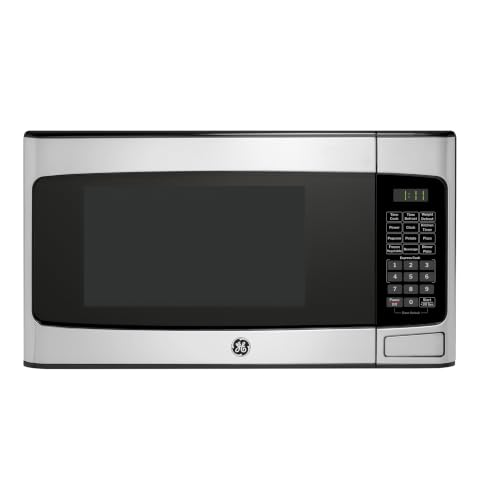
GE’s GCST11N1WSS is a straightforward 1.1 cu ft countertop model with a listed 950W of output and six auto cooking settings, plus convenience controls for everyday reheating and defrosting by weight or time. It is sized for apartments and smaller families: big enough for dinner plates, compact enough for a standard counter run.
Its distinguishing feature is the two-step child lock, which requires a deliberate two-step action to open the door and is a more meaningful safeguard than a simple control-panel lockout. The stainless steel finish matches GE’s other countertop appliances. Nothing here is flashy, and that is the point: it covers the core jobs in a widely available package.
Specs
- Capacity: 1.1 cu ft
- Output power: 950W
- Auto menus: 6 auto cooking settings
- Safety: Two-step child lock
- Finish: Stainless steel
- Dimensions: 20.3 x 15.6 x 12 in
- Weight: 30 lb
- Model: GCST11N1WSS
- ASIN: B0DD87CCQP
4. Breville Compact Wave Soft Close — the quiet premium compact

Breville built this 0.9 cu ft model around noise reduction. The soft-close door is engineered to shut gently instead of slamming, and a mute button silences the beeps entirely, which makes it a natural fit for open-plan kitchens, small apartments and offices. At 900W it is respectably powered for its size class.
Inside, Sensor IQ technology is listed to adjust power for reheating and defrosting, and a shortcuts panel covers common foods, with an A Bit More button for adding a short burst at the end of a cycle. The footprint is compact for the capacity, though at 29.8 pounds it is heavier than it looks. This is the premium-priced design of the group, and what you are paying for is the door, the quiet and the controls.
Specs
- Capacity: 0.9 cu ft (25 L)
- Output power: 900W
- Door: Soft close, with mute button
- Sensor: Sensor IQ
- Controls: Shortcuts panel, A Bit More button, child lock
- Dimensions: 19.1 x 17.3 x 11.5 in
- Weight: 29.8 lb
- Model: BMO650SIL1BUC1
- ASIN: B084T9RVSB
5. BLACK+DECKER EM720CB7 — the small-space pick
The EM720CB7 is the compact option: a listed 0.7 cu ft and 700W, in a cabinet just 17.3 inches wide. That output level means slower reheating than the larger models here, but for drinks, soups, instant meals and single servings in a dorm room, first apartment or office kitchenette, it covers the basics.
It still includes 10 power levels, six pre-programmed menu settings and both time and weight defrost, plus a removable glass turntable. The push-button door keeps the front flat and simple, and there is a child safety lock. Just check your plates first: the cavity is sized for bowls and mugs rather than wide dinner plates.
Specs
- Capacity: 0.7 cu ft
- Output power: 700W
- Power levels: 10
- Auto menus: 6 pre-programmed settings
- Door: Push-button
- Safety: Child safety lock
- Dimensions: 17.3 x 13.0 x 10.2 in
- Weight: 22.5 lb
- Model: EM720CB7
- ASIN: B07HGH1KG6
Quick Comparison
| Model | Capacity | Listed output | Power delivery | Turntable | Standout feature |
|---|---|---|---|---|---|
| Panasonic NN-SN966S | 2.2 cu ft | 1250W | Inverter | 16.5 in | Genius Sensor, optional trim kit |
| Toshiba EM131A5C-SS | 1.2 cu ft | 1000W | Conventional | 12.4 in | Mute function, ECO mode |
| GE GCST11N1WSS | 1.1 cu ft | 950W | Conventional | 12.75 in class | Two-step child lock |
| Breville Compact Wave Soft Close | 0.9 cu ft | 900W | Conventional | 12.5 in class | Soft-close door, mute |
| BLACK+DECKER EM720CB7 | 0.7 cu ft | 700W | Conventional | 10 in class | Smallest footprint |
FAQ
What size countertop microwave fits a full-size dinner plate?
Look at the turntable diameter and interior height rather than the headline capacity. A turntable of roughly 12 inches or more, which usually means a cavity of about 1.1 cu ft and up, takes standard dinner plates comfortably. Compact 0.7 cu ft models are better matched to bowls, mugs and side plates.
Is inverter technology worth choosing?
If you defrost meat, melt butter or reheat delicate foods often, yes. Inverter models deliver steady reduced power instead of cycling full power on and off, which is listed to produce more even results at low settings. For simple reheating at full power, a conventional model does the same job.
How much clearance does a countertop microwave need?
Follow the manual for the specific model, but plan on a few inches of open space at the sides, top and back so the vents can move air. Do not push a countertop model flush into a corner or a closed cabinet unless the manufacturer explicitly approves that installation.
Why do microwaves with similar wattage cook at different speeds?
Listed wattage follows a standard test procedure, but real-world speed also depends on cavity size, turntable movement and how power is delivered. A smaller cavity concentrates energy on small portions, while a large cavity spreads the same output over more space. Treat wattage as a guide and match it to your typical portion size.
Can a countertop microwave be installed in a cabinet or wall?
Only models the manufacturer lists for built-in installation, using the specified trim kit and clearances. The Panasonic in this roundup is one such design. A countertop-only model sealed into cabinetry can overheat, so if a built-in look is the goal, choose a model approved for it from the start.
Conclusion
Match the microwave to your plates and your counter first, and the choice narrows quickly. The Panasonic NN-SN966S is the pick for large dishes and frequent defrosting, the Toshiba EM131A5C-SS is the balanced mid-size option, and the GE adds a proper two-step child lock for family kitchens. Choose the Breville if quiet operation matters most, and the BLACK+DECKER if space is the hard limit. All five are countertop-only designs in the sizes listed, so measure once and order once.
FAQ
What size countertop microwave fits a full-size dinner plate?
Is inverter technology worth choosing?
How much clearance does a countertop microwave need?
Why do microwaves with similar wattage cook at different speeds?
Can a countertop microwave be installed in a cabinet or wall?
More from Amazon
Programs that pair well with the guide above. Offers and eligibility are set by Amazon and may change.
Free shipping on eligible items, Prime Video and more. Eligible new members can start with a free trial.
Start a Prime free trialAudiobooks and podcasts to listen to on the go. Eligible new members can start with a free trial.
Try Audible freeAd-free music streaming. Eligible new subscribers can start with a free trial.
Try Music Unlimited freeA free business account with business pricing and bulk-buying tools for work, shop or home office.
Create a business accountAs an Amazon Associate we earn from qualifying purchases.




Write Your Review
No reviews yet. Be the first to share your experience!