
Key takeaways
- Compare the best knife sharpeners for home kitchens, from electric and pull-through models to a whetstone and a guided system, with key specs for each.
A dull chef’s knife is more than an annoyance. It crushes tomato skins instead of slicing them, slips on onion surfaces, and turns simple prep into extra work. Restoring an edge, though, does not require professional equipment or skills. Home sharpeners cover every comfort level, from plug-in electric models that guide the blade for you to a traditional water stone that rewards a steady hand.

Disclosure: As an Amazon Associate, I earn from qualifying purchases. If you buy through links in this article, I may earn a commission at no extra cost to you.
This guide compares five sharpeners across four distinct designs: two electric models, a compact manual pull-through, a combination whetstone, and a guided clamp system. Each one suits a different kind of cook and knife collection. The sections below explain how the types differ, then break down the listed specifications of each pick.
How to Choose a Knife Sharpener
Sharpening method. Electric sharpeners use motor-driven abrasive wheels or discs inside guided slots, so the angle stays consistent while the machine does the work. Manual pull-through models use fixed carbide and ceramic elements in a preset V-shape; they are quick and small, but the angle is not adjustable. Whetstones remove the guides entirely and let the user control the angle along the blade, which offers the most control and the steepest learning curve. Guided systems sit in between: the knife is clamped in place while an abrasive rod moves at a set, adjustable angle.
Edge angle. Most European and American kitchen knives leave the factory with an edge around 20 degrees per side, while most Japanese knives use a finer edge near 15 degrees per side. A sharpener should match the knives it will service. Fixed-angle tools are simplest, while adjustable systems cover both conventions and everything in between.
Abrasive stages and grit. Coarse abrasives reshape a dull or damaged edge, medium abrasives refine it, and fine abrasives or stropping surfaces polish it. Diamond abrasives cut quickly and work on hard steels. Ceramic elements hone gently. On whetstones, grit numbers tell the story: around 1000 grit handles routine sharpening, while 6000 grit is a finishing step that polishes the edge.
Serrated knives. Serrations cannot run through standard slots. Only a tapered rod, a dedicated serrated stage, or a flexible stropping disc can reach into the scallops, so serrated owners should check compatibility before choosing.
Knife compatibility and care. Some electrics are designed for straight edges only, while others handle both straight and serrated blades. Whatever the type, a few light passes on a regular schedule keep edges from ever getting truly dull.
1. Chef’sChoice 15XV EdgeSelect — Electric, Three Stages
The Chef’sChoice 15XV is built around the 15-degree edge common to Japanese knives and modern premium cutlery. According to the manufacturer, its three-stage system converts traditional 20-degree factory edges into the thinner Trizor XV edge geometry, using 100-percent diamond abrasives in the first two stages and a flexible stropping and polishing disc in the third. Precision spring guides hold the blade at the set angle during each pass, which removes most of the guesswork from electric sharpening.
The third stage also handles serrated blades, since the flexible disc can follow the scalloped edge rather than grinding it flat. EdgeCraft lists the 15XV for straight-edge and serrated knives across kitchen, household, and sport categories. For a mixed drawer that includes a serrated bread knife alongside fine-edged chef’s knives, that breadth is the main draw.
Specs
- Type: Electric, 3-stage
- Abrasive: 100-percent diamond (stages 1–2), flexible stropping disc (stage 3)
- Edge angle: 15 degrees per side
- Serrated knives: Yes, stage 3
- Manufacturer: EdgeCraft
- Model: 0101500
- ASIN: B0018RSEMU
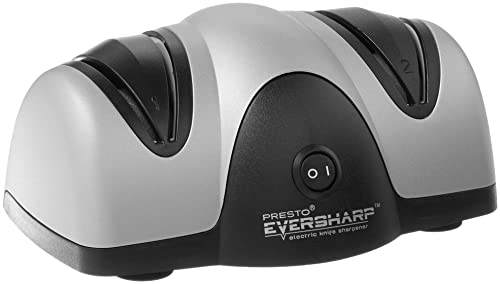
2. Presto 08800 EverSharp — Electric, Two Stages
The Presto EverSharp takes a simpler route. Its two-stage system uses Sapphirite sharpening wheels, an ultra-hard abrasive the manufacturer notes is also used in professional sharpening shops. The first stage precision-grinds the edge at a preset angle, and the second stage fine-hones and polishes it. Built-in blade guides hold the knife at the listed ideal angle automatically, so the user simply draws the blade through each slot in sequence.
Presto designs the EverSharp for non-serrated kitchen and sport knives, and the unit runs on standard 120-volt AC power with a compact countertop footprint. There is no angle conversion and no serrated stage here; the appeal is a short learning curve and a two-step process that covers the average home knife block.
Specs
- Type: Electric, 2-stage
- Abrasive: Sapphirite sharpening wheels
- Edge angle: Preset by blade guides
- Serrated knives: No
- Power: 120 volts AC
- Manufacturer: Presto
- Model: 08800
- ASIN: B00006IUWM
3. KitchenIQ 50009 Edge Grip — Manual Pull-Through

The KitchenIQ 50009 Edge Grip is the smallest option in this guide and the only one with no cord and no setup. Its two stages pair coarse carbide blades, which reset a dull edge, with fine ceramic rods that hone it. The fine stage also accepts serrated blades, which is uncommon in a pull-through design. A soft-grip handle and non-slip base keep the unit steady while the blade is drawn through.
The namesake feature is the edge grip design: the base is shaped to sit securely on the edge of a counter or table as well as on a flat surface, which adds leverage and keeps fingers clear of the slots. Its compact body stores in a utensil drawer. The trade-off is a fixed angle, so it suits standard Western-style edges rather than fine 15-degree blades.
Specs
- Type: Manual pull-through, 2-stage
- Abrasive: Carbide blades (coarse), ceramic rods (fine)
- Edge angle: Fixed preset
- Serrated knives: Yes, fine stage
- Base: Non-slip, edge grip design
- Manufacturer: Smith’s Consumer Products
- Model: 50009
- ASIN: B001CQTLJM
4. King KW65 1000/6000 — Combination Whetstone
The King KW65 is a traditional Japanese water stone with two working faces. The 1000-grit side is the everyday sharpening surface, coarse enough to restore a dulled edge and fine enough for regular maintenance. The 6000-grit side is a finishing surface that refines and polishes the edge after sharpening. The stone ships with a plastic base that holds it steady on the counter while in use.
As a soaking stone, the KW65 goes into water before a session until bubbles stop rising, and it is used wet throughout. There are no guides, slots, or presets: the user holds the angle by hand and sweeps the full length of the blade across the stone. That freedom is exactly the appeal for cooks who want one tool that can handle any angle, any blade shape, and delicate single-bevel knives that guided tools cannot accommodate, provided they are willing to practice the technique.
Specs
- Type: Whetstone (soaking water stone)
- Grit: 1000 / 6000 combination
- Base: Plastic holder included
- Edge angle: User-controlled
- Serrated knives: No
- Manufacturer: King (Matsunaga)
- Model: KW65
- ASIN: B001DT1X9O
5. Work Sharp Precision Adjust Elite — Guided Clamp System

The Precision Adjust Elite clamps the knife in a V-block and moves the abrasive instead of the blade. A rotating rod holder carries the abrasive rod along the edge at an angle the user sets on the unit, adjustable from 15 to 30 degrees. That range covers Japanese and Western kitchen knives as well as thicker outdoor blades in a single system.
The Elite kit expands the base system with a Tri-Brasive rod carrying 220, 320, and 400-grit diamond plates, plus additional 600 and 800-grit diamond plates, a fine ceramic rod, a leather strop, and a ceramic rod shaped for serrated edges, all packed in a storage case. A small knife table attachment supports short kitchen blades in the clamp. Because each abrasive is a separate listed step, the system handles everything from repairing a chipped edge to a final strop polish without changing tools.
Specs
- Type: Guided clamp system, manual
- Abrasives: Diamond plates (220, 320, 400, 600, 800 grit), ceramic rod, leather strop
- Edge angle: Adjustable, 15–30 degrees
- Serrated knives: Yes, ceramic serrated rod
- Clamp: V-block with small knife table
- Manufacturer: Work Sharp
- Model: WSBCHPAJ-ELT-ATL
- ASIN: B09FWWDFF9
Quick Comparison
| Sharpener | Type | Stages / Abrasive | Serrated | Angle |
|---|---|---|---|---|
| Chef’sChoice 15XV | Electric | 3 stages, diamond + stropping disc | Yes | Fixed 15° |
| Presto EverSharp 08800 | Electric | 2 stages, Sapphirite wheels | No | Preset guides |
| KitchenIQ 50009 Edge Grip | Manual pull-through | 2 stages, carbide + ceramic | Yes (fine) | Fixed preset |
| King KW65 | Whetstone | 1000 / 6000 grit | No | User-controlled |
| Work Sharp Precision Adjust Elite | Guided system | Diamond 220–800, ceramic, strop | Yes | Adjustable 15–30° |
FAQ
What is the difference between 15-degree and 20-degree edges?
The number describes the angle of each side of the edge. A 15-degree edge is thinner and slices with less resistance, which suits Japanese knives and delicate work. A 20-degree edge is sturdier and more forgiving of hard use, and it is the traditional standard for European and American knives. Matching the sharpener to the knife’s existing angle avoids regrinding the edge to a new geometry.
Can serrated knives be sharpened at home?
Yes, but only with the right contact shape. Serrations need a tapered rod, a dedicated ceramic serrated sharpener, or a flexible stropping disc that can dip into each scallop. Flat slots and stones cannot reach the recessed teeth, so serrated blades should never be forced through a standard straight-edge slot.
How often should kitchen knives be sharpened?
It depends on use, but a home knife that cooks daily usually needs true sharpening a few times a year, with light honing far more often. Honing realigns a folded edge without removing much metal, while sharpening grinds a fresh edge. Brief, regular maintenance sessions are the easier habit.
Do pull-through sharpeners damage knives?
Fixed carbide stages remove metal faster than stones or guided systems, and the preset angle may not match every blade. On everyday knives that trade-off is usually acceptable for the speed and simplicity. On expensive or thin Japanese blades, a gentler method such as a whetstone or an adjustable guided system gives more control over how much material comes off.
Does a whetstone need to be soaked before use?
The King KW65 is a soaking stone, so it should sit in water until air bubbles stop escaping before sharpening begins, and it should be splashed with water during use to keep the surface wet. Not every stone works this way: some are splash-and-go and others use oil, so the maker’s instructions for a specific stone always come first.
Conclusion
The right pick depends on the knives and the cook. The Chef’sChoice 15XV suits households with fine 15-degree edges and serrated blades that need one machine. The Presto EverSharp keeps things to two guided steps for standard straight edges. The KitchenIQ 50009 covers quick touch-ups in the least storage space. The King KW65 rewards practice with total control over any angle, and the Work Sharp Precision Adjust Elite splits the difference, pairing guided consistency with adjustable angles and a full ladder of abrasives. Any of the five beats working with a dull blade.
More from Amazon
Programs that pair well with the guide above. Offers and eligibility are set by Amazon and may change.
Free shipping on eligible items, Prime Video and more. Eligible new members can start with a free trial.
Start a Prime free trialAudiobooks and podcasts to listen to on the go. Eligible new members can start with a free trial.
Try Audible freeAd-free music streaming. Eligible new subscribers can start with a free trial.
Try Music Unlimited freeA free business account with business pricing and bulk-buying tools for work, shop or home office.
Create a business accountAs an Amazon Associate we earn from qualifying purchases.

Write Your Review
No reviews yet. Be the first to share your experience!