
Key takeaways
- Compare the best dehumidifiers for basements and bathrooms by pint capacity, tank size, pump and hose drainage, and cold-room performance indoors.
Disclosure: As an Amazon Associate, I earn from qualifying purchases. If you buy through links in this article, I may earn a commission at no extra cost to you.
A basement that smells musty or a bathroom where the mirror never clears is telling you the same thing: the air holds more water than the room can handle. Left alone, that moisture feeds mold, warps wood, and makes a finished basement feel clammy even when the temperature is fine. A dehumidifier is the straightforward fix, but the right one depends on the size of the space, how wet it gets, and where the collected water can go. Below are five machines covering the main situations: large damp basements, basements with no floor drain, and colder rooms where a standard compressor unit struggles. Each pick lists its capacity as the maker states it, with tank size and drainage options, so you can match a machine to your room instead of guessing.
How to Choose a Dehumidifier
Start with pints per day. Capacity is stated in pints of water removed in 24 hours, tested under the current Department of Energy standard. That number only means something alongside the size and wetness of your space. As a working guide: a 20 to 22 pint unit suits a moderately damp room of a few hundred square feet, such as a bathroom or small bedroom. A 30 to 35 pint unit handles a damp basement or open living area up to roughly 1,500 to 2,500 square feet. For a large basement that feels very damp, has visible condensation, or floods the air after rain, step up to a 50 pint unit, which makers generally position for spaces up to about 4,500 square feet. When in doubt between two sizes, choose the larger one: an oversized unit reaches its target humidity and cycles off, while an undersized one runs constantly and still loses ground.
Decide how the water leaves. Every machine here collects water in a bucket first. If the bucket is your only option, tank size matters, because a 50 pint machine can fill a small tank twice a day in a wet basement. A continuous drain port lets you attach a hose and run water by gravity into a floor drain, which removes emptying from your routine entirely. If there is no floor drain nearby, a built-in pump pushes water upward into a sink or out a window, and that single feature is worth prioritizing for finished basements.
Match the technology to the temperature. Compressor models do most home duty and are efficient in warm rooms, but their output falls sharply in cold spaces and their coils can frost below roughly 41 degrees Fahrenheit. Desiccant models use a rotating moisture-absorbing wheel instead of refrigerant, so they keep working in cold basements, garages, and crawl spaces where compressor units give up.
Check the extras. A built-in humidistat lets the machine hold a set level, ideally 30 to 50 percent relative humidity, instead of running flat out. Auto restart after a power outage matters in basements you rarely visit, and a washable filter keeps maintenance cheap.
The 5 Best Dehumidifiers
1. Midea Cube 50 Pint Dehumidifier with Built-in Pump (MAD50PS1QWT)
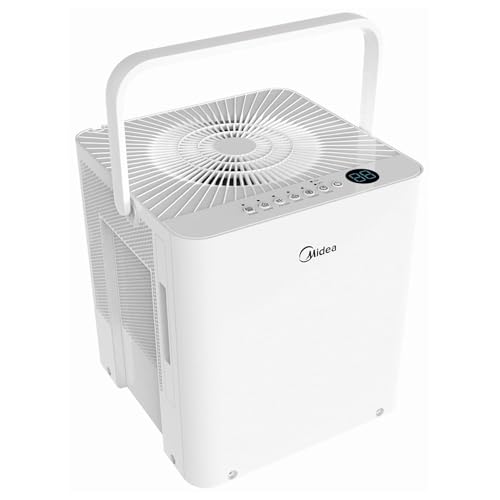
The Midea Cube takes a different shape from the usual tower. Its lift-and-twist body nests inside its own bucket for storage, then extends upward to hold a full 4.2 gallons of water, several times what most tanks carry, so it runs for long stretches between emptyings even before you connect a drain. Midea states 50 pints per day of removal for spaces up to 4,500 square feet, and this version adds a built-in pump on top of the standard hose connection, so water can go up into a sink if no floor drain is close. Wi-Fi control and Alexa support let you check humidity and tank level from upstairs. For a finished basement you live in rather than just store boxes in, that combination is the most complete package here.
Specs
- Brand: Midea
- Capacity: 50 pints per day; spaces up to 4,500 sq ft
- Tank size: 4.2 gallons
- Drain options: Bucket, continuous drain hose (included), built-in pump
- Type: Compressor
- ASIN: B091BYVD2W
2. hOmeLabs 50 Pint Dehumidifier with Pump (HME020391N)
The hOmeLabs 50 pint is the plain-workhorse option for big, damp basements. It states the same headline capacity as the Midea, 50 pints per day for areas up to 4,500 square feet, and pairs it with a built-in pump so you are not tied to a floor drain. Its 1.6 gallon tank is smaller than the Cube’s, which makes the pump or a gravity hose close to essential in a very wet space; with continuous drainage set up, tank size stops mattering. Controls are simple, the unit rolls on casters, and it shuts off automatically when the bucket fills. If your basement is unfinished and the humidity is high, this is the direct, no-frills way to dry it.
Specs
- Brand: hOmeLabs
- Capacity: 50 pints per day; spaces up to 4,500 sq ft
- Tank size: 1.6 gallons
- Drain options: Bucket, continuous drain hose, built-in pump
- Type: Compressor
- ASIN: B08MWTPS9T
3. Frigidaire 50 Pint Dehumidifier (FFAD5033W1)
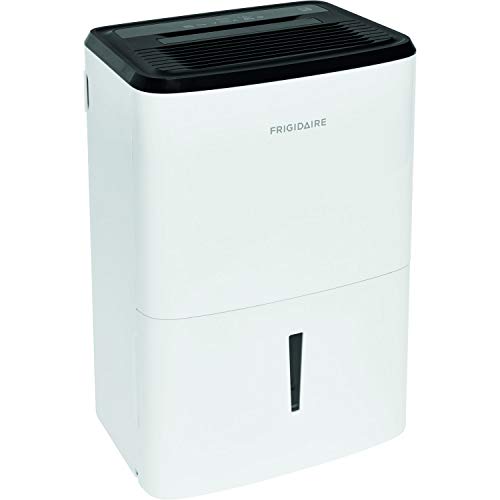
Frigidaire’s 50 pint model is built for high-humidity rooms and takes a simpler approach to drainage: there is no pump, but the front-loading 2.1 gallon bucket is easy to carry thanks to its handle and splash guard, and a continuous drain port accepts a standard hose for gravity drainage into a floor drain. Frigidaire states 50 pints per day of removal and positions the unit for large spaces up to 4,500 square feet. Custom humidity control lets you dial in a target level, the washable filter captures dust before it reaches the coils, and the controls are straightforward enough for a utility room appliance. Choose this one if your basement has a floor drain within hose reach and you would rather have a bigger bucket and simple mechanics than a pump and app connections.
Specs
- Brand: Frigidaire
- Capacity: 50 pints per day; spaces up to 4,500 sq ft
- Tank size: 2.1 gallons (16.9 pints)
- Drain options: Bucket, continuous drain hose (gravity); no built-in pump
- Type: Compressor
- ASIN: B07Z5PY294
4. Ivation 50 Pint Dehumidifier with Pump (IVADH50PW)

The Ivation splits the difference between the Frigidaire and the pump models above. It states 50 pints per day for areas up to 4,500 square feet, holds a comparatively generous 2.25 gallon reservoir, and includes a built-in pump alongside the hose connector, so it can drain upward to a sink or downward to a floor drain. A programmable humidistat with a built-in humidity readout shows the room’s current level on the LCD, and there are two fan speeds including a turbo mode for pulling a soaked room down quickly after a leak or a storm. Auto shutoff and auto restart cover the basics for a space you do not check daily. It is a sensible middle pick: pump drainage and a larger-than-average tank, without paying for smart-home features you may never open.
Specs
- Brand: Ivation
- Capacity: 50 pints per day; spaces up to 4,500 sq ft
- Tank size: 2.25 gallons
- Drain options: Bucket, continuous drain hose, built-in pump
- Type: Compressor
- ASIN: B01I5J19W0
5. Eva-Dry EDV-4000H Rotary Desiccant Dehumidifier

The Eva-Dry solves the problem the four compressor machines share: cold rooms. Its rotary desiccant wheel contains no refrigerant, so it keeps removing moisture down to 34 degrees Fahrenheit, where compressor coils would frost over. Eva-Dry states removal of 7 liters per day (about 14.8 pints) at 68 degrees and 60 percent humidity, and rates the unit for spaces up to 4,000 cubic feet, roughly 444 square feet, which makes it a fit for a cold basement corner, crawl space, garage, or a large bathroom rather than a whole open basement. The 2 liter tank is small, but the H version includes a drain hose for continuous drainage, and at about 13 pounds the unit is easy to move between problem spots. Output per day is modest next to the 50 pint machines; in a cold room, though, it is output the others cannot match at all.
Specs
- Brand: Eva-Dry
- Capacity: 7 liters per day (about 14.8 pints) at 68°F and 60% RH; spaces up to 4,000 cu ft (about 444 sq ft)
- Tank size: 2 liters
- Drain options: Bucket, continuous drain hose (included); no built-in pump
- Type: Desiccant (rotary, no compressor or refrigerant)
- ASIN: B09VLDJ1C6
Quick Comparison
| Model | Capacity (as stated) | Coverage (as stated) | Tank | Drainage | Type |
|---|---|---|---|---|---|
| Midea Cube MAD50PS1QWT | 50 pints/day | 4,500 sq ft | 4.2 gal | Bucket, hose, built-in pump | Compressor |
| hOmeLabs HME020391N | 50 pints/day | 4,500 sq ft | 1.6 gal | Bucket, hose, built-in pump | Compressor |
| Frigidaire FFAD5033W1 | 50 pints/day | 4,500 sq ft | 2.1 gal | Bucket, gravity hose | Compressor |
| Ivation IVADH50PW | 50 pints/day | 4,500 sq ft | 2.25 gal | Bucket, hose, built-in pump | Compressor |
| Eva-Dry EDV-4000H | 7 liters/day (about 14.8 pints) | 4,000 cu ft (about 444 sq ft) | 2 liters | Bucket, hose | Desiccant |
FAQ
What humidity level should I set?
Aim for 30 to 50 percent relative humidity. Below that range the air feels dry and can irritate skin and woodwork; above it, mold and dust mites thrive. Most basements do well held around 45 percent.
Is a 50 pint dehumidifier too big for a bathroom?
Usually, yes. Bathrooms are small and their moisture comes in bursts from showers, so a compact unit or a smaller compressor model is easier to place and empty. The 50 pint machines here earn their keep in basements and large open areas; the Eva-Dry is the better fit among these picks for a large, cold bathroom.
Do I really need a built-in pump?
Only if the water has to travel upward or a long way. With a floor drain nearby, a gravity hose does the same job for less. Without one, a pump is the difference between hands-free drainage into a sink and carrying a full bucket up the stairs every day.
Why does my compressor dehumidifier stop working well in winter?
Cold air slows refrigerant-based dehumidification and frost builds on the coils, so output drops and the unit spends its time defrosting. Desiccant models like the Eva-Dry are built for exactly that situation, since they have no coils to freeze.
Conclusion
For most damp basements, the decision comes down to drainage. If you have a floor drain, the Frigidaire covers the basics with a large, easy-carry bucket and simple controls. If you do not, pick a pump model: the Midea Cube adds the biggest tank and smart monitoring, the hOmeLabs keeps things simple, and the Ivation balances tank size and pump drainage in the middle. Save the Eva-Dry for the spaces the others cannot handle, the cold basement, garage, or crawl space where temperatures drop toward freezing. Size honestly using the pints-per-day guide above, set the humidistat once, and the room should stay dry without daily attention.
More from Amazon
Programs that pair well with the guide above. Offers and eligibility are set by Amazon and may change.
Free shipping on eligible items, Prime Video and more. Eligible new members can start with a free trial.
Start a Prime free trialAudiobooks and podcasts to listen to on the go. Eligible new members can start with a free trial.
Try Audible freeAd-free music streaming. Eligible new subscribers can start with a free trial.
Try Music Unlimited freeA free business account with business pricing and bulk-buying tools for work, shop or home office.
Create a business accountAs an Amazon Associate we earn from qualifying purchases.


Write Your Review
No reviews yet. Be the first to share your experience!