
Key takeaways
- Five replacement insoles for everyday shoes, work boots, and running shoes, compared by arch support, cushioning, materials, and fit to help you choose.
Most shoes ship with a thin, flat factory footbed. A replacement insole adds shape under the arch, cushioning under heel and forefoot, and a moisture-managing top layer — without replacing the shoe. The five below cover the main design families: a firm orthotic, an air-and-gel cushion, a work-boot insole, a running insole, and a heavy-duty everyday orthotic.

Disclosure: As an Amazon Associate, I earn from qualifying purchases. If you buy through links in this article, I may earn a commission at no extra cost to you.
How to choose insoles
Start with arch profile. Insoles are listed in low, medium, and high versions, and the profile should roughly match your foot. A high profile under a low arch feels intrusive; a low profile under a high arch adds little shape. If unsure, start with medium.
Next, match the insole to the activity. Everyday walking calls for balanced cushioning. Work boots call for a durable build that holds its shape through long shifts on hard floors. Running calls for a lighter, more flexible insole that moves with the foot rather than locking it in place.
Shoe volume matters as much as arch height. A thick, full-length insole raises the foot, so it suits roomy footwear with a removable factory insole. A low-profile insole fits tighter shoes. Remove the factory insole first for full-length replacements, and check the heel sits comfortably before wearing the pair for a full day.
Materials set the character. Firm molded shells give structured support and hold their shape. EVA foam gives soft, even cushioning. Gel pads absorb shock where impact is highest, and air chambers add spring under the heel. A moisture-wicking top layer keeps the surface drier. Fit is usually trim-to-fit: trace the factory insole onto the replacement and cut along the marked line. Replace insoles when the cushioning stops rebounding, the top layer wears smooth, or the shell starts to flex.
1. Superfeet Green All-Purpose Support High Arch Insoles
Superfeet Green is the long-running firm orthotic here, and the pick for people who want structure first. The design centers on a deep heel cup and a high arch profile, with a firm shell that holds its shape rather than compressing flat. Superfeet lists it as a professional-grade, trim-to-fit orthotic, sold since 2008.
The feel is firm rather than plush: the insole keeps the foot positioned on the arch and heel cup instead of sinking into soft foam. It suits roomy everyday shoes, walking shoes, and hiking footwear with removable factory insoles. The verified configuration is listed for men 7.5-9 and women 8.5-10; trim it against the factory insole and expect a short adjustment period.
- Specs:
- Design: full-length firm orthotic insole
- Arch: listed high arch support
- Heel: listed deep heel cup
- Top material: listed polyester
- Fit: trim-to-fit, listed men 7.5-9 / women 8.5-10
- First listed: December 2008
2. Sof Sole Airr Orthotic Insoles
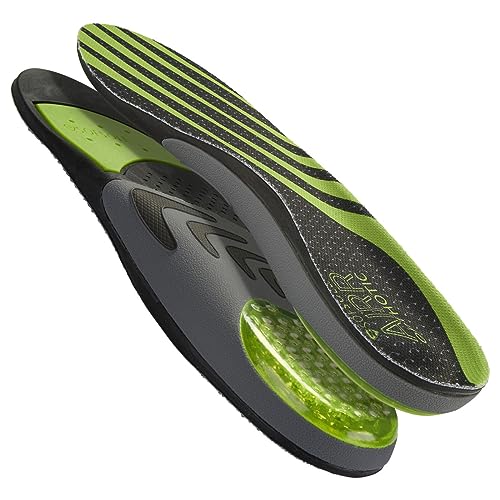
The Sof Sole Airr takes the opposite approach to the Superfeet: cushioning first, with structure built in around it. The heel carries an encapsulated air chamber, the forefoot carries polymer gel, and a reinforced stability plate runs through the arch. Sof Sole lists the combination as maximum shock absorption, aimed at all-day wear in athletic and casual shoes.
The air chamber gives the heel a springy landing, while the gel forefoot softens push-off. The stability plate keeps the arch from collapsing under load, so the insole reads as cushioned but not shapeless. A moisture-wicking top layer is listed to help keep feet drier through long wear — the pick for a softer landing than a firm orthotic.
- Specs:
- Design: full-length orthotic insole with air and gel cushioning
- Heel: listed encapsulated air chamber
- Forefoot: listed polymer gel
- Arch: listed reinforced stability plate
- Top layer: listed moisture-wicking
- Fit: full-length, men’s listed sizing
3. Timberland PRO Anti-Fatigue Technology Replacement Insoles
Timberland PRO Anti-Fatigue is the work-boot insole here, built for long days on hard surfaces. The core is inverted cone foam, listed to absorb shock and return energy with each step, under an OrthoLite top layer that adds rebound and moisture management. An Outlast top cover is listed for temperature regulation and odor control, and the footbed is anatomically contoured with a dynamic arch design listed to adapt to different foot shapes.
The build is tougher than the everyday picks, made to hold up inside work boots through repeated long shifts; the maker lists hand washing with warm water and mild detergent, then air-drying. The verified configuration is size X-Small, listed for men 5-6 — the choice for days on concrete, tile, or shop floors.
- Specs:
- Design: full-length replacement insole for work boots
- Foam: listed inverted cone foam
- Top layer: listed OrthoLite with Outlast cover
- Footbed: listed anatomically contoured with dynamic arch design
- Care: listed hand wash, air-dry
- Fit: listed size X-Small / men 5-6
4. CURREX RunPro Insoles

CURREX RunPro is the running insole here, built around dynamic support. Instead of holding the foot rigidly, the semi-rigid insole is listed to guide the foot through the gait cycle, supporting the arch while it flexes. It comes in low, medium, and high arch profiles; the verified configuration is high arch, size Large.
The build uses five listed performance layers, and the profile is thinner than a work-boot insole, which suits running shoes where spare volume is limited. CURREX lists four to six months, or about 400 to 600 miles, depending on body weight and use. Pick RunPro for running or fast walking shoes, where the priority is support that moves with the foot.
- Specs:
- Design: full-length dynamic running insole
- Arch: listed high arch profile, size Large
- Build: listed five performance layers
- Profile: listed thin, for running shoes
- Fit: listed men and women, size Large
- Listed lifespan: four to six months
5. WalkHero High Arch Orthotic Insoles

WalkHero is the heavy-duty everyday orthotic here. The design pairs a listed high arch with a deep heel cup that holds the heel in place, and the maker lists the insole for wearers over 220 lbs. The verified configuration is men 7-7.5 / women 9-9.5 in Olive Yellow.
The deep heel cup is the defining feature: it cradles the heel and keeps the foot centered on the arch support through the step. The full-length format replaces the factory insole outright, and the build is aimed at daily walking and long days on your feet. Choose WalkHero when you want a firm, structured everyday insole and the other picks feel too soft or too light.
- Specs:
- Design: full-length orthotic insole
- Arch: listed high arch support
- Heel: listed deep heel cup
- Listed for: wearers over 220 lbs
- Fit: listed men 7-7.5 / women 9-9.5
- Colour: Olive Yellow (listed)
Comparison
| Insole | Design | Arch | Best for | Fit |
|---|---|---|---|---|
| Superfeet Green | Firm orthotic | High | Everyday structure | Trim-to-fit, men 7.5-9 / women 8.5-10 |
| Sof Sole Airr | Air chamber and gel | Stability plate | Cushioned all-day wear | Full-length, men’s sizing |
| Timberland PRO Anti-Fatigue | Inverted cone foam | Dynamic | Work boots, hard floors | Size X-Small / men 5-6 |
| CURREX RunPro | Dynamic running | High | Running shoes | Size Large |
| WalkHero | Heavy-duty orthotic | High | Everyday walking | Men 7-7.5 / women 9-9.5 |
FAQ
How do I pick the right arch profile?
Match the profile to your foot shape: low, medium, or high as listed by the maker. Medium is the usual starting point when unsure, and several insoles above come in all three profiles.
Do I remove the factory insole first?
For full-length replacements, yes: the replacement takes the factory insole’s place, and leaving both in crowds the shoe. Low-profile insoles are the exception, only when the maker lists them as fitting over the factory footbed.
Can I move one pair of insoles between shoes?
You can, but it gets tedious: insoles are trimmed to one shoe’s shape, so moving them means re-checking the fit each time. A dedicated pair per shoe avoids the daily swap.
How often should insoles be replaced?
It depends on design and mileage. Foam packs down, top layers wear smooth, and shells lose firmness. CURREX lists four to six months for its running insole; work and everyday insoles are usually replaced when the cushioning stops rebounding or the heel cup no longer holds its shape.
Will a thick insole fit in any shoe?
No. Thick, structured insoles need roomy shoes with removable factory insoles; slim shoes need a low-profile design. If the shoe feels tight across the toes after the swap, the insole is too thick for that shoe.
Conclusion
The right insole matches your arch, your activity, and your shoes. Superfeet Green is the firm, structured everyday choice. Sof Sole Airr is the cushioned choice, with air in the heel and gel in the forefoot. Timberland PRO Anti-Fatigue is the work-boot choice for hard floors. CURREX RunPro is the running choice, with dynamic support in a thin profile. WalkHero is the heavy-duty everyday choice. Start with the arch profile and check the shoe volume, and the shortlist narrows to one quickly.
FAQ
How do I pick the right arch profile?
Do I remove the factory insole first?
Can I move one pair of insoles between shoes?
How often should insoles be replaced?
Will a thick insole fit in any shoe?
More from Amazon
Programs that pair well with the guide above. Offers and eligibility are set by Amazon and may change.
Free shipping on eligible items, Prime Video and more. Eligible new members can start with a free trial.
Start a Prime free trialAudiobooks and podcasts to listen to on the go. Eligible new members can start with a free trial.
Try Audible freeAd-free music streaming. Eligible new subscribers can start with a free trial.
Try Music Unlimited freeA free business account with business pricing and bulk-buying tools for work, shop or home office.
Create a business accountAs an Amazon Associate we earn from qualifying purchases.
Write Your Review
No reviews yet. Be the first to share your experience!