
Key takeaways
- Compare sleeping bag storage sacks, from compression stuff sacks to roomy cotton sacks, that keep sleeping bags packed and ready for the next camping trip.
A sleeping bag that fills half a pack makes every trip harder than it needs to be. A good compression sack squeezes a bulky bag into a tight cylinder, freeing room for food, layers, and shelter while keeping the bag clean and dry on the trail. The sacks below all use straps to shrink a sleeping bag down, and they span a wide range of sizes, fabrics, and budgets.
Each sack here suits a different kind of trip, from a light summer overnighter to a cold-weather car camp, so match the sack to the bag you own and the pack you carry. Size matters more than brand here: a sack that is too small will not close, and a sack that is too large will not compress, so check the liter figure against your bag before you buy.
Quick Picks
As an Amazon Associate we earn from qualifying purchases
| Product | Best for | Key spec from title |
|---|---|---|
| MOOCY Compression Stuff Sack | Light summer bags | 12L, 24L, and 45L sizes with four straps |
| Frelaxy Compression Sack | Mixed gear in five sizes | 11L to 52L sizes with four straps |
| REDCAMP Sleeping Bag Stuff Sack | Big loads on a budget | 17L to 63L sizes with six straps |
| OMVMO Compression Sack | Ultralight trips | 12L to 53L sizes in 400T and 320T nylon |
| M-Tac Compression Stuff Sack | Rough handling | 12L medium in military-grade nylon |
How to Choose
Match the sack to your bag
Measure your sleeping bag once it is stuffed into its own sack, then pick a compression sack with a liter figure close to that volume. A sack that is a little larger than the bag compresses well, while a sack that is much larger leaves dead air and a sack that is smaller will not close at all. If your bag is a bulky synthetic rectangle, look at the largest sizes here, and if your bag is a compact down mummy, a 12-liter sack may be all you need.
Count the straps and check the fabric
Straps do the work in a compression sack, so count them before you buy. Four straps pull a bundle down evenly, six straps give even more control on a bulky load, and quick-release buckles let you open the sack without fighting the webbing. Fabric matters too: 210T polyester and 400T nylon both resist tears and shed light rain, but neither one is a dry bag, so use a liner inside the sack if rain is likely on your next trip.
Think about the trip, not just the closet
A compression sack earns its keep on the trail, where space is tight and a bag must fit a pack. At home, the same bag does better in a roomy cotton sack that lets the fill stay lofty between camping trips, since months of tight compression can flatten insulation over time. Use the compression sack for travel and a loose cotton sack for storage, and your bag will pack small on the road ahead and stay warm and lofty for years.
Look at weight and pack shape
A sack that weighs 80 grams disappears into a load, while a sack near 200 grams still earns its place if the fabric is tougher and the straps are stronger. Cylinders pack neatly into a backpack, and a rectangular sack stacks well in a car trunk or on a closet shelf. Grab handles and straps that clip to the outside of a pack help on the walk to camp, and a top pocket keeps a headlamp and other small items close at hand.
The 5 Best Options
MOOCY Compression Stuff Sack

The MOOCY sack is the simplest pick here: a light nylon cylinder with four straps that pulls a summer bag into a tight bundle. Three sizes cover most one-person bags, and the 45-liter size handles a full-size synthetic bag without a fight. The drawstring top closes fast, the fabric sheds light rain, and the whole sack weighs little enough to live in a pack between trips. It suits campers who want a cheap, light sack for a compact down bag or a summer quilt.
Specs
- Sizes: 12L, 24L, and 45L
- Four adjustable straps with two side release buckles
- Material: nylon
- Closure: drawstring
- Item weight: 125 grams
- Warranty: 1 year
Best for: light summer down bags and tight pack compression.
Watch out for: the 12L size suits only a compact summer bag, so measure your bag before ordering, and the maker warns the sack is not a dry bag.
Frelaxy Compression Sack

Frelaxy covers the widest size range here, from an 11-liter sack for a summer quilt to a 52-liter sack for a bulky winter bag. Four straps squeeze the load down evenly, and the tear-resistant fabric holds up to repeated stuffing without splitting at the seams. The sack works for sleeping bags, clothes, and blankets alike, so one size can serve several jobs on a trip. Pick the size that matches your bag, since the range is wide and a wrong size wastes the compression.
Specs
- Sizes: 11L, 18L, 30L, 45L, and 52L
- Material: 210T tear-resistant nylon
- Four adjustable straps, two with quick-release buckles
- Weight: 80 to 140 grams depending on size
- Warranty: 12 months with free size exchange
Best for: mixed gear and backpacking with several bag sizes.
Watch out for: sizing runs tricky, so check the size chart before ordering and allow a swap if the fit is off.
REDCAMP Sleeping Bag Stuff Sack

REDCAMP brings six straps to the job, more than any other sack here, and that extra webbing tames bulky rectangular bags that fight back when you cinch them down. Four sizes run from 17 liters to a roomy 63 liters, so the range covers compact down bags and big family-size synthetics alike. The 210T polyester shell sheds rain and resists tears, and the buckle closure keeps the load shut on a rough road.
Specs
- Sizes: 17L, 27L, 40L, and 63L
- Material: 210T polyester
- Six adjustable straps
- Item weight: 6.52 ounces
- Model number: rc40204
- Closure: buckle
Best for: bulky synthetic bags and car camping on a budget.
Watch out for: the listing showed no current offers in one crawl, so confirm availability before ordering, and the largest size suits big rectangular bags best.
OMVMO Compression Sack

OMVMO pairs a 400T nylon body with tougher 320T panels at the top and bottom, the same kind of fabric found in high-end down bags, and it shows in the weight: the sack runs from 0.2 to 0.3 pounds across five sizes. Four straps with quick-release buckles pull the bundle down without bulges, and the water-resistant shell shrugs off a wet tent floor. It is the pick for ultralight hikers who count grams and still want a sack that lasts.
Specs
- Sizes: 12L, 19L, 32L, 46L, and 53L
- Body: 400T 20D nylon; top and bottom: 320T 40D nylon
- Water-resistant and tear-resistant
- Four compression straps, two with quick-release buckles
- Weight: 0.2 to 0.3 pounds depending on size
Best for: ultralight trips where every gram counts.
Watch out for: the size labels in the title and the size chart differ slightly, so match the liter figure to your bag, and confirm the listing is live before ordering.
M-Tac Compression Stuff Sack
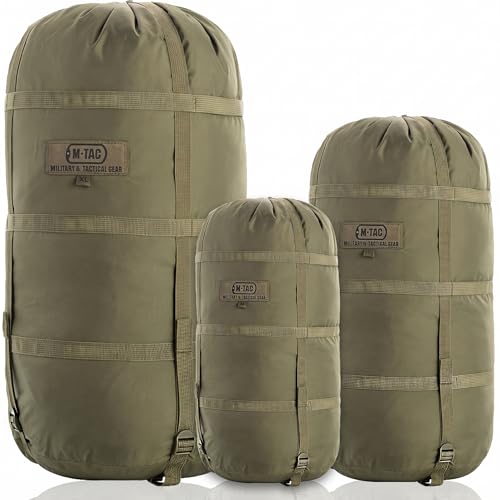
M-Tac builds its sack to the pattern of military stuff sacks, with heavy nylon and webbing you can haul on without worrying about stitching. The 12-liter medium takes a compact down bag with room for a liner, and the shape loads easily into a rucksack. It weighs more than the ultralight sacks here, and that weight buys durability for rough trails and repeated use. It suits campers who treat gear hard and want a sack that outlasts the bag inside it.
Specs
- Size: M, 12 liters
- Item dimensions: 15 x 8 x 3 inches
- Material: nylon
- Package weight: 0.21 kilograms
- Part number: 10324002
Best for: rough use and military-style kit where durability matters most.
Watch out for: the 12L medium suits a compact down bag and fills fast with a bulky synthetic bag, so size up for winter bags, and confirm the listing is live before ordering.
Which One Fits Your Situation
A light summer overnighter
Take the MOOCY 12-liter or the OMVMO small size for a summer down bag. Both weigh little, pack into a tight cylinder, and leave room in a daypack for food and a layer. A 25-liter sack is overkill here and will only add bulk to a light load on a warm night.
A cold-weather car camp
A bulky synthetic winter bag needs the biggest sacks here: the REDCAMP 63-liter or the OMVMO 53-liter, with six or four straps to tame the load. Car camping forgives the extra grams, so pick volume first and weight second, and keep a cotton sack at home for storage between trips.
A multi-day backpacking trip
Frelaxy fits this job best, since five sizes let you match the sack to each bag in your kit. A 30-liter sack takes most three-season bags, and the tear-resistant fabric survives daily stuffing and unpacking on the trail. Keep the sack inside a pack liner if rain is forecast, since none of these sacks is a dry bag.
A closet that needs to stay tidy between trips
Compression sacks pack a bag small for travel, but a bag that lives compressed for months loses loft. Between trips, move the bag into a roomy cotton sack on a closet shelf, where air can reach the fill. Keep the compression sack in the same spot, so the pair is ready to grab for the next trip.
Common Mistakes
- Buying a sack smaller than your bag’s packed volume, so the drawstring will not close.
- Storing a down bag compressed for months instead of moving it to a roomy cotton sack at home.
- Trusting the size on a listing title when the size chart lists different liter figures.
- Expecting a water-resistant sack to work as a dry bag in heavy rain.
- Picking a sleeping bag that comes with a sack and treating that included sack as a standalone storage pick.
Frequently Asked Questions
What size compression sack fits a standard sleeping bag?
A three-season one-person bag usually fits a 24-liter to 30-liter sack, while a compact summer down bag fits a 12-liter sack and a bulky winter synthetic bag needs 45 liters or more. Measure your bag stuffed into its own sack first, then match the liter figure, since brands measure volume differently.
Can I store a sleeping bag compressed for months?
No. Months of tight compression flatten the fill and the bag loses warmth over time. Use a compression sack only for travel, and store the bag loose in a roomy cotton sack at home, where air can reach the fill and keep it lofty between trips.
Are compression sacks waterproof?
Most are water-resistant, not waterproof: the fabric sheds light rain, but seams and drawstring tops let water in during a downpour. A dry bag with a roll-top closure is the safer choice for river trips or heavy rain, and a pack liner adds a second layer of protection on any trip.
What is the difference between a compression sack and a stuff sack?
A stuff sack is a simple bag that holds gear, while a compression sack adds straps that squeeze the contents down to a smaller bundle. Both store a sleeping bag, but only a compression sack shrinks it enough to free real space in a pack, which is why these picks all use straps.
FAQ
What size compression sack fits a standard sleeping bag?
Can I store a sleeping bag compressed for months?
Are compression sacks waterproof?
What is the difference between a compression sack and a stuff sack?
More from Amazon
Programs that pair well with the guide above. Offers and eligibility are set by Amazon and may change.
Free shipping on eligible items, Prime Video and more. Eligible new members can start with a free trial.
Start a Prime free trialAudiobooks and podcasts to listen to on the go. Eligible new members can start with a free trial.
Try Audible freeAd-free music streaming. Eligible new subscribers can start with a free trial.
Try Music Unlimited freeA free business account with business pricing and bulk-buying tools for work, shop or home office.
Create a business accountAs an Amazon Associate we earn from qualifying purchases.



Write Your Review
No reviews yet. Be the first to share your experience!