
Key takeaways
- Five home espresso machines compared on manufacturer-listed specs: pump pressure, portafilter size, grinder type, boiler design and tank capacity.
A home espresso machine replaces the daily café run with a counter-top routine built around a pump, a portafilter and a steam wand. The five machines below cover the main designs sold for home kitchens: two semi-automatics with built-in grinders, a traditional Italian manual machine with a 58 mm group, a compact fast-heating model that leaves grinding to a separate unit, and one fully automatic machine that grinds, brews and froths milk at the touch of a button. Every figure in this guide — pump pressure, portafilter diameter, tank capacity, grinder type — is a manufacturer-listed specification, so the comparison stays on hardware rather than on taste promises. Read the buying factors first, then match a machine to the counter space, routine and milk drinks your household actually makes.
Disclosure: As an Amazon Associate, I earn from qualifying purchases. If you buy through links in this article, I may earn a commission at no extra cost to you.
How to Choose an Espresso Machine
Machine type. Semi-automatic machines put dosing, tamping and shot timing in your hands, which gives control but asks for practice. Fully automatic machines handle grinding, tamping and brewing internally and suit households that want a repeatable drink with almost no technique. Decide which routine fits your mornings before comparing anything else.
Grinder: built in or separate. A built-in grinder saves counter space and pairs the grind settings with the machine, but it ties both appliances to one purchase. A machine without a grinder needs a separate burr grinder capable of a fine espresso grind, which adds cost and footprint yet lets you upgrade each half independently.
Portafilter size. Home machines cluster around 51 mm, 54 mm and the commercial-standard 58 mm. A 58 mm portafilter accepts the widest range of aftermarket baskets, tampers and distribution tools, while 54 mm systems are usually tied to the maker’s own accessory line.
Heating system. Thermocoil and ThermoJet systems heat water on demand and reach brewing temperature in seconds to a few minutes. A traditional stainless boiler takes longer to warm up but holds temperature steadily across back-to-back drinks and is the design long associated with Italian machines.
Milk system. Manual steam wands need technique but texture milk for latte art. Automatic systems such as a removable milk carafe froth and dispense with no skill involved. If milk drinks are a daily habit, weigh the wand or carafe design as heavily as the brew group.
Tank and footprint. Tanks on these machines run from about 1.4 to 2.5 litres; front-access tanks are easier to refill under low cabinets. Measure your counter depth and the clearance under upper cabinets before choosing, because several of these machines are taller than they look in photos.
1. Breville Barista Express (BES870XL) — All-in-One With Built-In Grinder

The Barista Express is the reference point for the grinder-included category. Its built-in conical burr grinder feeds a 54 mm stainless portafilter, and Breville lists dose-control grinding with adjustable grind size and amount, so a beginner can work through the dialling-in process on one appliance. Low-pressure pre-infusion is listed before full pump pressure, and an analogue pressure gauge on the front panel shows extraction pressure during the shot. The ThermoCoil heating system uses PID temperature control, and the manual steam wand swivels 360 degrees for milk texturing. A 67 fl oz removable tank with an included filter keeps refills infrequent. For a first machine that covers grinding, brewing and steaming in one footprint, this is the most complete package of the five.
Specs
- Type: Semi-automatic pump machine with built-in grinder
- Model: BES870XL
- Pump: 15 bar with low-pressure pre-infusion
- Portafilter: 54 mm stainless steel
- Grinder: Built-in conical burr, adjustable size and dose
- Heating: ThermoCoil with PID control
- Water tank: 67 fl oz removable, filter included
- Steam wand: Manual, 360-degree swivel
- ASIN: B00CH9QWOU
2. De’Longhi La Specialista Arte (EC9155MB) — Guided Tamping and Temperature Control

De’Longhi builds the La Specialista Arte around reducing the two steps beginners find hardest: dosing and tamping. The grinder uses what the maker calls Sensor Grinding Technology with eight grind settings, and the Smart Tamping Station tamps inside the machine with a lever, which keeps the puck level and the counter cleaner. Active Temperature Control offers three infusion temperature settings matched to bean type, and the MyLatteArt wand is a manual steam wand shaped for microfoam. The listing rates the machine at 1450W, and the included barista kit adds a knock box and tamping mat. It occupies the middle ground of this list: more guidance than a fully manual machine, more involvement than a fully automatic one.
Specs
- Type: Semi-automatic pump machine with built-in grinder
- Model: EC9155MB
- Power: 1450W (listing specification)
- Pump: 15 bar
- Grinder: Built-in, 8 settings, Sensor Grinding Technology
- Tamping: Smart Tamping Station
- Temperature: Active Temperature Control, 3 settings
- Steam wand: MyLatteArt manual wand
- ASIN: B099YT9MYG
3. Gaggia Classic Evo Pro (RI9380/46) — Traditional 58 mm Manual Machine
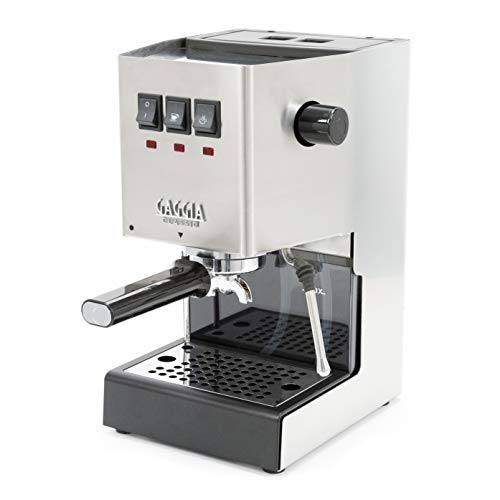
The Gaggia Classic Evo Pro is the traditionalist’s pick: a made-in-Italy manual machine with a commercial-style 58 mm chrome-plated brass portafilter and group, a three-way solenoid valve that releases pressure after the shot for a drier puck, and a rapid-heating stainless steel boiler. There is no grinder and no automation beyond the pump and boiler switches, so it assumes a separate espresso-capable grinder and a willingness to learn dose, yield and timing. In exchange, it uses the same basket size as commercial machines, which opens the full aftermarket of precision baskets and tampers, and its simple mechanical design has made the Classic line a long-running platform for home baristas. The 2.1 litre removable tank and professional stainless steam wand complete a spec sheet aimed at control rather than convenience.
Specs
- Type: Manual semi-automatic machine, no grinder
- Model: RI9380/46
- Portafilter: 58 mm commercial-style, chrome-plated brass
- Pump: 15 bar vibration pump
- Boiler: Stainless steel, rapid-heating
- Valve: 3-way solenoid valve
- Water tank: 2.1 L removable
- Steam wand: Professional stainless steel wand
- ASIN: B07RQ3NL76
4. Philips 3200 LatteGo (EP3241/74) — Fully Automatic With a Two-Part Milk System

The Philips 3200 is the fully automatic entry, and it removes nearly every manual step. Beans from the 275 g hopper are ground by 100 percent ceramic burrs with twelve settings, the brew group tamps and extracts internally, and the LatteGo system froths milk in a two-part carafe with no tubes, which Philips designs to rinse clean under a tap. Five drinks are available from the touch display, including an iced coffee cycle. The 1.8 litre tank removes from the front, the brew group lifts out for rinsing, and the AquaClean filter is listed as good for up to 5,000 cups without descaling when replaced as directed. Choose this design when several people in the house want different drinks with the same one-touch effort.
Specs
- Type: Fully automatic espresso machine
- Model: EP3241/74
- Pump: 15 bar
- Grinder: 100% ceramic burrs, 12 settings
- Milk system: LatteGo two-part carafe
- Drinks: 5 one-touch recipes, including iced coffee
- Water tank: 1.8 L, front access
- Bean hopper: 275 g
- ASIN: B0B7P81K6S
5. Breville Bambino (BES450BSS) — Compact and Ready in Seconds
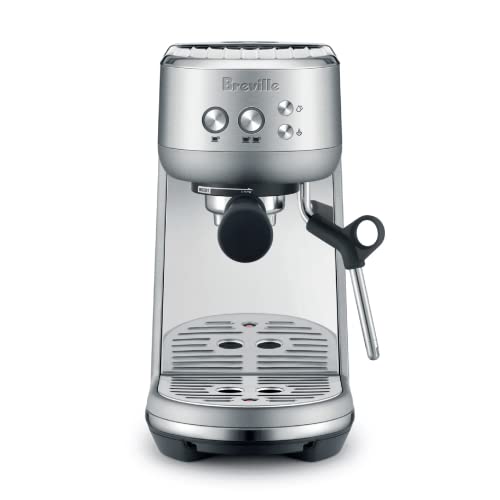
The Bambino is the small-footprint option for anyone who already owns a capable grinder. Breville’s ThermoJet heating system is listed with a three-second heat-up time, the fastest readiness figure in this group, and it pairs PID temperature control with low-pressure pre-infusion ahead of the 15 bar pump. The 54 mm portafilter matches Breville’s accessory range, and the manual steam wand produces microfoam with practical control. The 47 fl oz tank is the smallest here, which suits one or two drinkers better than a crowd. Because there is no grinder inside, the machine stays narrow and light for tight counters, and the budget it saves can go toward the separate grinder it requires.
Specs
- Type: Compact semi-automatic machine, no grinder
- Model: BES450BSS
- Heating: ThermoJet, 3-second heat-up (manufacturer-listed)
- Pump: 15 bar with low-pressure pre-infusion
- Portafilter: 54 mm
- Temperature: PID control
- Water tank: 47 fl oz removable
- Steam wand: Manual microfoam wand
- ASIN: B0B1JPPG2L
Quick Comparison
| Product | Type | Grinder | Portafilter | Tank |
|---|---|---|---|---|
| Breville Barista Express BES870XL | Semi-automatic | Built-in conical burr | 54 mm | 67 fl oz |
| De’Longhi La Specialista Arte EC9155MB | Semi-automatic | Built-in, 8 settings | 51 mm class | Removable tank |
| Gaggia Classic Evo Pro RI9380/46 | Manual | None | 58 mm | 2.1 L |
| Philips 3200 LatteGo EP3241/74 | Fully automatic | Ceramic burr, 12 settings | Internal brew group | 1.8 L |
| Breville Bambino BES450BSS | Semi-automatic | None | 54 mm | 47 fl oz |
FAQ
Do I need a separate grinder for espresso?
Only for machines without one built in, like the Gaggia Classic Evo Pro and the Breville Bambino in this list. Espresso needs a fine, consistent grind with small adjustment steps, so a burr grinder with espresso-range settings is the standard pairing; blade grinders do not produce the consistency a portafilter basket requires.
What does a 15 bar pump figure actually mean?
It is the pump’s maximum pressure specification as listed by the manufacturer. Extraction at the puck happens at lower pressure after pre-infusion and flow resistance do their work, so treat the figure as a shared industry spec for comparison rather than a promise about what happens inside the basket.
Is a 58 mm portafilter better than 54 mm?
Neither size extracts better by itself; the practical difference is accessories. The 58 mm size follows the commercial standard, so precision baskets, tampers and funnels are widely available. The 54 mm systems from Breville use that maker’s own accessory range, which is smaller but covers the essentials.
How often do these machines need descaling?
Scale builds up according to water hardness and volume brewed. Boiler and thermocoil machines follow a descale cycle described in their manuals, while the Philips 3200 uses an AquaClean filter that the manufacturer lists as extending the interval to 5,000 cups when the filter is changed as directed.
Can a fully automatic machine match a semi-automatic?
The hardware differs in control, not in basic method: both grind, tamp and push hot water through coffee under pump pressure. A fully automatic fixes the variables at factory-tuned settings, while a semi-automatic lets you change dose, grind and yield yourself. The choice is between repeatability with one touch and adjustability with practice.
Conclusion
Match the machine to the routine. The Breville Barista Express packs grinding, brewing and steaming into one appliance for a first home setup. The De’Longhi La Specialista Arte adds guided tamping and temperature settings for a learner who wants guardrails. The Gaggia Classic Evo Pro is the long-term manual platform, the Philips 3200 LatteGo serves a whole household at one touch, and the Breville Bambino keeps a small counter fast and simple when a grinder already lives beside it.
More from Amazon
Programs that pair well with the guide above. Offers and eligibility are set by Amazon and may change.
Free shipping on eligible items, Prime Video and more. Eligible new members can start with a free trial.
Start a Prime free trialAudiobooks and podcasts to listen to on the go. Eligible new members can start with a free trial.
Try Audible freeAd-free music streaming. Eligible new subscribers can start with a free trial.
Try Music Unlimited freeA free business account with business pricing and bulk-buying tools for work, shop or home office.
Create a business accountAs an Amazon Associate we earn from qualifying purchases.
Write Your Review
No reviews yet. Be the first to share your experience!