
Key takeaways
- Compare five shoe cabinets for entryways, from a tall cubby tower to a compact farmhouse cabinet, with maker-stated sizes, capacities and assembly notes.
Shoes migrate to the front door and stay there, turning the first space guests see into an obstacle course of sneakers, boots and sandals. A shoe cabinet solves the problem in the simplest possible way: it puts every pair behind closed doors, so the entryway reads as a calm piece of furniture instead of a storage pile. For a home that leans minimalist, that closed front matters as much as the storage itself, because nothing about the daily shoe collection stays on display.
This guide compares five shoe cabinets that suit different entryways: a louvered-door cabinet with a drawer, a tall cubby tower, a slim ten-tier tower, a compact farmhouse cabinet and a low woven-door cabinet. Every pair capacity below is the figure stated by the maker, and makers work those figures out using average-size shoes placed side by side, so large sizes, chunky boots and high heels will always reduce the real total. All dimensions and materials are as stated by the maker, and each cabinet needs assembly before use.
As an Amazon Associate, we earn from qualifying purchases.
Quick Answer
For most entryways, the Yaheetech 5-Tier Shoe Cabinet with Drawer is the balanced pick: five shelves, louvered doors and a top drawer for keys and mail in a footprint about 31 inches wide. Households with the biggest collections should look at the Prepac tall cubby cabinet, while small spaces suit the compact VASAGLE LIRY cabinet. Tall models must be wall-anchored with the included hardware.
How to Choose
Start with depth, because depth decides whether a cabinet works in your space at all. Standard cabinets with hinged doors run about 13 to 15 inches deep, which lets shoes sit flat with room to spare. Tall towers trade depth for height, stacking tiers upward when floor space is tight. Measure your wall run and the swing of your front door before anything else, and leave clearance so cabinet doors can open fully.
Count pairs honestly. Maker capacity figures assume average-size shoes, and a household of boots and large sneakers will fit noticeably fewer pairs than the headline number suggests. If your collection includes tall boots, look for adjustable or removable shelves, because one tall compartment is worth more than two short ones you cannot use.
Door style shapes daily use and airflow. Louvered and woven doors let air circulate around stored shoes while keeping them hidden. Solid doors give the cleanest, most furniture-like front. Cubby towers skip doors entirely in some sections, which speeds up grab-and-go routines but leaves shoes partly visible.
Stability is not optional. Tall and narrow cabinets have a small footprint for their height, so they must be anchored to the wall with the anti-tip hardware the maker includes, following the maker’s instructions exactly, and placed on a level floor. Finally, check the assembly notes before ordering: makers state the tools needed, and some manuals recommend two people for the build.
Yaheetech 5-Tier Shoe Cabinet with Drawer

The Yaheetech 5-Tier is the all-rounder of this group. Two louvered doors close with magnetic catches over five shelves, and the maker states that the first and fourth shelf partitions adjust or remove entirely, so a shelf can grow tall enough for ankle boots. A full-width drawer across the top swallows the small items that usually clutter an entryway surface: keys, sunglasses, mail and leashes. The maker includes anti-tipping hardware and instructs owners to secure the cabinet to the wall, and the manual lists a top load limit of 77 pounds with 22 pounds per shelf, all maker-stated figures.
Specs
- Model: YT-00129621RS
- Dimensions: 15 x 31 x 45.5 inches (depth x width x height), maker-stated
- Material: Painted MDF (engineered wood) with metal hardware, maker-stated
- Storage: 5 shelves plus 1 top drawer
- Doors: 2 louvered doors with magnetic catches
- Assembly: Required; screwdriver needed per the maker, anti-tipping hardware included
Prepac Tall Shoe Storage Cabinet
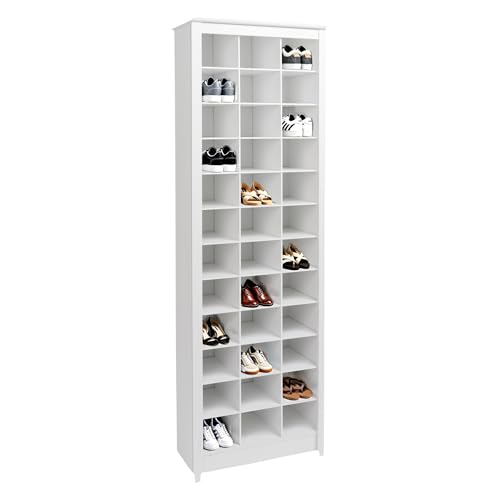
The Prepac is the capacity pick, built around 36 individual cubbies stacked in a tall, narrow frame about 72.5 inches high and only 13 inches deep. Cubbies suit households that think in pairs rather than shelves: each pair gets its own slot, muddy shoes stay separated from clean ones, and nothing topples when one pair is pulled out. The maker rates the cabinet at up to 36 pairs, a figure that, like every capacity in this guide, assumes average-size shoes. Because of its height, this cabinet must be anchored to the wall with the maker’s included hardware per the instructions before it is loaded.
Specs
- Model: WUSR-0009-1
- Dimensions: 13 x 23.5 x 72.5 inches (depth x width x height), maker-stated
- Storage: 36 cubbies
- Maker-stated capacity: Up to 36 pairs of average-size shoes
- Finish: White
- Assembly: Required; wall anchoring required per the maker
VASAGLE 10-Tier Shoe Storage Cabinet

The VASAGLE 10-Tier takes the tower approach furthest, stacking ten tiers into a frame roughly 73.6 inches tall and under 25 inches wide. The maker states a capacity of up to 30 pairs, which makes it a closet or spare-wall solution as much as an entryway one: it stores a full household collection vertically while giving up very little floor. The shallow 12.6-inch depth suits flats, sneakers and low shoes best. As with the Prepac, a cabinet this tall and narrow must be anchored to the wall with the maker’s included hardware, following the maker’s instructions, before use.
Specs
- Model: ULBS273T14
- Dimensions: 12.6 x 24.8 x 73.6 inches (depth x width x height), maker-stated
- Storage: 10 tiers
- Maker-stated capacity: Up to 30 pairs of average-size shoes
- Finish: White
- Assembly: Required; wall anchoring required per the maker
VASAGLE LIRY Collection Shoe Cabinet

The LIRY cabinet is the compact, furniture-first option. At about 27.6 inches high it sits at console height, mixing an open shelf with closed storage behind recessed-panel doors, and the maker states it holds 9 to 12 pairs depending on size and style. Tapered legs and a rustic white finish make it read as a small sideboard rather than storage equipment, which suits entryways that double as living space. The maker states a maximum static load of 165 pounds for the unit, includes an anti-tip kit, and its manual recommends two people for assembly with basic household tools.
Specs
- Model: ULBC038W01
- Dimensions: 13.8 x 31.5 x 27.6 inches (depth x width x height), maker-stated
- Storage: 3 tiers, open and closed sections
- Maker-stated capacity: 9 to 12 pairs, depending on shoe size and style
- Material: Particleboard (engineered wood), maker-stated
- Assembly: Required; anti-tip kit included, two people recommended per the manual
Baxton Studio Winda 3-Door Shoe Cabinet

The Winda is the low, wide alternative. Three woven wood doors with air slits hide the shelves inside, and the slits let air move around stored shoes while the front stays closed and tidy. The maker states the cabinet organizes up to 12 pairs depending on size, and the doors close with a magnetic system. At roughly 26 inches high and 30 inches wide, it fits under windows and along short walls where a tall cabinet would crowd the room. The dark brown finish and woven fronts give it a warmer, more traditional look than the white towers above. Assembly is required, per the maker.
Specs
- Model: SC864573 B-Wenge
- Dimensions: 13.1 x 29.95 x 26.33 inches (depth x width x height), maker-stated
- Doors: 3 woven wood doors with magnetic closing
- Maker-stated capacity: Up to 12 pairs, depending on shoe size
- Material: Engineered wood with a dark brown finish, maker-stated
- Assembly: Required
How Shoe Cabinets Compare With Other Storage
The main alternatives each give something up. Open shoe racks are quick to use and hold plenty, but every pair stays visible, which works against a tidy entryway. Over-door organizers save floor space yet suit light shoes only and can rattle against the door. Shoe benches add a seat, a genuine plus for households that sit to lace up, but their internal volume is small next to a full cabinet. Stackable plastic boxes protect individual pairs and suit closets and collections, though they look utilitarian by the front door. A closed cabinet is the choice when the entryway itself is on show: it stores a household’s worth of shoes, hides them completely, and presents as furniture. Within the cabinet category, the trade is depth against height: deep cabinets take boots and big sizes, tall shallow towers take more pairs per square foot of floor.
FAQ
How many pairs does a shoe cabinet really hold?
Fewer than the headline figure if your shoes run large. Maker capacities assume average-size shoes placed neatly side by side, so treat the stated number as a ceiling. Boots, heels and wide sneakers each displace more than one average slot, and adjustable shelves help by letting one tall space replace two short ones.
Do tall shoe cabinets have to be fixed to the wall?
Yes. Tall, narrow cabinets can tip if a child climbs or a loaded top shelf shifts the balance, so makers include anti-tip hardware and instruct owners to anchor the cabinet to the wall with that hardware, following the instructions exactly. Place the cabinet on a level floor as well, and check the anchoring after assembly.
Which door style suits a narrow hallway?
Any style works if the doors can open without blocking the walkway, so measure the swing before buying. Louvered and woven doors add airflow for shoes stored daily, while solid doors give the plainest front. In the tightest halls, a low cabinet like the Winda keeps the wall line open and doubles as a surface for keys and mail.
What tools do I need to assemble a shoe cabinet?
It depends on the maker, so read the manual first. The Yaheetech manual calls for a screwdriver, the VASAGLE LIRY manual recommends two people with basic household tools such as a screwdriver and hammer, and every model here ships as flat-pack furniture that must be assembled before use. Set aside an unhurried hour or two rather than rushing the build.
Final Verdict
Pick the Yaheetech 5-Tier for a single balanced cabinet with a drawer and adjustable shelves. Pick the Prepac when the collection is large and cubby order appeals, or the VASAGLE 10-Tier when floor space is scarce and height is available. The VASAGLE LIRY suits small, style-led entryways, and the Baxton Studio Winda fits low walls and traditional rooms. Whichever you choose, measure first, count pairs realistically, and anchor tall cabinets to the wall with the included hardware.
Product and ASIN Reference
| Product | ASIN |
|---|---|
| Yaheetech 5-Tier Shoe Cabinet with Drawer (YT-00129621RS) | B0CJ9CTQKP |
| Prepac Tall Shoe Storage Cabinet (WUSR-0009-1) | B01N593DPU |
| VASAGLE 10-Tier Shoe Storage Cabinet (ULBS273T14) | B09W9KHRZ2 |
| VASAGLE LIRY Collection Shoe Cabinet (ULBC038W01) | B0CV7FR8QT |
| Baxton Studio Winda 3-Door Shoe Cabinet (SC864573 B-Wenge) | B011CB3ZVG |
More from Amazon
Programs that pair well with the guide above. Offers and eligibility are set by Amazon and may change.
Free shipping on eligible items, Prime Video and more. Eligible new members can start with a free trial.
Start a Prime free trialAudiobooks and podcasts to listen to on the go. Eligible new members can start with a free trial.
Try Audible freeAd-free music streaming. Eligible new subscribers can start with a free trial.
Try Music Unlimited freeA free business account with business pricing and bulk-buying tools for work, shop or home office.
Create a business accountAs an Amazon Associate we earn from qualifying purchases.

Write Your Review
No reviews yet. Be the first to share your experience!