
Key takeaways
- A good honing rod realigns a knife edge between sharpenings. Compare five standalone rods in ceramic, steel, and diamond to find the right fit.
A sharp kitchen knife is safer and more pleasant to use than a dull one, and a honing rod is the simplest tool for keeping an edge in shape between full sharpenings. A few light passes before or after cooking can straighten the fine edge of a blade that has started to fold over. The rods below are all standalone tools: a single rod with a handle, made for hand honing at the counter or over a cutting board.
Disclosure: As an Amazon Associate, I earn from qualifying purchases. If you buy through links in this article, I may earn a commission at no extra cost to you.
How to choose a honing rod
Honing and sharpening do different work. Honing straightens an edge that has bent or rolled slightly out of alignment during use. It removes little or no metal, and it cannot rebuild an edge that is chipped, very dull, or damaged. Sharpening grinds away metal to form a new edge, which is what a whetstone, an electric sharpener, or a professional service does. A honing rod stretches the time between sharpenings, but it does not replace them. If a knife will not cut a tomato after honing, it needs sharpening, not more honing.
Rod material is the first choice to make. A grooved steel rod is the classic option. Its ridges push a rolled edge back into line, and it suits ordinary Western kitchen knives made from softer stainless steel. A fine-cut steel rod is gentler than a coarse-cut one, while a combination-cut rod has a fine section and a coarser section on the same rod. A ceramic rod is harder and has a fine abrasive surface, so it both realigns and lightly polishes the edge, which suits harder Japanese-style blades that a coarse steel rod could chip. A diamond-coated rod is the most abrasive of the three. It removes a small amount of metal with each pass, so it can revive an edge that a plain steel rod no longer helps, but it demands a light touch and is easy to overuse.
Length matters more than most buyers expect. The rod should be at least as long as the longest blade you plan to hone, and ideally a couple of inches longer, so the full edge travels along the rod in one smooth stroke. An 8 or 9 inch rod fits a home kitchen with paring knives and shorter chef knives, while a 10 or 12 inch rod suits a standard 8 inch chef knife and longer blades. A longer rod is harder to store in a drawer, so a hanging loop can be a practical feature.
Handle and guard design decide how safe the rod feels in use. Look for a handle that stays comfortable with wet hands and a guard between the handle and the rod that keeps fingers clear of the blade. A lighter rod is easier to hold up for vertical honing, with the tip of the rod resting on a cutting board. Ceramic rods need one extra note: the rod itself is hard but brittle, so dropping it on a hard floor can crack or break it.
1. DMT CS2 12-Inch Ceramic Steel
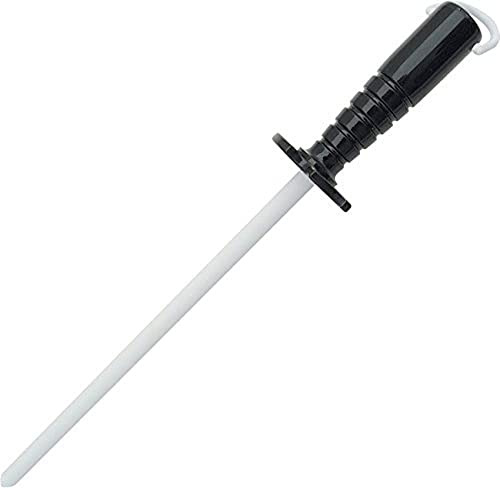
The DMT CS2 is a 12 inch ceramic rod built on an aluminum core, which sets it apart from a solid ceramic rod. The ceramic surface is listed at 7 micron, or 2200 mesh, so it polishes the edge finely while it realigns it. The aluminum core keeps the rod from shattering if it is knocked over, the usual worry with ceramic. The black plastic handle has a guard and a hanging ring, and the rod measures a listed 12 inches long by 0.5 inches in diameter. It is a natural first pick for cooks who own harder Japanese-style knives.
Specs
- Rod length: 12 inches
- Rod diameter: listed 0.5 inches
- Surface: ceramic, listed 7 micron / 2200 mesh
- Core: aluminum
- Handle: black plastic with guard and hanging ring
2. Victorinox Honing Steel Black Plastic Handle, 10-Inch, Combination Cut

Victorinox is a familiar name in kitchens, and this 10 inch steel is the straightforward, everyday option in this set. The rod is chrome-plated steel with a combination cut, meaning it has both fine and coarse sections, so one rod covers gentle daily honing and slightly more assertive edge straightening. The black plastic handle is simple and balanced, and the listed weight is 0.4 lb. It is a good match for a home cook who wants one traditional steel for Western chef, santoku, and utility knives.
Specs
- Rod length: 10 inches
- Cut: combination cut
- Material: chrome-plated steel
- Handle: black plastic
- Listed weight: 0.4 lb
3. Kota Japan 12 in. Diamond Carbon Steel Professional Knife Sharpener Rod
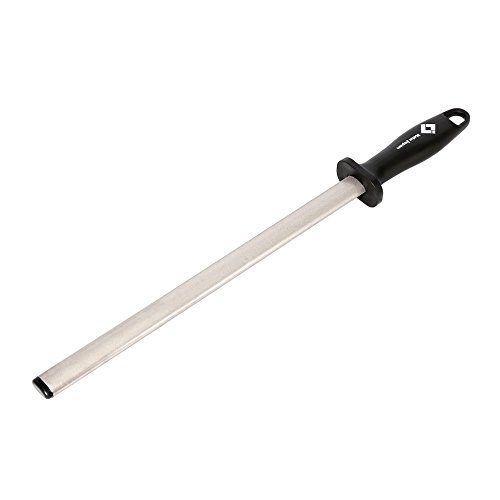
The Kota Japan rod is the diamond-coated pick in this set, and its oval cross-section sets it apart from the round rods above. The 12 inch rod is carbon steel with a diamond coating, which gives it a more abrasive surface than a plain steel or ceramic rod. That makes it useful for edges that have gone past the point where simple realigning helps, such as a blade that feels dull even after steeling. Use light pressure and few passes, since the diamond surface removes metal rather than only pushing the edge back into place.
Specs
- Rod length: 12 inches
- Surface: diamond-coated carbon steel
- Shape: oval
- Handle: listed ergonomic handle
4. Green Elephant Ceramic Honing Rod, 11-Inch
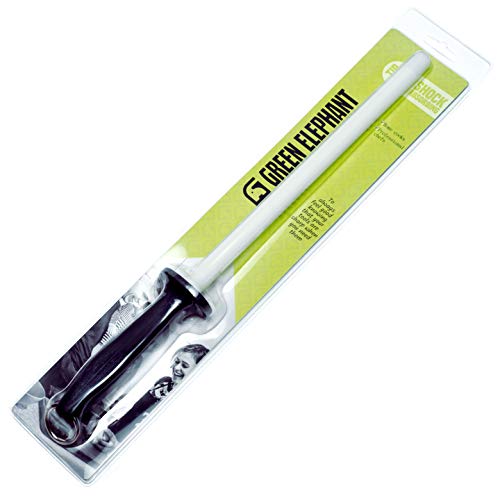
The Green Elephant rod is the most versatile design here, because it is really two rods in one handle. The handle accepts interchangeable rods, and the set includes a ceramic rod and a diamond rod, so you can switch between gentle ceramic honing and a more abrasive diamond pass without buying a second tool. The ceramic rod is listed as fine 1500, and the handle also carries a microforge tool for touching up both sides of an edge. The ceramic rod works for ceramic knives too, and the diamond rod covers serrated blades.
Specs
- Rod length: 11 inches
- Rods included: ceramic and diamond, interchangeable
- Ceramic rod: listed fine 1500
- Extra feature: microforge tool in handle
5. WUSTHOF 9-Inch Honing Steel

The WUSTHOF 9 inch steel is the compact pick, made for smaller kitchens and shorter blades. It is a high-carbon stainless steel rod, listed as model 4461/23, with a slip-resistant textured handle that gives a secure grip even with wet hands. Nine inches is enough for paring knives, utility knives, and chef knives up to about 7 inches, and the shorter rod stores easily in a drawer where a 12 inch rod would not fit.
Specs
- Rod length: 9 inches
- Material: high-carbon stainless steel
- Model: listed 4461/23
- Handle: slip-resistant, textured
Comparison
| Rod | Rod material | Rod length | Handle |
|---|---|---|---|
| DMT CS2 | Ceramic on aluminum core | 12 inches | Black plastic with guard |
| Victorinox Combination Cut | Chrome-plated steel | 10 inches | Black plastic |
| Kota Japan Diamond | Diamond-coated carbon steel | 12 inches | Ergonomic handle |
| Green Elephant | Ceramic and diamond, interchangeable | 11 inches | Handle with microforge tool |
| WUSTHOF | High-carbon stainless steel | 9 inches | Slip-resistant, textured |
Frequently asked questions
Does a honing rod sharpen a dull knife?
No, not in the full sense. A steel rod straightens a rolled edge, and a ceramic or diamond rod removes only a small amount of metal. A truly dull or chipped blade needs sharpening on a stone, with a dedicated sharpener, or by a professional.
How often should I hone my knives?
Light honing before or after each cooking session is a common habit, and a few passes per side are enough. Honing more often with light pressure is better than pressing hard once in a while.
What angle should I hold the knife at?
Match the bevel of the knife, which is often about 15 degrees per side for Japanese-style knives and about 20 degrees per side for Western knives. Keep the angle steady through the whole stroke.
Can I use a honing rod on serrated knives?
A round ceramic or diamond rod can touch up the scalloped side of a serrated blade, but a flat steel rod cannot reach into the serrations. The diamond rod in the Green Elephant set is the most practical option in this set for serrated edges.
How do I clean a honing rod?
Wipe a steel or diamond rod with a damp cloth and dry it fully. A ceramic rod can be cleaned with warm water and mild soap to remove the fine metal dust that builds up on its surface, then dried before storage.
Conclusion
The right honing rod depends on your knives and your kitchen. The DMT CS2 is the pick for harder blades and fine polishing, the Victorinox combination-cut steel is the reliable everyday rod for Western knives, and the Kota Japan diamond rod is there for edges that need more than realigning. The Green Elephant set covers the most ground with its two interchangeable rods, and the compact WUSTHOF 9 inch steel fits small kitchens and shorter blades.
More from Amazon
Programs that pair well with the guide above. Offers and eligibility are set by Amazon and may change.
Free shipping on eligible items, Prime Video and more. Eligible new members can start with a free trial.
Start a Prime free trialAudiobooks and podcasts to listen to on the go. Eligible new members can start with a free trial.
Try Audible freeAd-free music streaming. Eligible new subscribers can start with a free trial.
Try Music Unlimited freeA free business account with business pricing and bulk-buying tools for work, shop or home office.
Create a business accountAs an Amazon Associate we earn from qualifying purchases.


Write Your Review
No reviews yet. Be the first to share your experience!