
Key takeaways
- Five glass pitchers compared for entertaining and everyday use, from borosilicate jugs with filter lids to a mason jar pitcher, with sizing and care tips.
A glass pitcher earns its place on a calm table because it does one job quietly: it holds water, tea or juice without adding plastic to the routine or visual noise to the setting. Clear glass shows what is inside, rinses clean without holding flavors, and moves from fridge to table without a transfer step. The differences that matter are the glass itself, the lid, the pour and the footprint it takes up on a refrigerator shelf.
This guide compares five glass pitchers that suit a pared-back kitchen: three borosilicate jugs with stainless lids for hot and cold drinks, one Italian hermetic-seal pitcher built for fridge storage, one large open pitcher shaped for easy gripping, and one mason jar pitcher with a sealing flip cap. Each entry explains who it fits, where it falls short, and how it behaves in daily use.
As an Amazon Associate, we earn from qualifying purchases.
Quick answer
For most households, the Hiware 68-ounce borosilicate pitcher is the balanced pick: it takes boiling water, filters loose tea through its steel lid, and stays light in the hand. If fridge storage matters most, choose the Bormioli Rocco hermetic-seal pitcher. For big gatherings, the Libbey Impressions holds the most, while the County Line Kitchen mason jar pitcher seals tightest for cold drinks.
Hiware 68 oz Glass Pitcher with Lid and Spout
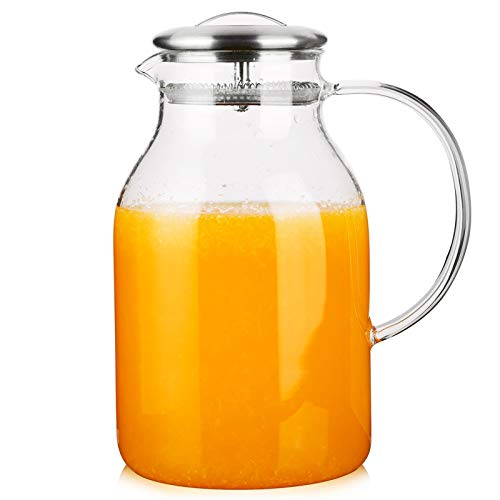
The Hiware pitcher is the all-rounder of this group. Its body is hand-blown borosilicate glass, the thin, light glass type that tolerates sudden temperature changes far better than ordinary soda-lime glass. The listing rates it for temperatures from freezing up to boiling, so it can receive freshly boiled water for tea and then move straight into the refrigerator once cooled, a rhythm that suits households that brew iced tea in batches.
The lid is 18/8 stainless steel with a filter built into the pour opening. Poured one way, the filter holds back ice, fruit slices and loose tea leaves; the design also includes a finer mesh section that strains loose-leaf tea more thoroughly than most pitcher lids manage. A cleaning brush is included, which helps with the narrow neck area under the lid.
Trade-offs are modest. The lid is not airtight, so this is not the pitcher to tip on its side in a crowded fridge door, and the wide body takes real shelf space. The handle is glass and well shaped, but a full 68 ounces of liquid still asks for a steady grip. For a single pitcher that covers hot brewing, cold storage and table service, it is the easiest recommendation here.
Aofmee 68 oz Glass Pitcher with Scale Line
The Aofmee pitcher follows the same borosilicate formula with a slightly more practical bent. It holds 68 ounces, carries an 18/8 stainless steel lid, and adds a printed scale line down the side, a small detail that quietly removes guesswork when following a recipe for lemonade, cold brew concentrate or a batch of sangria base. Measured pours also help when diluting concentrate to a consistent strength day after day.
Like the Hiware, the borosilicate body is heat resistant, so hot and cold drinks are both in bounds, and the wide mouth accepts ice cubes and fruit without a struggle. The shape is a touch more compact in feel, suiting smaller households that still want a two-liter batch size for weekend guests.
Where it gives ground is refinement: the lid is a simpler straining design than the Hiware’s dual-mode filter, and the overall finish feels more utilitarian than elegant. On a minimalist table that is hardly a flaw. If the routine is measured recipes, cold brew and everyday water service, the Aofmee covers it without decoration or fuss.
Bormioli Rocco Hermetic Seal Pitcher, 68 oz

Bormioli Rocco has made glassware in Italy for generations, and its hermetic-seal pitcher is the storage specialist of this group. The defining feature is the lid: it seals airtight against the glass rim, so juice, iced tea or milk keeps fresher in the refrigerator and absorbs fewer stray fridge odors than drinks stored under a loose cap. The spout pours cleanly when the seal is flipped open.
The glass is standard pressed glass rather than borosilicate, so treat it as a cold-drink pitcher: fill it with chilled or room-temperature liquids and let hot drinks cool before pouring them in. Within that role it is excellent. The tall, fridge-friendly profile slides into a door shelf or a narrow gap, and the 68-ounce capacity matches a full batch of lemonade or a day of infused water for a family.
The seal is also the maintenance point: the gasket needs a proper wash and dry to stay fresh, and the lid has more parts than a simple steel cap. Buyers who mostly serve at the table may not need an airtight seal at all. Buyers who batch drinks ahead for the week will find this the most purposeful design here.
Libbey Impressions 80 oz Glass Pitcher

The Libbey Impressions is the big, simple, open pitcher. At just over 80 ounces it holds more than any other pick here, and its four-sided body is pressed with deep dimples that let fingers settle into the glass, so a full pitcher can be lifted with one hand in the indents or by its sturdy handle. There is no lid, no gasket and nothing to disassemble: rinse it, and it is ready again.
The glass is lead-free and recyclable, and the wide mouth takes a serving spoon, a ladle or a stack of citrus slices without complaint. It suits the entertaining end of this guide best: punch, lemonade for a long lunch, or water for a full table where refills come from the pitcher rather than the tap.
The limits are stated plainly by the maker: it is not safe for hot liquids, and it is handwash only to keep the glass brilliant. Without a lid it also cannot store drinks in the fridge without picking up odors, and its broad shape claims serious shelf space. As a serving piece rather than a storage vessel, though, it is the most graceful option in the group.
County Line Kitchen 64 oz Mason Jar Pitcher

County Line Kitchen builds its pitcher around the familiar wide-mouth mason jar form, in heavy soda-lime glass with a handle and a screw-on lid. The lid carries a silicone seal and a flip cap over the pour spout, making this the one pitcher here that can genuinely travel: to a picnic, into a cooler, or onto its side in a packed fridge without leaking.
The wide mouth is the everyday advantage. Ice, fruit and tea bags go in easily, a brush or sponge reaches every surface, and the jar is dishwasher safe. The 64-ounce size is a practical middle ground, big enough for a family batch of sun tea or cold brew, small enough to handle comfortably when full.
The glass sets the boundary: soda-lime is heavier than borosilicate and less tolerant of thermal shock, and the maker warns against putting hot liquid into a cold jar or the reverse. It is a cold-drink pitcher, full stop. The mason jar look also divides opinion; on a rustic table it belongs, on a strict minimalist table it may read as casual. Functionally, it is the sturdiest and most portable pick here.
How to choose
Start with the glass. Borosilicate pitchers, like the Hiware and Aofmee, are lighter and tolerate boiling water and quick temperature changes, which makes them the right choice for brewing tea or pouring hot water over coffee grounds. Soda-lime and pressed glass, like the County Line Kitchen and Bormioli Rocco, are heavier and cheaper to replace but belong with cold drinks only. The Libbey sits in the same cold-only camp despite its size.
Next, decide how the pitcher will live between uses. If it stores drinks in the refrigerator for days, an airtight hermetic seal or a silicone-sealed flip cap protects flavor; the Bormioli Rocco and County Line Kitchen are built for that. If it mostly moves from counter to table, a straining steel lid or even no lid is simpler and easier to keep clean.
Capacity is the third call. Sixty-four to 68 ounces covers most households: enough for a family meal or a small group without refills. Move up to the 80-ounce Libbey only if gatherings are frequent, and check the height and width against your refrigerator shelves before ordering, because the larger pitchers are also the broadest.
Finally, weigh the pour and the cleaning. A filter lid earns its keep with loose tea and infused water. A wide mouth earns its keep every wash day. Handles matter when the pitcher is full; dimpled grips help, but a proper handle is still the safer hold for anyone carrying a full pitcher across a room.
Who should skip
Skip glass entirely if the pitcher will serve children outdoors or travel in a bag where drops are likely; a sealed stainless bottle or a shatter-resistant plastic jug is the honest tool there. Skip the cold-only pitchers, the Bormioli Rocco, Libbey and County Line Kitchen, if the plan is brewing tea directly in the pitcher with boiling water; choose a borosilicate model instead. Skip the lidless Libbey if drinks will sit in the refrigerator between meals, since uncovered drinks pick up odors quickly. And skip the larger sizes if your fridge shelves are short or narrow: an 80-ounce pitcher that cannot stand upright at home is a poor bargain at any quality.
FAQ
Can glass pitchers go in the dishwasher?
Some can. The County Line Kitchen mason jar pitcher is dishwasher safe, while the Libbey Impressions is handwash only by the maker’s instruction. Borosilicate pitchers generally tolerate dishwashers well, but steel lids and gaskets last longer washed by hand, so check the listing for the specific model before the first wash.
What is the difference between borosilicate and regular glass pitchers?
Borosilicate glass contains boron trioxide, which makes it lighter and far more resistant to thermal shock, so it can handle boiling water and quick moves between heat and cold. Regular soda-lime glass is heavier and sturdier against knocks but can crack when hot liquid meets a cold jar, which is why those pitchers are rated for cold drinks.
How much should a household pitcher hold?
For daily water or iced tea for two to four people, 64 to 68 ounces is the comfortable range: a full batch lasts the day without constant refilling. For parties and long meals, 80 ounces or more reduces trips to the kitchen. Smaller households that brew small batches may prefer a compact pitcher that fits a fridge door.
How do I stop a glass pitcher from cracking with hot drinks?
Choose a borosilicate pitcher for anything hot, and let the glass warm gradually: rinse it with warm tap water before adding boiling water, and avoid setting a hot pitcher on a cold stone counter. With soda-lime glass, the safe rule is simpler: keep it for cold drinks only, exactly as the makers instruct.
Final verdict
Each of these five pitchers is the right answer to a slightly different question. The Hiware 68-ounce is the best single buy for most kitchens, pairing borosilicate glass with a genuinely useful filter lid. The Aofmee matches it closely and adds a scale line for measured recipes. The Bormioli Rocco is the fridge-storage specialist with its airtight hermetic seal, the Libbey Impressions is the entertainer with the largest capacity and the easiest grip, and the County Line Kitchen mason jar pitcher is the sealed, portable, dishwasher-safe workhorse. Pick by glass type first, then by how the pitcher will spend its days, and any of the five will serve a quieter, simpler table well.
Product and ASIN Reference
| Product | ASIN |
|---|---|
| Hiware 68 oz Glass Pitcher with Lid and Spout | B06ZXRK2Q8 |
| Aofmee 68 oz Glass Pitcher with Lid | B07TX92M23 |
| Bormioli Rocco Hermetic Seal Pitcher, 68 oz | B0131EKHO0 |
| Libbey Impressions Glass Pitcher, 80 oz | B01F1X6NCO |
| County Line Kitchen Glass Mason Jar Pitcher, 64 oz | B09HTM1WZZ |
FAQ
Can glass pitchers go in the dishwasher?
What is the difference between borosilicate and regular glass pitchers?
How much should a household pitcher hold?
How do I stop a glass pitcher from cracking with hot drinks?
More from Amazon
Programs that pair well with the guide above. Offers and eligibility are set by Amazon and may change.
Free shipping on eligible items, Prime Video and more. Eligible new members can start with a free trial.
Start a Prime free trialAudiobooks and podcasts to listen to on the go. Eligible new members can start with a free trial.
Try Audible freeAd-free music streaming. Eligible new subscribers can start with a free trial.
Try Music Unlimited freeA free business account with business pricing and bulk-buying tools for work, shop or home office.
Create a business accountAs an Amazon Associate we earn from qualifying purchases.



Write Your Review
No reviews yet. Be the first to share your experience!